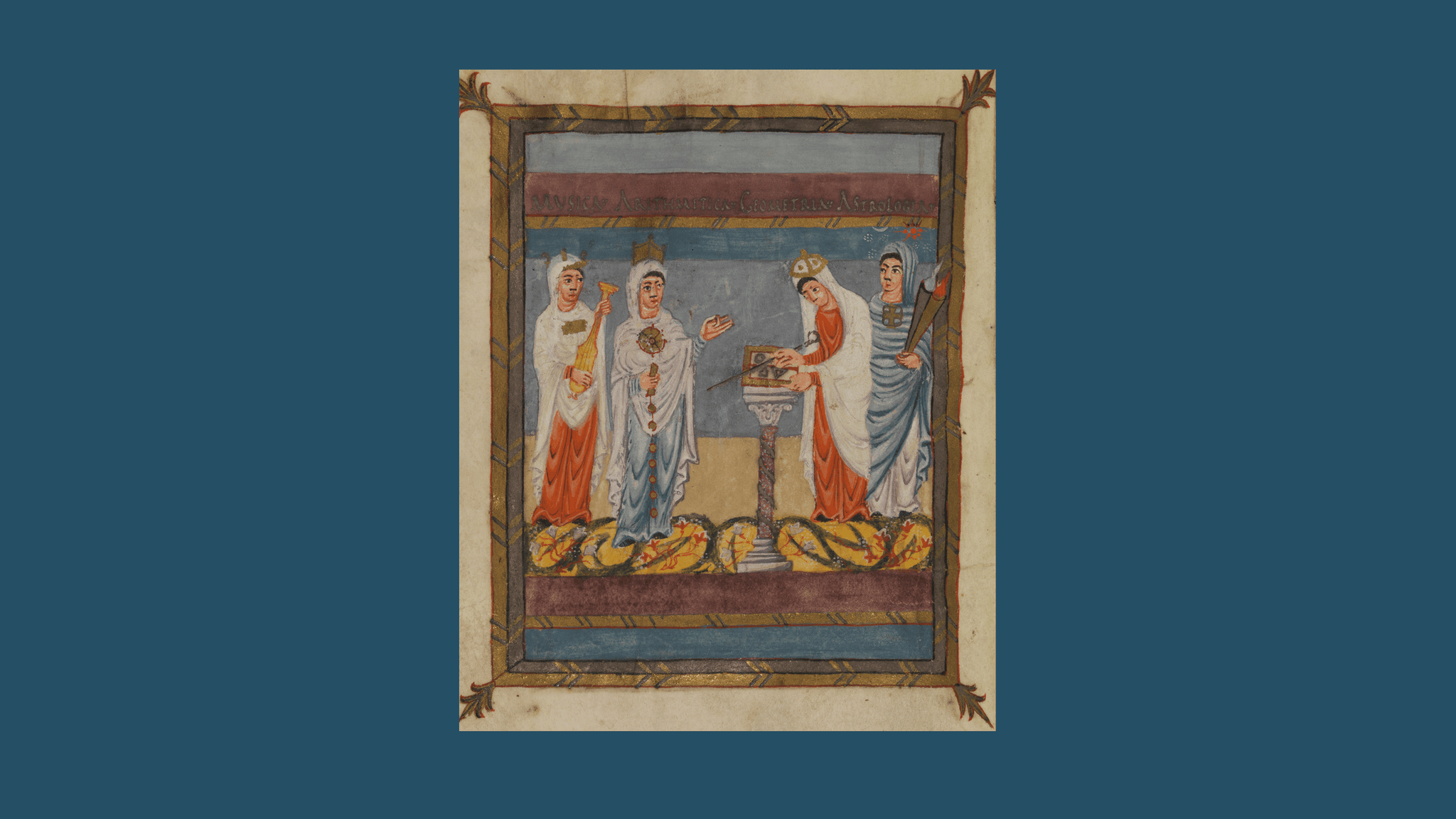
.png)
The Fundamental Mathematicians, an interlude in two parts. Part Two.
Use.
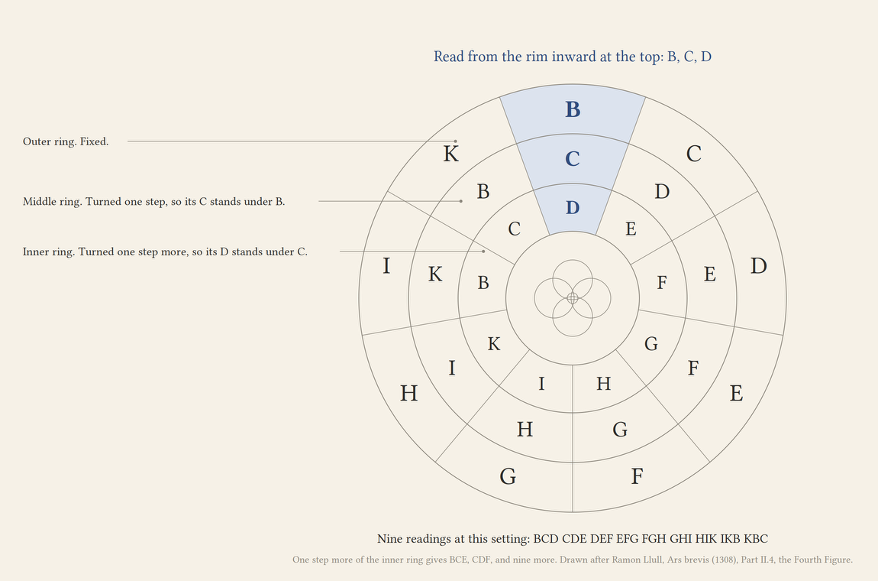
Three concentric circles above carry the same nine letters around their rims, B to K with the J left out.1 The outer circle does not move. The reader is told to turn the middle circle until its C stands under the outer B, then to turn the inner circle until its D stands under that C. Read from the outer rim inward, the figure now gives BCD, and next to it CDE, and so on around, nine groups of three letters. One step more of the inner circle puts E under C, and the figure gives BCE, then CDF, nine more, and it goes on producing groups of three for as long as a hand keeps moving it. Each letter stands for six things at once.
The Art, Llull's name for his method, Ars in his Latin titles and Art in his Catalan, keeps six lists, a principle, a relation, a question, a subject, a virtue and a vice, and every letter has one entry in each. Read down its column, B is goodness, difference, the question whether a thing is, God, justice, and avarice. Between 1283 and 1308 Ramon Llull's Art turned letters and revolving figures like this one. The figure produces the combination. Which of the six meanings of each letter is in play, and what may be concluded from putting them together, the practitioner has to work out under the definitions and rules the Art lays down, and Llull's own instructions say that the Art does not work for someone who will not reason.2
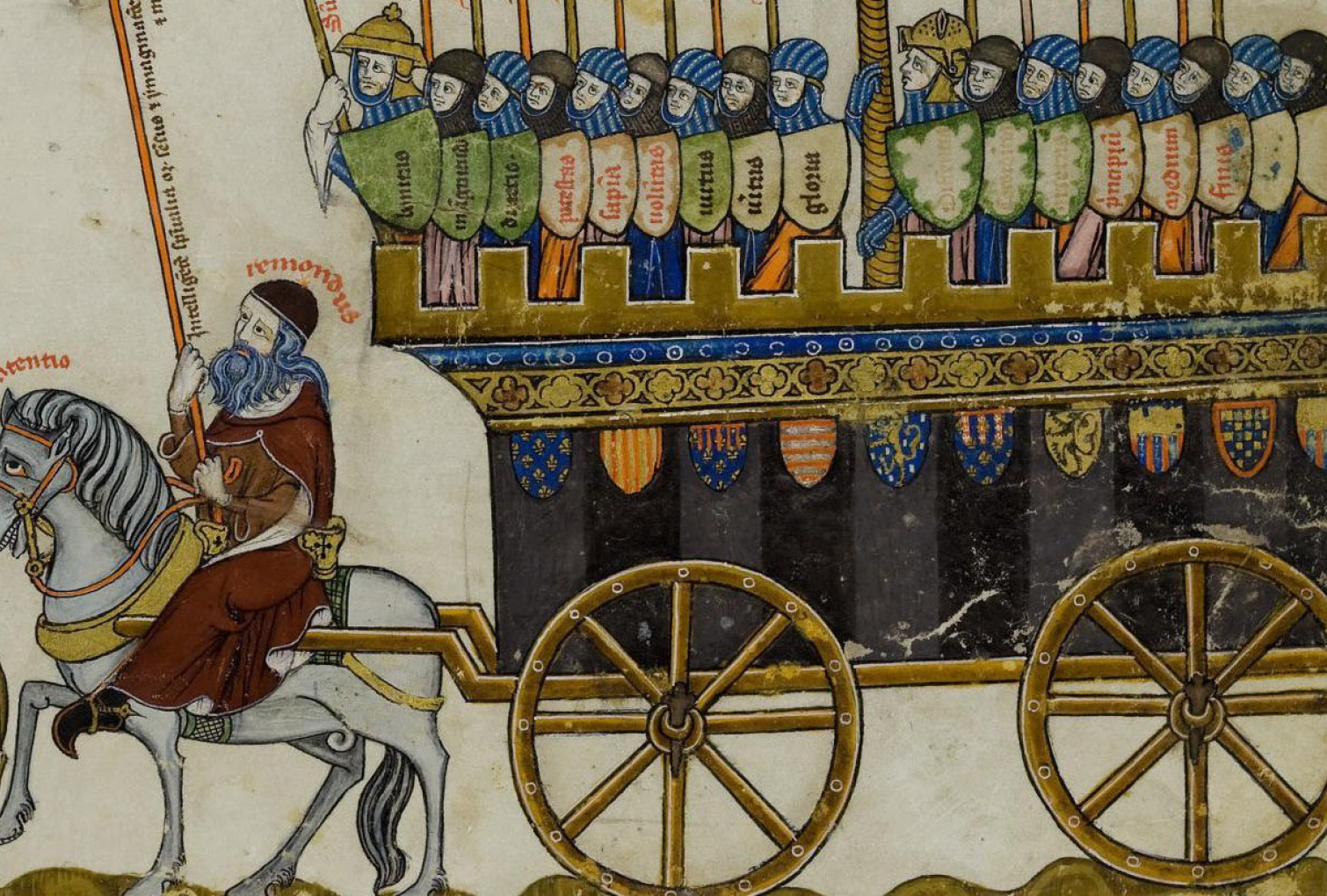
The miniature is one of a pair in the Breviculum compiled about 1321 by Thomas le Myésier,3 Llull's disciple, and its legend has the army marching to bring down the tower of falsehood and ignorance. On the facing page Aristotle rides at the same tower, with truth in its dungeon, on a horse named ratiocinatio, reasoning, and his wagon carries the five predicables and the ten categories. Llull's horse is named recta intentio, right intention, and the three trumpeters before him are intellectus, voluntas and memoria, the powers of the soul. Behind them the wagons carry the Art's eighteen principles, the nine on the shields and the nine relations that make the second of Llull's six lists. The painter drew the Art as an arsenal brought to a disputation, letters on wagons and powers on horses and trumpets, and set a man at its head. Nothing in the wagons moves toward the tower on its own.
How much of reasoning can be carried out by following rules, without having to rediscover why they work? Part One followed methods through the people who kept them, and the keeping, the copying and teaching that carried a method from one generation to the next, was itself a kind of work. A procedure for solving equations traveled with the demonstration of why it worked. A reader who learns a method receives more than the words in which it survives. The method gives that reader something to do and the knowledge of how to do it.
The clearest case was a textbook. Peter of Spain, master by the title the manuscripts give him, a teacher of logic whose identity is still not settled, wrote a Tractatus in the thirteenth century that came to be called the Summulae logicales, and the universities of Europe taught logic from it into the seventeenth century.4 John Buridan, a teaching master who spent his whole career in the arts faculty at Paris, twice its rector, and never moved on to theology, law or medicine, lectured on it for most of that career, and what he lectured from became his own Summulae de dialectica. He kept the parts of Peter he found sound and necessary, replaced the fourth treatise, on the properties of terms, with his own, and added an eighth, on divisions, definitions, and demonstrations, where Peter had nothing. The result ran to more than ten times the length of the book it began as a commentary on.5 The first page of the Elements sets down definitions, postulates and common notions before the first proposition, and Buridan's eighth treatise gave the logic student that apparatus in the abstract. Euclid has no rules and no divisions, but the order is his, say what the words mean and what is granted, then prove.6 The same man drew a line. There is the logic that teaches, which shows how arguments are built and from what, and there is the logic that is used, which builds them to find out whether a conclusion holds, and he held that the teaching exists for the sake of the use.7 Custody could change what it carried, and a custodian could already say what the carried thing was for. There is no page in the Summulae where keeping stops and thinking starts.
Between Llull's wheel and Boole's calculus, people kept moving some part of the work of reasoning onto a page or into a mechanism, and every time they did, something stayed with the reader. I follow what moved and what stayed, person by person, to the point in 1847 where the operation on the page became the inference itself, and the question turned into what a person must still be able to do.8
A Reader's Compass
The last station of the series was Euclid. The next is George Boole's The Mathematical Analysis of Logic of 1847, a chosen turn in the series, since the history did not have to arrive there and other turns were open. Between them the question is what a page or a mechanism took over and what stayed with the reader, and Leibniz, who asked the signs to do the most, stands at the center of this part.
This is not a survey of the mathematics of these centuries, and most of its great names, Euler among them, do not appear. The people here are the ones through whom the work of reasoning moved, step by step, onto a page or into a mechanism, and the line from Llull's wheel to Boole's operation passes through letters, a table, a machine, rules in print and a characteristic, and ends in a calculus. What this essay asks of each page and mechanism, what it took over and what the person still had to supply, is being asked now of machines that draft, answer and recommend.9 These figures are here because their work puts that division in plain view, across centuries that can be seen whole. That the centuries after Llull are crowded here and the centuries before him are not says less about minds than about carrying. The schools taught methods across generations, and the press put the same pages into many readers' hands.
I. The letters
Llull's figures were drawn in manuscript, and their letters named things, goodness, difference, God. Three centuries later a printed page asked letters to stand for quantities and to be worked, added, multiplied and divided by rule as numbers are, by anyone who had learned the rules. The book was short, In artem analyticem isagoge, an introduction to the analytic art, by François Viète, printed at Tours by Jamet Mettayer in 1591.10 It put letters on the page for two kinds of quantity. Vowels stood for the quantities a problem asked for. Consonants stood for the quantities a problem gave. Letters for the unknown were old. Letters for the known were not new in themselves. Jordanus de Nemore, in the thirteenth century, had let letters stand for unspecified numbers in the prose of his demonstrations, with no signs of operation between them.11 Letters for the known that could be reckoned with by rule were the new thing on the page. Chapter IV of the Isagoge names the two kinds of reckoning. There is calculation carried out by numbers, and there is calculation carried out by species, by the forms of things, which Viète says are shown by the letters of the alphabet.12 Species is his word for a kind rather than an instance. A letter names any magnitude of its kind, so a working in species is every problem of that shape at once. The letters stood for magnitudes, and a magnitude for Viète was a line, a surface, or a body. His law of homogeneity let the letters be added or set equal only when they stood for magnitudes of the same kind, a line with a line, a surface with a surface. A page of Viète's species can be worked without knowing which particular magnitudes are meant, and the working still keeps lines with lines and surfaces with surfaces.
Viète's letters kept their dimensions. A unit took the dimensions away. René Descartes chose one at the opening of La Géométrie, the third of three essays printed at Leiden in 1637, forty-six years after the Isagoge, behind a volume whose long title began Discours de la méthode.13 With a unit chosen, the product of two lines is a line, found by a construction, and often, he says, there is no need to draw the lines on paper at all, since it is enough to designate each by a single letter. The letter had taken over the drawing. By a squared or b cubed, he adds, he ordinarily conceives nothing but simple lines, though he calls them squares and cubes after the custom of algebra.14 The unit had bought that, and all of Descartes's letters could be lines. He wrote a, b, c for the quantities given and x, y, z for the quantities sought. He stated no rule, and he did not hold to the practice without exception, since on one page of the first book z names a term of a given ratio. A textbook printed in 1660 still offered its reader the choice between vowels and consonants and the first and last letters of the alphabet.15
The same volume carried the reader's side of the arrangement. On page 20 of the Leiden printing, in the second part of the Discours, Descartes gives four rules.16 The method comes before the metaphysics there, four rules for reaching clear and distinct knowledge, and none of the four can be followed by a hand. Accept nothing not evidently known to be true. Divide each difficulty into as many parts as it takes. Conduct thoughts in order, from the simplest to the most complex. Make enumerations so complete that nothing is omitted. Each rule asks for a judgment at every step, and a reader who could not judge could not use them. What the volume pairs is a notation that lets a pen carry a whole family of problems and a method that leaves every decision with the person holding the pen.
The reader of al-Khwarizmi's algebra, the book Part One followed, written at Baghdad in the ninth century by the man whose name gives us algorithm, had held steps and reasons together in one book, the procedure for a square and ten roots equal to thirty-nine and the geometrical reason the steps came out right.17 A student of Viète or Descartes holds a general problem in mind, with the definitions that give the letters their meaning, and performs one step at a time as a rule prescribes. The letters do not perform the holding.
Outside Europe the unknown had signs nine centuries before Viète. Brahmagupta wrote it by ya and further unknowns by the initials of colours in 628, and Bhaskara still did in 1150. In China, Li Ye's Sea Mirror of Circle Measurements of 1248 set a polynomial in a column of rod numerals, position doing the work of a sign. Al-Qalasadi, in fifteenth-century Spain and Tunisia, wrote the unknown, its powers and equality by letters from their names, with signs a century older.18 Three places, three times, and what passed between them is partly known, Indian reckoning reaching the Arabic world, the Chinese method not known to have reached Europe, and no sign for the unknown documented on either road. All carried the unknown through a computation, and none made letters for the given the material of a reckoning with rules of its own, which was Viète's step of 1591.
II. The table and the machine
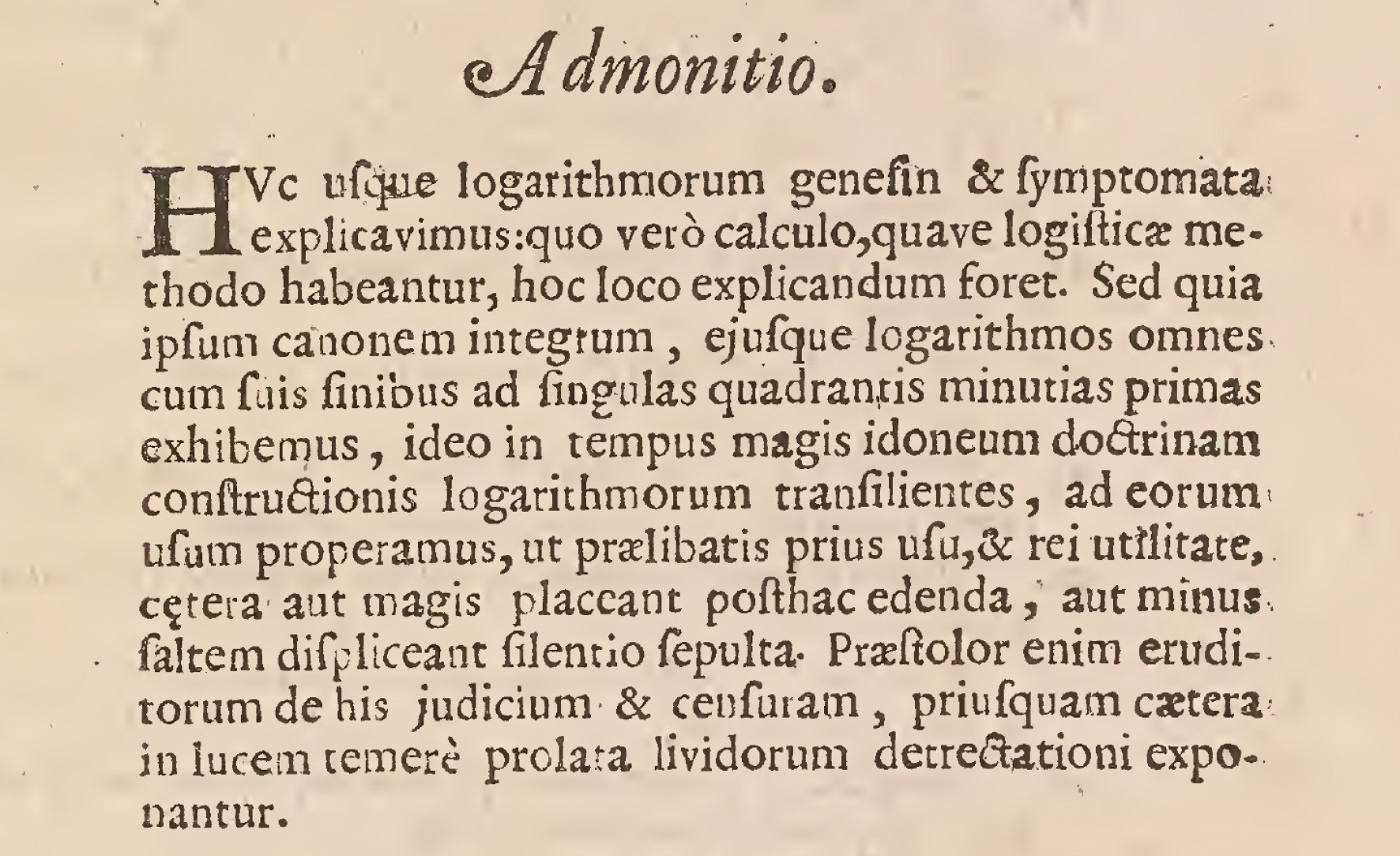
A table moved a different part of the work, the computing itself, and moved it before the reader arrived. John Napier's Mirifici logarithmorum canonis descriptio, from Andrew Hart's press in Edinburgh in 1614, says in its preface why it was made. Multiplication, division, and the extraction of roots of large numbers were the most troublesome parts of mathematical practice, and the book put other numbers in their place, so that the work could be done by adding, subtracting, halving, and thirding entries looked up in a table.19 The book said what a logarithm was, proved that the logarithms of proportional numbers differ by equal amounts, and drew the rules for using the table from that. Then, on its seventh page, Napier stopped. "We should here show by what calculations or method of computing they are to be had," he wrote, but he would "leave the Theory of their Construction for a more fitting time and pass on to their use," because he awaited "the judgement and criticism of the learned" before publishing the rest. On the last page he counted what he had given, that "there are Logarithms, what they are, and of what use they are," demonstrated and shown by examples, and he said again that if the canon pleased the more learned of his readers he might be encouraged to publish the method of constructing the table.20 A reader of 1614 had the table, the rules for using it, and the demonstrations that made the rules sound. What the reader did not have was the way the entries had been computed.
The construction came into print in 1619, two years after Napier's death, as Mirifici logarithmorum canonis constructio, from the same press. Robert Napier, the son, explained the order of publication in his preface. His father "made public the use of the Wonderful Canon of Logarithms," but, "as he himself mentioned on the seventh and on the last pages of the Logarithms, he was decidedly against committing to types the theory and method of its creation, until he had ascertained the opinion and criticism on the Canon of those who are versed in this kind of learning." Since his father's death, Robert went on, it had been made plain to him "by unmistakable proofs, that the most skilled in the mathematical sciences consider this new invention of very great importance," and so the construction could go forth into the light. It had been written first. Robert says his father "had this treatise written out beside him several years before the word Logarithm was invented," and in it the numbers are still called artificial numbers.21 The use of the tables was public for three years while their author lived, and for two more after his death in April 1617, before the way their entries had been computed came into print. What any user of the tables understood of that, or wanted to, neither book says. What had moved onto the page was the computing. What stayed with the reader was the rule for using the page and, for anyone who wanted it, the proof that the rule was sound.
A machine took the work off the page altogether and put it into moving parts. Blaise Pascal built his in the 1640s. He built it, he told the chancellor in the letter of 1645 that presented it, to relieve himself of the large calculations that had occupied him for some years in the business of the offices his father held for the king in Upper Normandy, the arithmetic of collecting taxes. His sister Gilberte wrote that he invented the machine at nineteen, which by the birth date she gives was 1642 or 1643, and that he spent two years bringing it to its finished state. The letter and the printed notice that went with it are of 1645. A royal privilege of May 1649 protected it.22 Take one of the columns that count in tens. The digits nought to nine stand on a fixed circle, and inside it turns a wheel with ten notches, one at each digit. The operator sets a stylus in the notch at the digit wanted and turns the wheel to a fixed stop, and a drum in a small opening above shows the digit. A second number is turned in the same way, and the sum shows in the openings, because the machine adds as the wheel turns. When a wheel passes from nine to nought, a weighted piece it has lifted falls and pushes the next wheel one notch, and the ten has been carried without anyone thinking of it. Subtraction is done by turning in complements, since the wheels turn one way only.23
The operator supplies the numbers and reads the result. The machine does the carrying.24 What the numbers count, and whether adding them is what the task calls for, stays with the operator. A table had turned multiplication into the addition and subtraction of its entries, and a machine had put addition into moving parts, and neither drew a conclusion. A conclusion follows from its premise because of what the two say. A sum shows in an opening because a wheel turned, and nothing in the machine says why the numbers were added or what the total is a total of, any more than the table says why two entries were looked up.
III. The press
The press did to methods what no scribe could. It fixed them in the same order copy after copy and put the same pages in many hands at once, so that rival methods stood side by side in the same stall and the rules of a method could be learned from type with its author dead or a thousand miles away.25 That is the part of the work print took over. The part it left standing is the part a book printed at Paris in 1555 put into a mason and a harpist.
The book was the Dialectique of Petrus Ramus, a logic textbook written in French where the schools wrote Latin, and it opens by defining dialectic as the art of disputing well. The Latin Dialecticae libri duo followed the year after, and the Latin went through hundreds of editions and into schoolrooms and universities across Europe, above all in Protestant countries.26 The books carried large bracketed tables that divided an art into its parts and its parts into theirs, and the tables became what Ramus was known for. On page 136 of the 1555 Dialectique he distinguishes knowing the general rules of an art from knowing how to use them in a particular case, and he gives two craftsmen for the difference. A mason knows the rules of building. Whether he can build this wall is another knowledge. A harpist knows the rules of the harp. Playing this piece is a second thing.27 Buridan had drawn a line of the same shape two centuries earlier, between the logic that teaches and the logic that is used, and each man drew it for his own purposes.
Print served Viète's letters as readily as Ramus's rules, and it made no judgment between the two. Whether anyone could use either was the mason's question, and the press left it standing. Nothing of the mason's second knowledge had moved onto the page.
IV. The characteristic
The man who asked the signs to do the most began from a claim of Hobbes's that he endorsed at twenty. Gottfried Wilhelm Leibniz published at Leipzig in 1666 a Dissertatio de arte combinatoria, and in its sixty-third paragraph he calls Thomas Hobbes the most profound examiner of principles in all things, who rightly held that every work of our mind is a computation, and he went on to the parallel with adding and subtracting.28 The young author agreed, and set about the arithmetic of concepts. He would serve dukes, build a calculating machine, invent a calculus, and leave more paper than any editor has yet finished with, and the arithmetic of concepts went on beside all of it.
Thirteen years later, in April 1679, he wrote out how the arithmetic might go, in a paper headed Elementa calculi. A concept receives a number, and a compound concept the product of the numbers of its parts. His example is the old definition of man as rational animal. Let animal be 2 and rational be 3. Then man is 6. A proposition of the form every S is P is true when the number of the subject divides exactly, without remainder, by the number of the predicate, so whether every man is an animal is settled by dividing 6 by 2. If monkey is 10, every monkey is an animal, and neither man nor monkey contains the other, since 6 will not go into 10 nor 10 into 6. A concept that cannot be resolved further takes a prime, a number that divides by nothing but one and itself. Negation would not fit into one number, and in another paper of the same month he tried pairs of numbers, one marked plus and one minus, with rules for reading them, which carried the syllogism's negative propositions and never the negative concept.29 What had moved onto the page, in a paper he kept to himself, was the test of an inference. What stayed with the reader was the assignment of the numbers, which is to say the analysis of man into animal and rational, and of those into whatever they are made of.
The numbers served a larger hope, a universal characteristic in which disputes could be settled by calculation, and in the 1680s he was trying to reduce reasoning to a calculus. The characters were to be built as 6 had been built from 2 and 3, the concepts analyzed into their simple elements so that the make-up of a character answered to the make-up of the thought it stood for, and the parties to a dispute would have to agree on what the characters stood for, as they would have to agree that man is 6 before dividing. He had measured Llull's Art against that requirement in the Dissertatio of 1666 and found its terms chosen arbitrarily, nine to a class, will and glory in, beauty and number out, a method that had become, in the hands of the Lullists if not in Llull's, a way of speaking readily on a subject rather than knowing it whole.30 Llull had chosen his terms, and Leibniz wanted terms that had been analyzed. Leibniz did not make the whole analysis a condition of beginning, since one of his fragments on the art of thinking allows provisional definitions that resolve an idea only as far as it can be conceived, without going back to first ideas. He never completed the analysis, and the agreement was not his to supply.31 He is, for me, the ancestor of every formal system I care about.
The claim Leibniz had endorsed at twenty was older than his project and plainer, a sentence saying what reasoning is where Leibniz wanted a calculus to do it, and Hobbes had made it in two books. In Leviathan, in 1651, reason is "nothing but Reckoning (that is, Adding and Substracting) of the Consequences of generall names agreed upon," and in the same chapter Hobbes says that a reader who takes a conclusion on an author's word, without following the reckoning that produced it, has trusted and has not reasoned.32 The names had to be agreed on first, and the agreement is inside the definition. In De Corpore, in 1655, and in its English of the next year, the first chapter says it in a sentence a schoolboy could hold. "By RATIOCINATION, I mean Computation. Now to compute, is either to collect the sum of many things that are added together, or to know what remains when one thing is taken out of another."33 Hobbes built no calculus to go with it. He supplied a definition and an insistence that the reader follow the grounds, and he left the operations to be found.
Llull's Art was the earlier form of the ambition. The Ars demonstrativa of 1283 already carried a figure built to rotate. The Art was recast on a ternary plan and abridged in the Ars brevis, the version most commented on in the Renaissance.34 Its nine letters carried fifty-four significations among them, principles and questions, subjects, virtues and vices, and the figures set the letters in relation so that questions could be put and answered from principles the Art proposed to Christians, Jews, and Muslims as common ground.35 In the Book of the Gentile and the Three Wise Men, written between 1274 and 1276, a Jew, a Christian and a Muslim agree to argue before a gentile from the flowers of five trees rather than from their scriptures, the attributes of God and the virtues and vices taken in pairs by concordance or contrariety, and the book ends without the gentile telling them which law he has chosen. In the Liber de fine of 1305 Llull called that book a version of the Art. The figure generates the combinations. The practitioner weighs the meanings, keeps subject and predicate in agreement, and supplies the reasons, and Llull said so. The teacher, his instructions run, is to propose questions to the students and solve them by giving reasons according to the process of the Art, "for without reasoning, the artist cannot make it work." Leibniz's characteristic would ask the signs to do more than generate.36
The logical papers in which Leibniz worked at his calculus were not printed in his lifetime. They went with the rest of his manuscripts to the Royal Library at Hanover. What was printed from them and when, who read it, and what reached Boole are three different questions.
Publication began in 1765. Rudolf Erich Raspe, working from the Hanover manuscripts, issued at Amsterdam and Leipzig the Oeuvres philosophiques latines et françoises de feu Mr. de Leibnitz. Its main matter was the Nouveaux essais, and behind them came shorter pieces, among them the Difficultates quaedam logicae and a history and commendation of the universal characteristic.37 Three years later Louis Dutens printed six volumes of Leibniz at Geneva, and the logical tracts at issue were not among them.38 Then, in 1839 and 1840, Johann Eduard Erdmann published the logical fragments together at Berlin in the Opera philosophica.39 Some of these writings had been in print for more than eighty years when Boole's book appeared.
Adolf Trendelenburg read the Berlin Academy a paper on Leibniz's project of a universal characteristic on Leibniz Day in 1856, and the paper works from Erdmann's pages. He called the project a monument to a wide and enterprising mind, although it remained a sketch.40 In 1857 Robert Leslie Ellis, editing Bacon's Novum Organum, came to the passage where Bacon compares a mathematical postulate with the structure of the syllogism and added a note. Boole's Laws of Thought, he wrote, contained the first development of ideas whose germ was in Bacon and Leibniz, and he sent the reader to a page of Erdmann's edition for Leibniz's knowledge of the principle that in logic a squared is a.41 The page number was wrong. In 1877 William Stanley Jevons, in the preface to the second edition of his Principles of Science, confessed that the logical tracts had been unknown to him until the past twelve months, that the copy of Leibniz he had used at Owens College was Dutens's, which did not contain them, and that his successor at Owens College, Robert Adamson, had traced the principle of substitution to Erdmann's page 94. He judged the tracts "little more than brief memoranda of investigations which seem never to have been followed out." The most learned logicians, Hamilton and Ueberweg among them, ignored Leibniz's principle of substitution, he found, and he presumed the reason was how recently the tracts had been printed.42
Erdmann's page 94 opens with a definition. "Eadem sunt quorum unum potest substitui alteri salva veritate." Things are the same when one can be put in place of the other without loss of truth.43 It is a sentence from a manuscript Leibniz wrote and kept correcting, printed at Berlin in 1840 by Erdmann, and identified in 1877 as the principle of substitution put in the form of a definition. The law Boole had printed at Cambridge in 1847 Jevons found four pages on, in the Addenda at page 98, where Leibniz writes that repeating a letter within a term is superfluous, since man man is animal says no more than man is animal. When Boole pointed out that in logic xx equals x, Jevons wrote, "this seemed to mathematicians to be a paradox, or in any case a wholly new discovery," and here it was, "plainly stated by Leibnitz." Those pages establish what was in print, not what Boole had read.
V. The operation
Cambridge's symbolical algebra separated rules for combining signs from any one interpretation of them. Boole chose a logical interpretation. George Peacock's Treatise on Algebra, in the preface to the 1842 edition of its first volume, separates arithmetical algebra, whose rules carry the restrictions that number imposes, from symbolical algebra, which adopts the rules and removes the restrictions, so that the science is governed by the laws of its symbols rather than by what the symbols stand for.44 Duncan Gregory carried the view forward at Cambridge and edited the journal in which Boole, a Lincoln schoolmaster who had made mathematics his special study, published his first papers, and the book of 1847 was written from inside that view.45
The occasion was a quarrel. In the spring of 1847 Boole's attention was drawn to one between Sir William Hamilton and Augustus De Morgan, and it sent him back to inquiries he had set aside. By the autumn he had a book of eighty-two pages, The Mathematical Analysis of Logic, printed at Cambridge.46 De Morgan's Formal Logic appeared the same year. The two calculi are distinct and were arrived at separately, and Boole said in his preface what he owed De Morgan for the stimulus, credited him by name on page 42 for a condition on lawful inference, and in a postscript gave up a claim to discovery when he saw that De Morgan's doctrine already contained it.47
Peacock had opened a possibility, and the form Boole gave it was logical. He reached it without Leibniz's logical writings, some of them already in print, and the anticipations among them, on Harley's later report, not yet known to him. Robert Harley, in a paper read to the British Association at Nottingham in 1866 and printed the next year, reported that Boole did not become aware of Leibniz's anticipations until more than twelve months after the publication of The Laws of Thought in 1854, when Robert Leslie Ellis pointed them out to him, and Leibniz is absent from the text of 1847 and from the text of 1854.48 Harley also finished Ellis's work. The Erdmann page Ellis had cited, 130, held nothing on the logical question, and Harley thought the passage intended was probably at page 103, in the Difficultates. Leibniz had come near Boole's law there without stating it, Harley said, and it was Harley who drew it out.49
On page 3 Boole set down the proviso the whole book depends on. Those acquainted with symbolical algebra, he wrote, "are aware, that the validity of the processes of analysis does not depend upon the interpretation of the symbols which are employed, but solely upon the laws of their combination," and every system of interpretation that does not affect the truth of the relations supposed is equally admissible.50
Then he chose his interpretation. Let 1 stand for the universe of things. Let x be a symbol that, "operating upon any subject comprehending individuals or classes, shall be supposed to select from that subject all the Xs which it contains," so that xy, the Xs selected from the Ys, is the class of things that are both. He called such symbols elective.51 Now take a proposition. Boole writes y equals z for the statement that the classes Y and Z are equivalent, member for member. Multiply both sides by x, and xy equals xz, which says that the individuals common to X and Y are the individuals common to X and Z. "This is a perfectly legitimate inference," he writes, "but the fact which it declares is a less general one than was asserted in the original proposition." The sentence before it states the rule. "The expression of a truth cannot be negatived by a legitimate operation, but it may be limited."52 A rule for operating on the symbols had determined what followed from a premise, and the operation was the inference itself. The wheel had given the practitioner a combination to argue from, and the machine had given the operator a sum. The symbol gave a conclusion, with its warrant and its cost in the same sentence.
Boole did not think the operation excused the person who used it. Of the machines of the present this Review has held a neighbouring thing, that accountability stays with those who made them once the machine operates on its own.53 Boole had chosen what 1 and x would stand for, and the choice still needed reasons, as did the operations he allowed on the symbols. The book supplies them in the pages that give the operations. Whether a reader took the reasons or only the operations was the mason's question again, and he answered it in his introduction, on pages 9 and 10. He grants there that symbolical methods accomplish labor and free the investigator for harder problems, and then he asks about discipline. It matters, he writes, whether the symbols are used "with a full understanding of their meaning, with a perfect comprehension of that which renders their use lawful, and an ability to expand the abbreviated forms of reasoning which they induce, into their full syllogistic development," or whether they are "mere unsuggestive characters, the use of which is suffered to rest upon authority." In the first case, he says, there is an intellectual discipline of a high order. In the second, "there is no mental discipline whatever."54
A reader who has written xy equals xz under y equals z should be able to put the step back into words. The Ys are the Zs, so whatever is both X and Y is both X and Z, and the reverse. The reader should also be able to say why the step is allowed and what it gives up. Boole does not ask the reader to unfold the reasoning at every use. He asks that the reader be able to. His word for what is otherwise lost is discipline. Validity is not lost, since the symbols give the same result whether or not the reader understands them. The discipline is the piece that stayed with the reader. His preface had rested the defence of a mechanical notation on a principle from John Stuart Mill, that where the nature of the subject lets reasoning be carried on mechanically without danger, the language should be built on principles as mechanical as possible, and where it does not, the language should stand in the way of a merely mechanical use.55
Llull's wheel gave the combinations and left the reasons. Viète's letters carried a family of problems and left the working, and the holding of the general problem, to the hand. Napier's table did the computing and left the proof. Pascal's machine carried the tens and left what the total was a total of. The press left the wall to the mason. Leibniz put a number built from primes on the page, with a rule for reading it, and left the analysis unfinished and the agreement to others. Boole's symbols took the inference itself and left the ability to say what the symbol had done and why it was allowed. To supersede common reason, or to bind it in technical forms, Boole wrote, "would be the last desire of one who knows the value of that intellectual toil and warfare which imparts to the mind an athletic vigour."56 The ambition to make reasoning easier became the harder task of specifying what counts as reasoning.
What was carried.
A page of the Elements came out of a rubbish mound at Oxyrhynchus, and the book it belonged to opens with definitions, postulates and common notions before anything is proved. Between that page and this one the whole was copied by hands that each judged it worth copying. A library in Bamberg holds two copies of the same arithmetic book. Boethius is on the shelf, and al-Khwarizmi's square and ten roots equal to thirty-nine, and the translators at Toledo, and Peter of Spain's textbook, and then the seven instruments of this part, from Llull's wheel to the operation Boole printed at Cambridge.
Stephen DeAngelis
Princeton, NJ
September 2026
About the Author
Stephen F. DeAngelis is the founder, president, and CEO of Enterra Solutions and Massive Dynamics, two companies that apply artificial intelligence and advanced mathematics to complex enterprise challenges. His work spans international relations, national security, and commercial technology, with visiting research affiliations at Princeton University, Department of Chemistry, the Computing and Computational Sciences and National Security Directorates of the Oak Ridge National Laboratory, the Software Engineering Institute at Carnegie Mellon University, and the MIT Computer Science and Artificial Intelligence Laboratory. He holds patents in autonomous decision science.
Endnotes
1. Ramon Llull, Ars brevis (1308), Part I, "The Alphabet," and Part II.4, "The Fourth Figure," trans. Yanis Dambergs (Gatineau, 2006), pp. 2 and 7 to 8, at <https://lullianarts.narpan.net/ArsBrevis.pdf>. For B the alphabet gives "goodness, difference, whether? God, justice, avarice." The instruction: "Turn the middle circle inside the outer circle to place C under B. Then turn the inner circle inside the middle circle and place D under C. This gives rise to nine cameras: first BCD, then CDE, and so forth." The drawing shows the generic mechanism, not a surviving specimen. The Fourth Figure is one instrument of the Art and not the Art. Anthony Bonner, The Art and Logic of Ramon Llull: A User's Guide (Leiden: Brill, 2007), pp. xii to xiii, counts among modern misapprehensions the belief that the Art "functions essentially (the adverb is important) by a system of revolving combinatorial disks." His account of the figure's turning, p. 144, is the setting drawn here.
2. Llull, Ars generalis ultima (1305 to 1308), Part XIII, "How to Teach this Art," sections 3 and 4, trans. Dambergs, at <https://lullianarts.narpan.net/Ars-Magna/x12-13.htm>: the teacher "shall propose questions to the students and solve them by providing reasons according to the process of this art, for without reasoning, the artist cannot make it work." Ars brevis, II.4, trans. Dambergs, p. 8, on the intellect weighing the meanings of the letters and keeping subject and predicate in agreement. That the figure generates combinations and establishes no conclusion is common to Gardner, Bonner and Eco, who differ on much else. Martin Gardner, Logic Machines and Diagrams (New York: McGraw-Hill, 1958), p. 17, https://archive.org/details/logicmachinesdia00mart: Llull "certainly did not think that the mere juxtaposition of terms provided in themselves a proof by 'necessary reasons.'" Bonner (note 1), pp. 303 to 305, objects to Gardner's presenting the Art as a series of spinning wheels, and to the disparagement that goes with it, not to that sentence. Umberto Eco, The Search for the Perfect Language, trans. James Fentress (Oxford: Blackwell, 1995), pp. 64 to 67: Llull "never considered his to be an art where the combination of the elements of expression was free rather than precisely bound in content." The agreement claimed here reaches that distinction and no further.
3. Thomas le Myésier, Breviculum ex artibus Raimundi electum, c. 1321, Karlsruhe, Badische Landesbibliothek, Cod. St. Peter perg. 92, fols. 6v and 7r, Miniatures VI and VII. The legend of Miniature VII reads "Retrobellum et succursus exercitus domini Raimundi Lul de Maioricis ad corruendum turrim falsitatis et ignorantiae," that of Miniature VI "exercitus Aristotelis ad destruendum turrim falsitatis cum suo commentatore." The horses are labelled "recta intentio," "ratiocinatio" and "imaginatio," the trumpeters intellectus, voluntas and memoria; the wagons of Miniature VII carry the nine absolute principles and the nine relative principles, differentia, concordantia, contrarietas, principium, medium, finis, maioritas, aequalitas, minoritas. Legends and inscriptions as transcribed in the Universitätsbibliothek Freiburg description, "Thomas Le Myésier: Breviculum ex artibus Raimundi Lulli electum," https://www.ub.uni-freiburg.de/fileadmin/ub/referate/04/breviculum.htm, and the digitised manuscript at the Badische Landesbibliothek, https://digital.blb-karlsruhe.de/98159. The three powers as the Art's three uses are Frances A. Yates's reading, The Art of Memory (London: Routledge and Kegan Paul, 1966), p. 174: "As intellectus, it was an art of knowing or finding out truth; as voluntas it was an art of training the will towards loving truth; as memoria, it was an art of memory for remembering truth." The reading of the wagons is the essay's.
4. Peter of Spain, Tractatus, called afterwards Summule logicales, ed. L. M. de Rijk (Assen: Van Gorcum, 1972). Written between the 1220s and the 1250s; the old identification of its author with the Portuguese who became Pope John XXI in 1276 is now doubted. Buridan's commentary took as its base an interpolated version, the Summulae logicales. See Joke Spruyt, "The Logic of Peter of Spain," Stanford Encyclopedia of Philosophy, https://plato.stanford.edu/entries/peter-spain/.
5. John Buridan, Summulae de propositionibus, ed. Ria van der Lecq (Turnhout: Brepols, 2005), prooemium, pp. 7 to 8: an eighth treatise "apponetur de divisionibus, definitionibus, demonstrationibus, de quibus auctor noster in hoc libro suo non tractavit." Gyula Klima, introduction to Buridan, Summulae de Dialectica (New Haven: Yale University Press, 2001), p. xxxi, for the parts retained and the fourth treatise replaced. "More than ten times longer than the original" is Jack Zupko's, "John Buridan," Stanford Encyclopedia of Philosophy, section 4, https://plato.stanford.edu/entries/buridan/.
6. Stephen DeAngelis, "Euclid's Page That Held," DeAngelisReview, Section I, https://www.deangelisreview.com/blog/euclids-page-that-held, on the definitions, postulates and common notions with which Elements I opens. Buridan's eighth treatise is Summulae de dialectica, treatise 8, on demonstrations, trans. Gyula Klima (New Haven: Yale University Press, 2001), its matter announced in the prooemium quoted in note 5. Division as a logician's instrument reached the Latin schools through Boethius, De divisione.
7. Zupko, "John Buridan," section 4, for logica docens and logica utens and the ordering of the first to the second, citing Buridan, Quaestiones in Isagogen Porphyrii, q. 1, ed. Ryszard Tatarzynski, Przegląd Tomistyczny 2 (1986), pp. 126 to 127. The text paraphrases and quotes no words as Buridan's.
8. The question has been asked of writing as such, and carried across instruments. Sybille Krämer, "Writing, Notational Iconicity, Calculus: On Writing as a Cultural Technique," trans. Anita McChesney, MLN 118 (2003), pp. 518 to 537, https://german.yale.edu/sites/default/files/writing_notational_iconicity_calculus.pdf, at p. 532: written calculation "separates the knowledge of how to solve a problem from the knowledge of why this solution functions. Knowing recipes and knowing explanations diverge." The same page has the mechanical calculators of the seventeenth century demonstrate "that cognitive operations, in so far as they depend on syntactic manipulation on paper, can also be performed by a real machine," and the pages that follow take up Viète, Descartes and Leibniz. Her book is Symbolische Maschinen: Die Idee der Formalisierung in geschichtlichem Abriß (Darmstadt: Wissenschaftliche Buchgesellschaft, 1988). What is followed here is a particular set of persons and instruments, and at each what was left.
9. The division was drawn once before, for machines in general. John Venn, Symbolic Logic (London: Macmillan, 1881), chapter V, pp. 120 to 121, https://archive.org/details/symboliclogic00vennuoft, on a machine for combining the premises of a logical problem: "if we begin from the beginning, that process would involve four tolerably distinct steps," the statement of the data in accurate logical language, their reduction to a form the engine can work with, the combination of the premises so reduced, and the reading off of the results, which "generally gives rise to much opening for skill and sagacity." "I cannot see that any machine can hope to help us except in the third of these steps." The steps are his, in his order, and so is the verdict on the third, which he gives for any machine and not for his own alone. The instruments of this part stand beside that division as a comparison, each asked what it took and what it left, and are not offered as a correction of it.
10. François Viète, In artem analyticem isagoge (Tours: Jamet Mettayer, 1591), https://archive.org/details/bub_gb_BWTyywN39KEC, read in Frédéric Ritter's French translation, Introduction à l'Art Analytique (Rome, 1868), reprinted in Cahiers François Viète I-7 (2004), pp. 11 to 37, https://journals.openedition.org/cahierscfv/2414.
11. Jordanus de Nemore, De numeris datis (thirteenth century), whose demonstrations use letters for unspecified numbers in prose, without signs of operation. Jens Høyrup, "Jordanus de Nemore: A Case Study on 13th Century Mathematical Innovation and Failure in Cultural Context," Philosophica 42 (1988), pp. 43 to 77, https://www.philosophica.ugent.be/article/id/82461/, for the letter symbolism.
12. Viète, Isagoge, chapters III, IV, V.5 and VIII.26, in Ritter's translation. Chapter IV: "Logistique numérale est celle qui est exposée par des nombres. Logistique spécieuse est celle qui est exposée par des signes ou des figures, par exemple, par des lettres de l'alphabet." Chapter V.5 assigns the vowels and consonants, chapter III states the law of homogeneity, chapter VIII.26 names lines, surfaces and bodies. The Latin of chapter IV (1591, fol. 5a) is given in Jeffrey A. Oaks, "François Viète's revolution in algebra," Archive for History of Exact Sciences 72 (2018), pp. 245 to 302.
13. René Descartes, Discours de la methode (Leiden: Jan Maire, 1637), title page, listing after the Discours "LA DIOPTRIQUE. LES METEORES. ET LA GEOMETRIE. Qui sont des essais de cete METHODE." Smithsonian Libraries copy, https://library.si.edu/digital-library/book/discoursdelamet00desca.
14. Descartes, La Géométrie, Book I, pp. 1 to 2 of the Paris edition of 1886 (A. Hermann), Project Gutenberg 26400, https://www.gutenberg.org/ebooks/26400, where the sentence reads: "par a², ou b³, ou semblables, je ne conçois ordinairement que des lignes toutes simples, encore que pour me servir des noms usités en l'algèbre je les nomme des carrés ou des cubes." The operational reading of the letters, and of the unit that lets the product of two lines be a line, is Michael S. Mahoney's, "The Beginnings of Algebraic Thought in the Seventeenth Century," in Stephen Gaukroger, ed., Descartes: Philosophy, Mathematics and Physics (Brighton: Harvester Press, 1980), pp. 141 to 156: the algebraic mode of thought is marked by "an operative symbolism ... a symbolism with which one operates."
15. Descartes, La Géométrie, Book I, pp. 3 and 8 of the 1886 edition; at p. 8 a given ratio is set "comme de z à b." The textbook of 1660 is Jonas Moore, Moor's Arithmetick (London, 1660), as reported in Florian Cajori, A History of Mathematical Notations, vol. 1 (Chicago: Open Court, 1928), p. 381, https://archive.org/details/historyofmathema031756mbp.
16. Discours de la méthode (Leiden: Jan Maire, 1637), second part, p. 20 of the 1637 printing.
17. Muhammad ibn Musa al-Khwarizmi, born about 780, died about 850, worked at Baghdad in the House of Wisdom under the caliph al-Ma'mun, caliph from 813, and dedicated his algebra to him. Its title, Hisab al-jabr w'al-muqabala, gives the word algebra, and his name, Latinized, gives algorithm. J. J. O'Connor and E. F. Robertson, "Al-Khwarizmi," MacTutor History of Mathematics, https://mathshistory.st-andrews.ac.uk/Biographies/Al-Khwarizmi/. Part One followed the square and ten roots equal to thirty-nine in Robert of Chester's Latin translation, ed. L. C. Karpinski (New York: Macmillan, 1915), https://archive.org/details/robertofchesters00khuw, pp. 79 to 81.
18. H. T. Colebrooke, Algebra, with Arithmetic and Mensuration, from the Sanscrit of Brahmegupta and Bhascara (London: John Murray, 1817), https://archive.org/details/algebrawitharith00brahuoft, Dissertation, pp. x to xi, referring to Bhaskara, Vija-ganita §17, and Brahmagupta, chapter XVIII §2: the unknown by ya, further unknowns by the initials of colours, the known number by ru; a sample at Vija-ganita ch. I §26 reads "yav 15 ya 48 ru 36." On the same pages Colebrooke writes that "No marks or symbols indicating operations of addition, or multiplication, &c. are employed by them: nor any announcing equality or relative magnitude," that the intent "is in the instance to be collected from the recital of the steps of the process in words at length, which always accompanies the algebraic process," and that symbols are employed "especially in demonstrations, for both given and sought quantities." The dates 628 and 1150 are Colebrooke's (pp. vi and ii to iii). Li Ye, Ceyuan haijing (Sea Mirror of Circle Measurements), 1248, and Zhu Shijie, Siyuan yujian (Jade Mirror of the Four Unknowns), 1303, which sets four unknowns around the constant, described from Donald B. Wagner, "The development of the classical Chinese algebra of polynomials" (2025), https://donwagner.dk/AlgPoly/Algebra-of-polynomials.pdf, which carries Li Ye's column of rod numerals and Zhu Shijie's arrays of 1303. The date 1248 and the placing of the four unknowns around the constant are from the Encyclopaedia Britannica article "East Asian mathematics," https://www.britannica.com/science/East-Asian-mathematics. Abu al-Hasan al-Qalasadi (1412 to 1486), Kashf al-asrar 'an 'ilm huruf al-ghubar. That the signs were a century older than al-Qalasadi, in the line of Ibn al-Banna, and not claimed by him is Julio Samsó's point, in reviews quoted in J. J. O'Connor and E. F. Robertson, "Al-Qalasadi," MacTutor History of Mathematics, https://mathshistory.st-andrews.ac.uk/Biographies/Al-Qalasadi/. Ibn al-Banna of Marrakesh (died 1321) wrote the Talkhis on which al-Qalasadi commented. Al-Qalasadi claimed no originality. The three traditions are separate cases and none of them reached Viète. Indian astronomy and reckoning had entered Arabic scholarship by the ninth century, when al-Khwarizmi wrote on Indian calculation, as Part One records, and the Arabic books entered Latin in the twelfth century. Whether the signs for the unknown travelled either route is not documented. Colebrooke's translation of 1817 carried Bhaskara's algebra into English from the Sanskrit. The Chinese rod-numeral algebra is a development of its own, and is not known to have reached Europe.
19. John Napier, Mirifici logarithmorum canonis descriptio (Edinburgh: Andrew Hart, 1614), https://archive.org/details/mirificilogarit00napi, Praefatio: other numbers are put in place of those to be multiplied, divided and resolved into roots, "qui illorum munere fungantur per solas additiones, substractiones, bipartitiones, & tripartitiones." In Napier's scale the logarithm of the whole sine is 0, so a multiplication uses the entry for 1 as well as the two factors, as Graham Jagger explains in "The making of logarithm tables" (Oxford, 2003).
20. Napier, Descriptio, the Admonitio at p. 7 and the Conclusio at p. 57, the last page, in William Rae Macdonald's translation, The Construction of the Wonderful Canon of Logarithms (Edinburgh: William Blackwood and Sons, 1889), https://archive.org/details/constructionofwo00napiuoft, "Notes by the Translator." The Latin of p. 7, "in tempus magis idoneum doctrinam constructionis logarithmorum transilientes, ad eorum usum properamus ... Praestolor enim eruditorum de his judicium & censuram," is the page reproduced as Figure 3.
21. Robert Napier, "To the Reader Studious of the Mathematics," preface to John Napier, Mirifici logarithmorum canonis constructio (Edinburgh: Andrew Hart, 1619), in Macdonald's translation (1889), whose English is quoted. The date of the death, 4 April 1617, is Jagger's.
22. Blaise Pascal, "Lettre dédicatoire" to the Chancellor and the Avis nécessaire, in OEuvres de Blaise Pascal, ed. Léon Brunschvicg and Pierre Boutroux, vol. I (Paris: Hachette, 2nd ed., 1923), https://archive.org/details/uvresdeblaisepas00pasc, under 1645: "pour me soulager dans les grands calculs où j'ay esté occupé depuis quelques années en plusieurs affaires qui dependent des emplois dont il vous a pleu honorer mon pere." Gilberte Périer, La vie de Monsieur Pascal, same volume, for the birth on 19 June 1623, the invention "à l'âge de dix-neuf ans," and the two years. The Privilège, vol. II, pp. 399 to 404, is of 22 May 1649. That the offices were the collection of taxes is carried from J. J. O'Connor and E. F. Robertson, "Blaise Pascal," MacTutor History of Mathematics, https://mathshistory.st-andrews.ac.uk/Biographies/Pascal/.
23. Charles Belair, "Explication de la Machine de M. Pascal," sent to Huygens with his letter of 4 July 1659, in Pascal, OEuvres, vol. I (1923), pp. 315 to 321: the numerals on fixed circles, the wheels "qui ont chacune 10 crans," turning one way only, and the carry, a piece that "sert à faire passer le mouvement d'une roüe a l'autre par sa pesanteur." The anonymous Usage de la Machine, Clermont-Ferrand MS 1522, transcribed in Courrier du Centre international Blaise Pascal 8 (1986), pp. 4 to 25, https://journals.openedition.org/ccibp/443, gives subtraction "par le supplement de 9."
24. The work followed here is the judgment the operator keeps, what the numbers count and whether adding them is what the task calls for. Two other kinds of work that stayed with people have their historians. Lorraine Daston, "Calculation and the Division of Labor, 1750-1950," Bulletin of the German Historical Institute 62 (2018), pp. 9 to 30, https://www.ghi-dc.org/fileadmin/publications/Bulletin/bu62.pdf, at p. 29, on the attention the later machines newly required of their operators, a "vigilant attention" that was "every bit as wearisome as the mental labor that had motivated the invention of calculating machines in the first place." Simon Schaffer, "Babbage's Intelligence: Calculating Engines and the Factory System," Critical Inquiry 21 (1994), pp. 203 to 227, at p. 218, on the makers, for whom "manual dexterity remained a central attribute of 'the skilled workman.'" Daston's "Enlightenment Calculations," Critical Inquiry 21 (1994), pp. 182 to 202, at p. 185, is the reminder that the line between calculating and reasoning has itself moved, calculation in the eighteenth century having "not yet become mechanical." The sentence above about a sum and a conclusion is drawn for this essay's purpose and is not offered as that century's.
25. The claim is about order, not letters. Elizabeth L. Eisenstein, The Printing Press as an Agent of Change (Cambridge: Cambridge University Press, 1979), vol. I, p. 7. In "An Unacknowledged Revolution Revisited," American Historical Review 107 (2002), pp. 87 to 105, at p. 93, answering Adrian Johns, The Nature of the Book (1998), she allows that "early printing methods led to the multiplication of variants, and errata had to be issued," and holds that "the very output of errata pointed to standardization as a feature of print." That copies agreed in the order of the method, copy after copy, is what the sentence claims.
26. Pierre de La Ramée, Dialectique (Paris: André Wechel, 1555), opening of Book I: "Dialectique est art de bien disputer." Erland Sellberg, "Petrus Ramus," Stanford Encyclopedia of Philosophy, https://plato.stanford.edu/entries/ramus/, for the dates 1515 to 1572, the French textbook as a break with the Latin of the schools, the Dialecticae libri duo of 1556, and the editions and their reach.
27. Ramus, Dialectique (1555), p. 136, the mason and the harpist. Bibliothèque interuniversitaire de la Sorbonne copy, <https://nubis.univ-paris1.fr/ark:/15733/3nrt>. The paraphrase is the essay's.
28. G. W. Leibniz, Dissertatio de arte combinatoria (Leipzig, 1666), paragraph 63, in Sämtliche Schriften und Briefe, series VI, vol. 1 (Akademie edition), https://www.uni-muenster.de/Leibniz/DatenVI1/A_VI_1.pdf, p. 194: "Profundissimus principiorum in omnibus rebus scrutator Th. Hobbes merito posuit omne opus mentis nostrae esse computationem." Leibniz was born at Leipzig in 1646 and died at Hanover in 1716.
29. Leibniz, Elementa calculi (April 1679), in Sämtliche Schriften und Briefe, series VI, vol. 4 (Berlin: Akademie Verlag, 1999), https://www.uni-muenster.de/Leibniz/DatenVI4/vi4pur.pdf, N. 57, pp. 195 to 205, at p. 196: "Verbi gratia quia Homo est Animal rationale (et quia Aurum est metallum ponderosissimum) hinc si sit Animalis (metalli) numerus a, ut 2 (m ut 3) Rationalis (ponderosissimi) vero numerus r ut 3 (p ut 5), erit numerus hominis seu h idem quod ar id est in hoc exemplo 2, 3 seu 6," and at p. 202: "si Numerus characteristicus hominis fingatur esse 6, simiae vero 10 patet quod nec simiae notio contineat notionem hominis, nec contra haec illam, quia nec 10 dividi potest exacte per 6 nec contra 6 per 10." The rule of exact division is stated in so many words in the companion paper of the same month, Elementa characteristicae universalis, N. 56, pp. 181 to 194, at p. 182: "Si Propositio Universalis Affirmativa est vera, necesse est ut numerus subjecti dividi possit exacte seu sine residuo, per numerum praedicati." Louis Couturat, ed., Opuscules et fragments inédits de Leibniz (Paris: Alcan, 1903), https://archive.org/details/opusculesetfrag01coutgoog, pp. 49 to 57; English in G. H. R. Parkinson, ed., Leibniz: Logical Papers (Oxford: Clarendon Press, 1966), pp. 17 to 24. The pairs of numbers are in the Regulae ex quibus de bonitate consequentiarum formisque et modis syllogismorum categoricorum judicari potest, per numeros, also of April 1679, N. 63, pp. 242 to 257, Couturat pp. 77 to 84, Parkinson pp. 25 to
30. Leibniz, Dissertatio de arte combinatoria (Leipzig, 1666), paragraph 60, in Sämtliche Schriften und Briefe, series VI, vol. 1, N. 8, p. 193: "Verùm in Terminis Lullianis multa desidero. Nam tota ejus methodus dirigitur ad artem potius ex tempore disserendi, quàm plenam de re data scientiam consequendi, si non ex ipsius Lullii, certè Lullistarum intentione. Numerum Terminorum determinavit pro arbitrio, hinc in singulis classibus sunt novem. Cur prædicatis absolutis, quæ abstractissima esse debent, commiscuit Voluntatem, Veritatem, Sapientiam, Virtutem, Gloriam, cur Pulchritudinem omisit, seu Figuram, cur Numerum?" In paragraph 56, p. 192, he had counted the propositions Llull's nine terms yield, thirty-six lines between nine points, seventy-two with conversion. The praise of Hobbes quoted in note 28 is paragraph 63, p. 194. Eco, Search, pp. 64 to 67, turns Leibniz's complaint around: "the real question ought to be not why Lull fixed upon this or that number, but why the number of elements should be fixed at all."
31. Leibniz, "Omnia quae certo cognoscimus," in C. I. Gerhardt, ed., Die philosophischen Schriften von Gottfried Wilhelm Leibniz, vol. VII (Berlin: Weidmann, 1890), https://archive.org/details/11172348bsb, pp. 198 to 203: "calculemus." "De Organo sive Arte Magna cogitandi," in Couturat, Opuscules et fragments inédits, pp. 429 to 432, at p. 432, undated, for the allowance of provisional definitions.
32. That the pairs never reached negative concepts is Wolfgang Lenzen's judgment, "Leibniz: Logic," Internet Encyclopedia of Philosophy, https://iep.utm.edu/leib-log/. That the numbers must be chosen before the division can prove anything has been observed before. Louis Couturat, La Logique de Leibniz d'après des documents inédits (Paris: Alcan, 1901), https://archive.org/details/lalogiquedeleib00coutgoog, p. 62, gives animal 2, raisonnable 3, homme 6. At p. 111, of the scheme of paired numbers and not of the single-number example, he finds Leibniz discovering "qu'il est très difficile de choisir des symboles convenables pour toutes les idées," since each idea must take two numbers prime to each other and the pairs must satisfy conditions of divisibility against the numbers of every other idea. Eco, Search (note 2), pp. 281 to 284: "in order to demonstrate that 'man' does not contain 'monkey,' the numerical values must be chosen according to a previous semantic decision." The paragraph above says the same with the papers' own numbers.
33. Hobbes, Elementorum philosophiae sectio prima De corpore (London: Andrew Crooke, 1655), https://archive.org/details/bim_early-english-books-1641-1700_elementorum-philosophi-_hobbes-thomas_1655, Part I, chapter I, article 2, and Elements of Philosophy, the First Section, Concerning Body (London: R. and W. Leybourn for Andrew Crooke, 1656), https://archive.org/details/b30335838, Part I, chapter I, article 2, pp. 2 to 3, whose wording is quoted.
34. The Ars generalis ultima was begun at Lyon in November 1305 and finished at Pisa in March 1308 by its colophon; the Ars brevis epilogue (trans. Dambergs, p. 37) is dated January 1307 of the Incarnation, January 1308 in modern reckoning, as Alexander Fidora explains in his edition (Hamburg: Felix Meiner, 1999). Ernesto Priani, "Ramon Llull," Stanford Encyclopedia of Philosophy, https://plato.stanford.edu/entries/llull/, for the Ars demonstrativa of 1283 and its rotating figure, and for the Ars brevis as the version most commented on in the Renaissance.
35. Ars brevis, Part I, trans. Dambergs, p. 2, the table of fifty-four significations. Llull, Libre del gentil e los tres savis, prologue, ed. Jeroni Rosselló, Obras de Ramón Lull, vol. I (Palma, 1886), https://www.cervantesvirtual.com/obra/obras-de-ramon-llull--0/, pp. 7 to 12: the sages, unable to agree "per auctoritats," will try "per rahons demostratiues e necessaries." For the date, the five trees, the ending, and the Liber de fine (1305), see the Llull database Qui est Lullus, "Book of the Gentile and the Three Wise Men," https://quisestlullus.narpan.net/en/book-gentile-and-three-wise-men. The dialogue is Llull's proposal of common ground, not a record of assent.
36. Llull, Ars generalis ultima, XIII.3, trans. Dambergs (note 2), with its continuation: "the art has three friends, namely intellectual subtlety, skill in reasoning, and good intentions." Leibniz knew the Art and weighed it in 1666, in paragraph 60 of the Dissertatio de arte combinatoria (note 30). The line from Llull to Leibniz asserted in this essay runs through that criticism and through nothing adopted.
37. The chronology that follows, from Raspe to Jevons, is Volker Peckhaus's, "Leibniz's Influence on 19th Century Logic," Stanford Encyclopedia of Philosophy (2009, revised 2024), https://plato.stanford.edu/entries/leibniz-logic-influence/, sections 2 to 5. His book is Logik, Mathesis universalis und allgemeine Wissenschaft: Leibniz und die Wiederentdeckung der formalen Logik im 19. Jahrhundert (Berlin: Akademie Verlag, 1997), whose chapter 5 Grattan-Guinness cites for Ellis's part (note 55). The order is his, and so is the observation about Harley at Ellis's page. What is added here is the reading of the editions at the pages named, Erdmann 94, 98 and 103, and Ellis's 130 found in the Foucher correspondence. His verdict, section 6, that "there was no initial influence of Leibniz on the emergence of modern logic in the second half of the 19th century," is accepted. His judgment that the new logic "was created in a Leibnizian spirit" is not adopted (note 48). Oeuvres philosophiques latines et françoises de feu Mr. de Leibnitz, ed. Rudolf Erich Raspe (Amsterdam and Leipzig: Jean Schreuder, 1765), https://archive.org/details/oeuvresphilosoph00leibuoft, table of pieces: "Difficultates quaedam Logicae. p. 513" and "Historia & commendatio characteristicae universalis quae simul sit ars inveniendi. p. 533," with the Nouveaux Essais at pp. 1 to 496.
38. Louis Dutens, ed., Gothofredi Guillelmi Leibnitii Opera omnia, 6 vols. (Geneva: Fratres de Tournes, 1768). That the logical tracts were not in it is Jevons's testimony (note 42): "The logical tracts in question were not printed in that edition."
39. God. Guil. Leibnitii Opera philosophica quae exstant Latina Gallica Germanica omnia, ed. Joannes Eduardus Erdmann (Berlin: G. Eichler, 1839 to 1840), https://archive.org/details/godguilleibniti00erdmgoog. The pieces cited: Fundamenta calculi ratiocinatoris, p. 92; Non inelegans specimen demonstrandi in abstractis, pp. 94 to 97, whose headnote records the title struck out by the author; Addenda ad specimen calculi universalis, p. 98; Difficultates quaedam logicae, pp. 101 to 104. Page 130 falls in the Foucher correspondence.
40. Adolf Trendelenburg, Über Leibnizens Entwurf einer allgemeinen Charakteristik, read to the Berlin Academy on Leibniz Day 1856, Philosophische Abhandlungen der Königlichen Akademie der Wissenschaften (Berlin, 1856), pp. 36 to 69, and separately printed (Berlin: Ferdinand Dümmler, 1856), https://archive.org/details/berleibnizense00tren. His verdict: "ungeachtet er Entwurf blieb, ein Denkmal seines umfassenden und unternehmenden Geistes." Erdmann is cited fourteen times.
41. Robert Leslie Ellis, note to Bacon, Novum Organum, II.27, in The Works of Francis Bacon, ed. Spedding, Ellis and Heath, vol. I (London: Longman and Co., 1857), https://archive.org/details/worksoffrancisba01bacoiala, p. 281, n. 1: "Mr. Boole's Laws of Thought contain the first development of ideas of which the germ is to be found in Bacon and Leibnitz," citing "Leibnitz, Philos. Works, by Erdmann, 1840, p. 130."
42. W. Stanley Jevons, The Principles of Science, 2nd ed. (London and New York: Macmillan, 1877), https://archive.org/details/ajn1869.0001.001.umich.edu, preface to the second edition, pp. x to xv: "It is, I presume, the comparatively recent publication of Leibnitz' most remarkable logical tracts which explains the apparent ignorance of logicians as regards their contents and importance."
43. Erdmann, Opera philosophica, p. 94, XIX, "Definitio 1. Eadem sunt quorum unum potest substitui alteri salva veritate." Jevons (pp. x to xv) calls this the principle of substitution "in the form of a definition" and sets the Addenda, Erdmann p. 98, "Repetitio ejusdem literae in eodem termino est inutilis," beside Boole's Mathematical Analysis of Logic, pp. 17 to 18.
44. George Peacock, A Treatise on Algebra, 2nd ed., vol. I, Arithmetical Algebra (Cambridge: J. and J. J. Deighton, 1842), https://archive.org/details/bub_gb_Ap54gR4l-y8C, preface, pp. vi to viii, paraphrased.
45. "George Boole," Proceedings of the Royal Society of London 15 (1867), https://archive.org/details/proceeding1518661867roya, Obituary notices of deceased fellows, pp. vi to xi, at p. vii: "Henceforward mathematics became his special study," and the editor Duncan F. Gregory's "generous assistance." The attribution of the notice to Robert Harley is Alexander Macfarlane's. Stanley Burris and Marcel Jackson, "George Boole," Stanford Encyclopedia of Philosophy, https://plato.stanford.edu/entries/boole/, for Peacock and Gregory as the setting.
46. George Boole, The Mathematical Analysis of Logic, Being an Essay Towards a Calculus of Deductive Reasoning (Cambridge: Macmillan, Barclay, and Macmillan; London: George Bell, 1847), Project Gutenberg 36884, https://www.gutenberg.org/ebooks/36884, preface, p. 1: "In the spring of the present year my attention was directed to the question then moved between Sir W. Hamilton and Professor De Morgan." The preface does not name the subject of the question.
47. Boole, Mathematical Analysis of Logic, p. 42, a condition "ably and clearly shewn by Professor De Morgan to be necessary," and the postscript, p. 82: "I therefore relinquish all claim to a discovery." Augustus De Morgan, Formal Logic, or The Calculus of Inference, Necessary and Probable (London: Taylor and Walton, 1847), https://archive.org/details/formallogicorthe00demouoft.
48. Robert Harley, "Remarks on Boole's Mathematical Analysis of Logic," Report of the Thirty-Sixth Meeting of the British Association for the Advancement of Science; held at Nottingham in August 1866 (London: John Murray, 1867), https://archive.org/details/reportofbritisha67brit, Notices and Abstracts, pp. 3 to 6, at p. 5: "Boole did not become aware of these anticipations by Leibnitz until more than twelve months after the publication of his 'Laws of Thought,' when they were pointed out to him by R. Leslie Ellis." The absence from the 1854 text is Volker Peckhaus's finding, "Leibniz's Influence on 19th Century Logic," Stanford Encyclopedia of Philosophy, https://plato.stanford.edu/entries/leibniz-logic-influence/. Whether anything of Leibniz's reached Boole by another road, through Peacock, Gregory or De Morgan, is a question this essay does not ask, because the scholarship cited above has answered it as far as it has been asked. Peckhaus concludes that there was no initial influence of Leibniz on the emergence of modern logic, and reports Heinrich Scholz's judgment of 1931 that the calculi of De Morgan and Boole were independent of Leibniz altogether. No evidence for another road was needed here, and none was sought.
49. Harley, "Remarks," pp. 4 to 5: "Probably the passage intended is that which occurs on p. 103," where Leibniz "makes a near approach to the enunciation of the fundamental law of logic." Leibniz there observes that AB equals BA and infers from all A is B that AB equals A. The step from that inference to the law is Harley's own: the inference, "applied to the identical proposition A is A, gives us Boole's law of duality, AA=A." 50 Boole, Mathematical Analysis of Logic, pp. 3 to 4. The next sentence reads, "Every system of interpretation which does not affect the truth of the relations supposed, is equally admissible."
50. Boole, Mathematical Analysis of Logic, pp. 3 to 4. The next sentence reads, "Every system of interpretation which does not affect the truth of the relations supposed, is equally admissible."
51. Boole, Mathematical Analysis of Logic, pp. 15 to 17, "First Principles": "Let us employ the symbol 1, or unity, to represent the Universe." 52 Boole, Mathematical Analysis of Logic, pp. 18 to 19: "Multiply it by a factor x, and we have xy=xz, which expresses that the individuals which are common to the classes X and Y are also common to X and Z, and vice versa." Boole's classes are the ancestor of the algebra of sets, and the Boole station of the series is where that belongs. They are not Cantor's sets, whose theory of the infinite came from analysis a generation later and asked a different question, how many.
52. Boole, Mathematical Analysis of Logic, pp. 18 to 19: "Multiply it by a factor x, and we have xy=xz, which expresses that the individuals which are common to the classes X and Y are also common to X and Z, and vice versa." Boole's classes are the ancestor of the algebra of sets, and the Boole station of the series is where that belongs. They are not Cantor's sets, whose theory of the infinite came from analysis a generation later and asked a different question, how many.
53. Stephen DeAngelis, "What the Instrument and the Practitioner Owe the World," DeAngelisReview, https://www.deangelisreview.com/blog/pax-hominibus-bonae-voluntatis: "The burden of accountability does not transfer when the machine begins operating on its own. It remains with those who made it." The DeAngelisReview Glossary, version 1.1, https://www.deangelisreview.com/blog/the-work-that-names-our-present-tense, under Answerable and Warrant. Boole's point on pages 9 and 10 is about the discipline of the mind that uses the symbols. The Review's is about who answers for the instrument. They meet in the person, not in the argument.
54. Boole, Mathematical Analysis of Logic, pp. 9 to 10. The unfolding of xy = xz into words is the essay's illustration of the third condition, built on Boole's example from pp. 18 to 19. Boole's page 14 carries the remainder past the unfolding: "it is one thing to arrive at correct premises, and another thing to deduce logical conclusions, and ... the business of life depends more upon the former than upon the latter." The symbols of 1847 took the second of these and never the first. Stanley N. Burris, Boole's Algebra of Logic 1847, annotated presentation dated November 20, 2022, https://www.math.uwaterloo.ca/~snburris/htdocs/MAL_Nov_20_2022.pdf, keeps the pamphlet's pages beside a modern reading.
55. Boole, Mathematical Analysis of Logic, preface, pp. 1 to 2, quoting "an able living writer," identified in Boole's footnote as "Mill's System of Logic, Ratiocinative and Inductive, Vol. ii. p. 292": "Whenever the nature of the subject permits the reasoning process to be without danger carried on mechanically, the language should be constructed on as mechanical principles as possible; while in the contrary case it should be so constructed, that there shall be the greatest possible obstacle to a mere mechanical use of it." Boole's borrowing of Mill's rule for a language is not agreement with Mill about logic. Ivor Grattan-Guinness, The Search for Mathematical Roots, 1870-1940 (Princeton: Princeton University Press, 2000), p. 51: "in the underlying philosophy of logic Boole stood at the opposite pole from the empiricism of John Stuart Mill, for whom even the principles of logic, if true, were formed by induction from experience." The same page dates Boole's learning of Leibniz through Ellis to 1855, consistent with Harley's lower bound in note 48.
56. Boole, Mathematical Analysis of Logic, preface, pp. 1 to 2, the sentence that follows the quotation from Mill: "To supersede the employment of common reason, or to subject it to the rigour of technical forms, would be the last desire of one who knows the value of that intellectual toil and warfare which imparts to the mind an athletic vigour, and teaches it to contend with difficulties and to rely upon itself in emergencies."
Share this post