The Fundamental Mathematicians, Essay One
Thirty-three assumptions, stated in the open, carried by hand for two thousand years.
In 2020, my company optimized a trade promotion calendar for a large manufacturer. The work covered every product line and every retail planning account, week by week across an entire year, and it solved the calendar as a single problem under thirty-one constraints simultaneously. Consider the search space: SKUs, accounts, weeks, and the feature and display options a promotion can take. The solution space ran to 186 million combinations.1 No team re-runs a search like that by hand. No examiner reconstructs it from a log of its steps. One recommendation was simple to state, delete a promotion in week 32, which was a promotion the company had run before and that had worked.
Nobody deletes a promotion that demonstrably performs on a machine's say-so, and nobody should. The recommendation had to be opened and examined, piece by piece, in a room where the people who owned the decision could press on it. Systems now produce mathematical results at a speed no human review can match, inside models whose internal commitments nobody wrote down on the first page, and the world runs on the results. The old question is an engineering question again: What, exactly, are you assuming?
The oldest answer to that question is a single page, written in Alexandria around 300 BCE.
A Reader's Compass
The page examined here is the opening of Euclid's Elements. Before he proves anything, he lists everything he intends to consider: thirty-three commitments, set out where any reader can inspect them. Only then do the propositions begin.
The page crossed two thousand years to reach that room, carried by hand the whole way. Its most famous feature is the one assumption Euclid could not make look obvious and did not try to hide. His first page states the requirement twenty-three centuries before the machine was built. Its commitments must be declared where an examiner can reach them.
I. The page
Begin with how little there is. Nearly everything known about Euclid's life comes from Proclus, a philosopher writing around 450 CE, roughly seven centuries after the fact. Proclus reports that Euclid taught at Alexandria in the time of Ptolemy I, which places the Elements near 300 BCE. That is close to the whole of the record.2 We know almost nothing about the man who wrote the book. We know almost everything about the book itself, because everything the book is survives on its pages—and nowhere else.
So go to the pages.
The Elements runs to thirteen books, and Book I opens with something stranger than a theorem. Before a single claim is argued, the text lays out its entire stock of commitments: twenty-three definitions, five postulates, and five common notions—thirty-three commitments in three declared kinds. Only then do the propositions begin.3 Whatever else Elements is, its first page is an act of disclosure. That disclosure is organized, which means the organizing was work that someone chose to do. Most books, ancient or modern, open by trying to win the reader over. This one begins by listing every commitment a reader will need to inspect before the first proposition.
The definitions come first, and the first of them reads, "A point is that which has no part." Eight words, and not one of them explains how to find a point or how to draw one, because that is not the work a definition does. The sentence fixes what the word will mean every time it appears, and fixing meaning is the whole of the job. It is a strange first sentence for so durable a book, an austere little refusal of everything a point seems to be in the hand, dot, mark, prick of the compass. The refusal is deliberate. The term is being declared, and the declaration owes nothing to the pencil.
"A line is breadthless length." "A straight line is a line which lies evenly with the points on itself." A modern reader can quarrel with these, and modern readers have, but no reader can claim the terms were smuggled in. Anyone who has fought over the meaning of a word in a contract, statute, or specification will recognize what that is worth. The fight, if there is going to be one, happens at the front of the document, in daylight, and never again. Twenty-three times over, the page fixes a word in place before the word is allowed to do any work.
The fixing held. Point, line, right angle, parallel are still working terms in every schoolroom, worn so far into common speech that nobody thinks of them as one writer's choices, which is the quietest kind of permanence a page can earn.
Then the register changes. A single line announces, "Let the following be postulated," and four demands come before the fifth. A postulate is a request for permission rather than a claim that anything is so. It asks the reader to treat certain moves as granted, and it asks before the argument needs them.
The first asks permission, "to draw a straight line from any point to any point." The second, to extend a straight line as far as needed. The third, to draw a circle with any center and any radius. The fourth, that all right angles equal one another. Small, plain, almost embarrassingly modest requests, and every one of them visible before the first proposition asks the reader to grant anything at all.
The five common notions are quieter still.
"Things which equal the same thing also equal one another." That is the first of them. The other four are of the same plain kind: rules of reasoning itself—the moves any argument, in any subject, would want to make. Euclid writes them all down. Nothing is beneath declaration. That is the discipline of the page, applied without exception, down to statements a lesser writer would have assumed silently because surely no one could object.
Then there is the fifth postulate. The first four take a line of text each. The first needs eleven words in the standard English text. The fifth needs forty-five in full:
That, if a straight line falling on two straight lines makes the interior angles on the same side less than two right angles, the two straight lines, if produced indefinitely, meet on that side on which are the angles less than the two right angles.
It does not sound like the others. It sounds like a theorem that wandered into the wrong list, a conditional with a diagram struggling inside it. In plain speech, it says that two lines leaning toward each other will eventually meet, which sounds obvious until you notice what it quietly claims about regions of the plane nobody will ever survey, infinitely far out, where the leaning lines are asserted to arrive.
Readers noticed the mismatch early and kept noticing it for two thousand years. Eleven words for the first postulate, forty-five for the fifth, and the disproportion sat there, in the founding document of deductive method, like a beam everyone could see bowing. Euclid had choices here. The statement could have been folded into the phrasing of others or deferred to the book’s interior, where assumptions go to hide. It sits instead in the front list with the plain ones, its awkwardness in the open, where every reader who would ever open the book could find it.
II. Hands
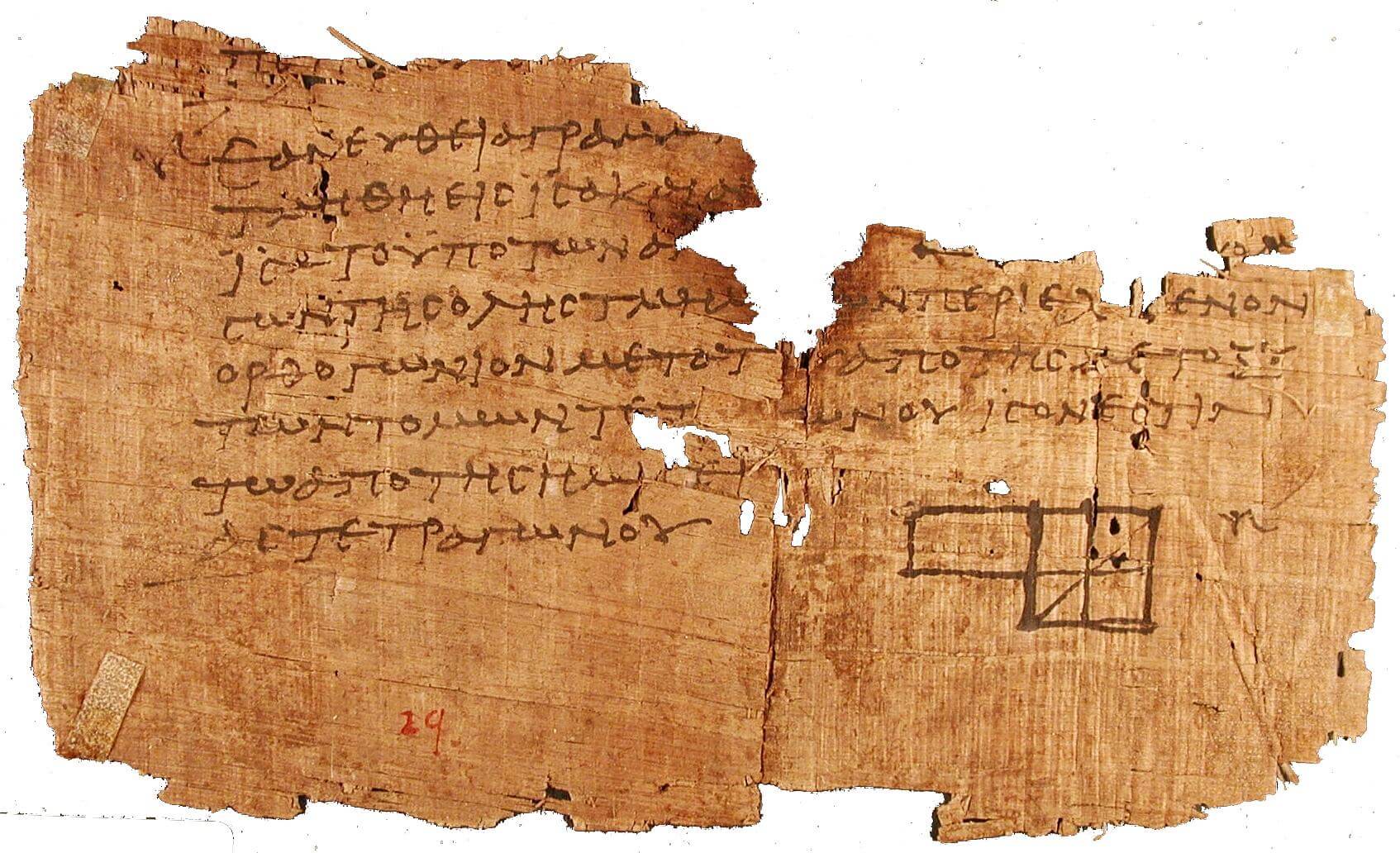
A page only holds if someone carries it. Each copy either kept the declared page intact or did not. The oldest physical witness anyone has found is a scrap of papyrus dug out of a rubbish mound at Oxyrhynchus, in Egypt, by the excavators Grenfell and Hunt in 1897. It carries the statement of one proposition from Book II with a small unlabeled diagram beside it, and no proof. Some scholars have dated the handwriting to within a century of the Year One; others to two or three centuries later.4 The scrap now lives at the University of Pennsylvania under the inventory number E 2748. Historian David Fowler estimated that less than one percent of Euclid's Greek text survives from any source older than the year 888.
What survived instead was the text as a relay, and the first hand in the relay pressed hardest. In the fourth century CE, Theon of Alexandria, father of the philosopher Hypatia, edited Elements with textual changes and some additions. He did not hide the work. In his commentary on Ptolemy, he noted of one result that it "has been proved by me in my edition of Elements, at the end of the sixth book." An editor recording his own intervention, in his own hand.
Theon’s version succeeded so completely that it drove older copies out of existence. For the next fourteen centuries, every Greek copy anyone read, and every Arabic and Latin translation made from the Greek, descended from his edition. The manuscripts announce it themselves, carrying titles that declare them "from the edition of Theon" or "from the lectures of Theon." The philologists call copies that descend from his edition Theonine.5
What Theon did deserves a moment’s weight. He changed a book whose whole authority rested on declared commitments, and he declared the change. For fourteen centuries, the remark read as a scholar's housekeeping. It was a fingerprint: a mark that sets one line of copies apart, waiting for a match.
The carriers were not one civilization. In Baghdad, al-Hajjaj ibn Yusuf ibn Matar translated Elements into Arabic twice, once for each of two caliphs, and a third translation followed before the century was out.6 Three full translations inside roughly a hundred years, commissioned from the top of the state. Cultures do that for instruments they intend to use, and Elements was used.
In that same ninth century, in Constantinople, a scribe named Stephen the Clerk copied the thirteen books of Elements onto parchment for Arethas of Patras. Arethas paid fourteen gold coins for the work. The last stroke went down in September of the year 888. A scholar paid gold for a geometry text already more than a thousand years old, and the payment is its own evidence of what the book had become.
An authoritative catalogue calls it the oldest dated manuscript of a classical Greek author. You can still see the volumes today. Since 1804, they have sat in the Oxford’s Bodleian Library under the shelfmark MS D'Orville 301.7 They contain all thirteen books. Euclid's opening page crossed the ninth century on parchment; the fifth postulate as visible to Arethas as it is to you.
D ‘Orville 301 is a copy of Theon's edition, like nearly everything else. One other ninth-century copy, sitting in the Vatican, was not. For nearly a thousand years, that difference remained invisible.
Meanwhile the book kept moving west by the long way around. Western Europe had lost Elements almost entirely, holding little more than fragments of a Latin translation from around 500. About 1120, the English scholar Adelard of Bath translated Elements from Arabic into Latin. He worked from an Arabic version produced in Baghdad, rather than from the Greek—almost certainly using a copy obtained in Spain.8 A page composed in Alexandria returned to Europe through Constantinople, Baghdad, and Spain, fourteen centuries after it was written, wearing its third language.
Then the printing press arrived. In May 1482, in Venice, the printer Erhard Ratdolt published the first printed edition of Elements, using the Latin text descended from Adelard's translation as edited by Campanus of Novara. In his preface, dedicating the book to the doge Giovanni Mocenigo, Ratdolt explained that printing the geometrical diagrams had presented particular technical difficulties, which is a printer's way of saying he had solved a problem nobody had solved before.
The difficulty was worth Ratdolt’s trouble. A geometry text without its figures is a wall of unsupported prose, and the whole point of this book, from the first page forward, is that nothing in it stands unsupported. Whoever printed Elements had to print the evidence, too. The figures stood beside the words they supported, the page's old discipline surviving its first change of medium. From that font, modern versions poured. Well over a thousand editions have followed since 1482—a total said to trail only the Bible.9
The last two carriers were scholars, and they closed the loop Theon opened in the fourth century. After Napoleon's Italian campaign (1796-1797), Greek manuscripts were taken from the Vatican to Paris by an agent who searched the Holy City, in Augustus De Morgan's words, "with the eye of a hawk and the nose of a greyhound for spoil."
In 1808, François Peyrard, preparing a new edition of Euclid, examined the Paris haul and noticed that one manuscript, the ninth-century codex now known as Vatican graecus 190, lacked an addition to the text that Theon had mentioned making. Nearly every other manuscript carried that addition. The Vatican codex did not, which meant it descended from a version older than the edition that supposedly drove all others out of existence.
Theon's remark sat in the record for fourteen centuries, waiting for a hand to match it, and Peyrard matched it. The paperwork shows how seriously they took the find. When the looted manuscripts were due to be returned, permission was obtained for the Vatican codex to remain in Peyrard's hands until his edition was completed. The first volume appeared in 1814. Between 1883 and 1888, the philologist J. L. Heiberg rebuilt the Greek text in five volumes. He based the reconstruction on the Vatican codex and nearly all the other known manuscripts,. His text remains the standard, the text beneath every serious modern translation, including the English quoted here.10
Across that whole itinerary, one thing remained constant. The carriers changed language, alphabet, religion, and technology, traveling from a rubbish mound to a caliph's court, from a scribe's September colophon to a Venetian pressroom, and finally to a philologist's apparatus. Any hand in the chain could have trimmed the front matter away, as handbooks do, keeping the useful propositions and shedding what looks like philosophical throat-clearing. Nobody voted on this. No institution was charged with protecting the front matter. There was no office of the postulates. Its preservation was distributed across a thousand years of individually mortal hands, each with cheaper options. None of the copies that became the tradition took them.
III. The assumption in the open
Why does the fifth postulate matter so much? Because of what it carries. Grant it, and the familiar geometry follows: a geometry in which parallel lines keep their distance, the angles of every triangle add up to two right angles, and the plane behaves as surveyors and builders need it to behave. Refuse it, and none of that is available on the strength of the other four. The theorem of Pythagoras stands among its dependents. So does the whole practice of similar figures, the scaling up and scaling down that lets a drawing stand for a field or a small model stand for a large design. The fifth postulate is where flat space lives on the page.
Readers responded the way readers respond to a visibly expensive assumption. They tried to get it cheaper. For over two thousand years, in the phrasing of the UNESCO nomination file that now attends Bolyai's little 1832 book, The Science Absolute of Space, many of the best mathematicians tried to prove Euclid's parallel postulate from the rest, to show that the forty-five words were a theorem in disguise and that the page could stand on its other thirty-two commitments.11 Every attempt failed, and the failures, made in Alexandria, Baghdad, and Europe across twenty-one centuries, accumulated into a literature of their own, each generation's dead end filed where the next generation could read it. Nobody proposed deleting the postulate, because the deletion would have taken the geometry's best results with it. The ambition was always tidier than that: to show that the fifth was contained in the rest all along, a hidden consequence rather than a standing debt.
Because the assumption was declared, everyone who attacked the problem across those centuries was attacking the same forty-five words in the same position on the same page. The target never moved. An assumption buried in phrasing can be argued about forever, because no two readers are certain they dispute the same thing. An assumption stated in the open can be besieged. What Euclid's page offered was a marked location for doubt, and twenty-one centuries of attempted proofs show what readers can do with one.
Anyone who has audited anything, such as a ledger or a piece of software, knows the two conditions from the inside. There is the document that shows you where to press, and there is the document you must take whole or leave whole. Only the first kind can be improved by its readers. A declared assumption gives scrutiny a place to begin. It cannot, by itself, preserve a page or system. That takes hands and institutions.
IV. The departure
What finally happened at the marked location was stranger than a proof. Between 1826 and 1854, three men working far apart, a Russian in Kazan, a Hungarian army engineer in Transylvania, a German in Göttingen—stopped treating the fifth postulate as a debt to be discharged and began treating it as a door. None of the three was reading a rare book. By then, Elements had been in print for roughly three and a half centuries and lay beneath the common training of European mathematics. The marked page was among the most public pages in their profession, which is what makes what happened next a fact about the page rather than an accident of discovery.
Nikolai Lobachevsky went first in public. In February 1826, he read a paper to the department of physics and mathematics at Kazan. Between 1829 and 1830, he published a series of five papers under the title "On the Principles of Geometry" in the Kazan Messenger, a journal that Britannica describes, a bit cruelly, as a minor periodical.12 The first systematic published development of a geometry in which Euclid's fifth postulate fails appeared at the edge of the mathematical world—in a venue few working mathematicians would ever see. What the papers contained was coherent geometry. Through a point outside a line, more than one parallel could be drawn. The angles of a triangle summed to less than two right angles. There was no contradiction anywhere. That was the entire point.
The fifth postulate had resisted proof for two thousand years because geometries exist in which the other assumptions hold and it does not.
János Bolyai arrived independently, by the least commanding route of all. He was an army engineer, posted to the fortification directorate at Temesvár, in Transylvania. On November 3, 1823, he announced the discovery in a letter to his father, Farkas Bolyai. Farkas’s two-volume textbook would eventually carry the son's discovery into print.
Print took nine more years. In 1832, the work appeared in Latin, in forty-three compressed sections, as an appendix bound into the first volume of Farkas Bolyai's Tentamen, printed at Marosvásárhely. Its title begins with Appendix and promises, in the Latin of the day, “the absolutely true science of space.”13
The title pulls in two directions: an afterthought yoked to absolute truth. Both descriptions tell the truth. The name on the volume is the father's. The discovery inside the appendix is the son's.
Bernhard Riemann's turn came in a lecture hall. For his Habilitation lecture at Göttingen—the public trial by which a German university then licensed a scholar to teach—Riemann proposed three topics. Carl Friederich Gauss, his senior professor, chose the one on geometry, against Riemann’s expectations. His lecture, "On the Hypotheses That Lie at the Foundation of Geometry," was delivered on June 10, 1854, with Gauss in the audience, and it widened the question past anything Euclid or Lobachevsky had asked, treating flat space and curved spaces alike as members of one family, with the choice among them answerable to measurement rather than to the front page of a book. A report of the lecture was not published until 1868, after Riemann's death. The U.S. Naval Academy's mathematics department states the afterlife in one sentence. Riemann's vision was realized by Einstein's general theory of relativity sixty years later.14
None of the three caught Euclid in a mistake. The fifth postulate was not false, and the structure raised on it did not fall. It stands today as it stood for Arethas, sound geometry for the surfaces it was written for. What the three of them showed was that the postulate was a choice, one road where the page had honestly marked a fork, and they built their new geometry at the marked place and at no other place on the page. That specificity is the measure of the page. Readers had been told for two thousand years exactly where the foundation was heaviest, and when the departure finally came, it came through that spot.
The new geometries needed a name, and the name that stuck was non-Euclidean, a word that defines a whole field by its distance from one man's book. His name slipped loose of him and became a fixed point that later work is measured from, twenty-one centuries after he wrote.
In October 1848, the British mathematician Augustus De Morgan wrote, "There never has been, and till we see it we never shall believe that there can be, a system of geometry worthy of the name, which has any material departures (we do not speak of corrections or extensions or developments) from the plan laid down by Euclid." Lobachevsky's papers and Bolyai's Appendix were in print by then and essentially unread in western Europe. Sixty years later Sir Thomas Heath, writing with the full history of the departure in front of him, set De Morgan's sentence at the head of his own edition of Elements and declined to revise it.15 What De Morgan praised was Euclid’s plan: the architecture and the declared assumptions, not the truth of the propositions.
The page held. What moved, when something finally moved, moved at the one place the page had marked.
V. The page now
My field, enterprise intelligence systems and autonomous decision science, sorts its systems into glass boxes and black boxes, and the sorting is cleaner than the systems are. A system may expose its constraints and what drove a result while leaving its data sources and override authority undisclosed.16 Each commitment stands declared where an examiner can reach it or buried, the way a bad geometry text buries its parallel assumption in the phrasing. The difference between declared and buried decides whether a result can be examined or must be believed.
The vocabulary is new and the condition is not. A model whose commitments are undeclared is a Theonine edition without the remark, one editor's version standing in for the original and driving the alternatives out of circulation. Take the declaration away and the takeover is permanent, even with the older copy still on the shelf. A declared assumption in a model is not only where trust is checked but where the next improvement enters.
Theon's remark, the record of his own edit, eventually served a reader. Not Theon, who got nothing for it, and nobody for fourteen centuries after him. The reader was Peyrard, a man the editor could not have imagined, examining manuscripts a war had carried to Paris. A declared commitment serves the examiner at the table and waits for the examiner not yet born.
Euclid's own page does not pass that examination clean. In the sentence that follows De Morgan's in the 1908 preface, Heath grants that Euclid made further tacit assumptions in certain propositions, "content apparently to let their truth be inferred from observation of the figures as drawn." The page that priced its costliest assumption at forty-five words still leaned on its diagrams for commitments it never wrote down. Heath names the repair in the same breath, the "much valuable work" done on the continent in the investigation of the first principles across the interval, 1848 to 1908. Moritz Pasch stated the unnoted assumptions in 1882 and set a rule stricter than Euclid's own. Nothing may be inferred from the figure as drawn. Every step must follow from the stated axioms and from nowhere else. Hilbert finished the repair on that foundation in the Grundlagen der Geometrie of 1899.17
Pasch's rule reads like pedantry until a machine enters the room. A machine cannot look at the figure. Whatever a machine reasons from must be declared to it, all of it, in advance, and the discipline of declaration that Euclid began and the continental program completed is the form machine inference inherits. My field built a whole discipline on that requirement, knowledge engineering, the hand-writing of common-sense knowledge as explicit statements a machine can reason over, because everything a person knows without saying is a figure the machine cannot see. What Pasch did for Euclid's diagrams, the knowledge engineers did for human common sense. Heath drew his own conclusion in the same sentence of his 1908 preface. Once the first principles are disposed of, the body of doctrine "does not, and from the nature of the case cannot" differ substantially from the Elements. The repair went down to the foundations and the plan above them never moved.
The Dover paperback of Heath's translation and introductions to Euclid's Elements is on the desk beside the machine as I write, Volume I, Books I and II, second edition unabridged. Heath translated the Greek that Heiberg rebuilt on the manuscript Peyrard recognized. Behind those two stand Ratdolt's Venetian press, Adelard's Latin, the Arabic of Baghdad, the parchment Stephen the Clerk finished in 888, and the scrap from the rubbish mound. That chain of hands ends, for now, at the copy on this desk.
I am under this requirement myself as I build enterprise intelligence systems. A recommendation from one of those systems is not permitted to arrive bare. Whoever receives one has to be able to open the analysis and confirm that the mathematics and the data underneath it hold up under rigorous scrutiny. The machine that recommended deleting week 32 was built under that rule.
We built the machine’s model out of readable parts, a method called high dimensional model representation, which assembles its picture of a tangled system from pieces a person can inspect, the effect of each variable on its own and the effect of small sets of variables moving together. The search we ran over those parts was a constraint-based non-linear optimization, and because it searched the readable pieces, every recommendation it returned arrived attached to the contributions that produced it.18 If the recommendations were ever going to be examined rather than believed, the reasons had to come out of the same structure the recommendations did.
The machine was not catching errors. The week 32 promotion performed, and the recommendation to delete it stood anyway, because the budget it consumed bought materially more in week 41, and the machine-made trades of that shape hundreds of times across the calendar, good promotions given up for better ones. A cost like that has no existence promotion by promotion. It comes into view only when the year is held whole, which is why the optimization considers the whole calendar at once. A recommendation to stop doing something that works is exactly the recommendation that cannot travel on trust. The examiner has to see the displaced money earning more somewhere else, or the answer is no.
So I carried the recommendations to a large retailer and explained them there, with the manufacturer's retail account team in the room, the people who would have to carry the explanation forward after the meeting ended. Provable was only the first requirement. The recommendations also had to make sense to everyone at the table, on the manufacturer's side and on the retailer's, and the ones that proposed stopping something successful had the farthest to travel.
I opened the analysis at the week 32 trade: the promotion to be dropped and the better use its budget had elsewhere in the year. The retailer said that they had intuited this result but had never been able to prove it. What they had suspected, without being able to demonstrate, that some of their good weeks were quietly eating their better ones.
Nobody asked the retailer to believe the recommendation. The means to examine it were on the table, and the examination produced assent. Euclid's page demonstrates the limit. It has lain open for two thousand years while carrying assumptions Pasch had to state in 1882 and Heath was still identifying in 1908.
The system built the analysis in roughly twenty minutes. That number measures the machine's share of the work, and nothing else. What stays with me from that room is a person agreeing to stop doing something that worked because they had taken the argument apart and watched it hold. The examiner's question is Euclid's first page, asked at machine speed.
The glass-box/black box divides the evidence, too. Euclid's thirty-three commitments, Pasch's rule of 1882 that nothing may be inferred from the figure as drawn, Hilbert's completion of 1899, the published decomposition cited in the endnote, the granted specification of a system in this domain that stands in the public record under my name,19 all of it sits on the open side of that line, where any reader can press on it.
The record establishes, with no help from testimony, that the reasoning behind a consequential result can be made inspectable, because the page has been meeting that requirement in public for twenty-three centuries. The meeting with the retailer lies on the other side of that line. No reader can reopen that room. It remains testimony: one examiner taking an argument apart and agreeing with what they found. That is what a witness can offer. The requirement remains mine to keep’; the testimony is not proof that it has been kept.
The proof remains where it has always been: on the open page, wherever the page is tonight.
The page held because the people who carried it could always see what they were carrying.
Stephen DeAngelis
Princeton, NJ
August 2026
About the Author
Stephen F. DeAngelis is the founder, president, and CEO of Enterra Solutions and Massive Dynamics, two companies that apply artificial intelligence and advanced mathematics to complex enterprise challenges. His work spans international relations, national security, and commercial technology, with visiting research affiliations at Princeton University, Department of Chemistry, the Computing and Computational Sciences and National Security Directorates of the Oak Ridge National Laboratory, the Software Engineering Institute at Carnegie Mellon University, and the MIT Computer Science and Artificial Intelligence Laboratory. He holds patents in autonomous decision science.
Endnotes:
1 The engagement is bound by client confidentiality. Neither company is named, and no dollar figure, market size, industry sub-sector, or region is given, and the account is offered as testimony rather than record. What is claimed is only what the author can attest and has authorized for print. The year was 2020. The calendar covered every product line and every retail planning account, week by week across a year, solved as one problem. Thirty-one constraints were optimized simultaneously. The solution space ran to 186 million combinations, arising from the number of SKUs, the number of retail planning accounts, the weeks of the year, and the feature and display options that had to be accounted for. The mathematics behind the model, and the sense in which its recommendations could be examined, are set out in the note attached to the closing section, where the engagement returns.
2 The biographical record is as thin as stated. Thomas Heath opens his introduction with it: "As in the case of the other great mathematicians of Greece, so in Euclid's case, we have only the most meagre particulars of the life and personality of the man. Most of what we have is contained in the passage of Proclus' summary relating to him," which places Euclid "in the time of the first Ptolemy." Heath grounds the Alexandria connection on a different witness: "One thing is however certain, namely that Euclid taught, and founded a school, at Alexandria. This is clear from the remark of Pappus about Apollonius." Sir Thomas L. Heath, The Thirteen Books of Euclid's Elements, Vol. I, Chapter I, "Euclid and the Traditions About Him," pp. 1 to 2, full text at https://archive.org/stream/euclid_heath_2nd_ed/1_euclid_heath_2nd_ed_djvu.txt. D. E. Joyce of Clark University gives the same assessment: http://aleph0.clarku.edu/~djoyce/elements/Euclid.html. On the lateness of the sources, see the St Andrews MacTutor overview: https://mathshistory.st-andrews.ac.uk/SH/euclid_sh.pdf.
3 The counts are checkable against any complete text of Book I. Joyce's guide states that Book I contains 23 definitions, five postulates, five common notions, and 47 propositions: http://aleph0.clarku.edu/~djoyce/elements/bookI/guide1.html. The Purdue University course text of Book I, from which this essay's quotations are taken, prints the same front matter and lists 48 propositions: https://www.math.purdue.edu/~goldberg/Math460/Euclid-BKI.pdf. The proposition-count discrepancy between the two sources is real, turns on how the final propositions are divided, and is why this essay states no proposition count. The English is the standard text descended from Thomas Heath's translation.
4 Papyrus Oxyrhynchus 29 was excavated by Grenfell and Hunt in 1897. It carries the statement of Book II, Proposition 5, with an unlabeled diagram and no proof, and is held at the University of Pennsylvania as E 2748. Its date is genuinely disputed. The editors' own first publication assigns it to the third or fourth century: "From the character of the handwriting, which is a sloping rather irregular informal uncial, this papyrus may be assigned to the latter part of the third or the beginning of the fourth century." B. P. Grenfell and A. S. Hunt, The Oxyrhynchus Papyri, Part I (1898), no. 29, p. 58, https://archive.org/download/oxyrhynchuspapyr01gren/oxyrhynchuspapyr01gren_djvu.txt. Bill Casselman of the University of British Columbia records the redating: "It was dated by its original finders to around 300 A.D., but a more recent judgment by Eric Turner places it between 75-125 A.D." The redating is therefore attributed to Turner through Casselman rather than taken from Turner at first hand. David Fowler's estimate, that less than one percent of Euclid's text in Greek survives from any source earlier than 888, is on the same page: https://personal.math.ubc.ca/~cass/Euclid/papyrus/.
5 Theon of Alexandria (c. 335 to 405 CE), the father of Hypatia, edited the Elements with textual changes and additions, and said so himself. Heath, drawing his whole chapter on the text from Heiberg's critical edition, records the evidence: "most of the MSS. of the Greek text prove by their titles that they proceed from the recension of the Elements by Theon; they purport to be either 'from the edition of Theon' or 'from the lectures of Theon.'" Theon's commentary on Ptolemy contains what Heath calls "a passage of the greatest importance in this connexion": "But that sectors in equal circles are to one another as the angles on which they stand has been proved by me in my edition of the Elements at the end of the sixth book." Heath's gloss: "Thus Theon himself says that he edited the Elements and also that the second part of VI. 33, found in nearly all the MSS., is his addition." The takeover was all but total. Heath describes "the ante-Theonine variety of which the Vatican Ms. 190 (P) is the sole representative." That single exception surfaced in 1808: "when Peyrard found in the Vatican the MS. 190 which contained neither the words from the titles of the other MSS. quoted above nor the interpolated second part of VI. 33, he was justified in concluding, as he did, that in the Vatican MS. we have an edition more ancient than Theon's." Sir Thomas L. Heath, The Thirteen Books of Euclid's Elements, Vol. I, Chapter V, "The Text," pp. 46 to 47, and Chapter VIII, p. 103, full text at https://archive.org/stream/euclid_heath_2nd_ed/1_euclid_heath_2nd_ed_djvu.txt. Heath's own note on his sources for that chapter reads: "The material for the whole of this chapter is taken from Heiberg's edition of the Elements, introduction to vol. v."
6 The Arabic transmission is set out in Heath's Chapter VII, "Euclid in Arabia." The text reached the Islamic world from Byzantium by diplomacy: "We are told by Haji Khalfa that the Caliph al-Mansur (754 to 775) sent a mission to the Byzantine Emperor as the result of which he obtained from him a copy of Euclid among other Greek books, and again that the Caliph al-Ma'mun (813 to 833) obtained manuscripts of Euclid, among others, from the Byzantines." On the translations: "The version of the Elements by al-Hajjaj b. Yusuf b. Matar is, if not the very first, at least one of the first books translated from the Greek into Arabic. According to the Fihrist it was translated by al-Hajjaj twice; the first translation was known as 'Haruni' ('for Harun'), the second bore the name 'Ma'muni' ('for al-Ma'mun') and was the more trustworthy." And on the third: "The Fihrist goes on to say that the work was next translated by Ishaq b. Hunain, and that this translation was improved by Thabit b. Qurra." Sir Thomas L. Heath, The Thirteen Books of Euclid's Elements, Vol. I, Chapter VII, pp. 75 to 76, https://archive.org/stream/euclid_heath_2nd_ed/1_euclid_heath_2nd_ed_djvu.txt.
7 The Clay Mathematics Institute, which hosts images of the manuscript, states that MS D'Orville 301 contains the thirteen books of Euclid's Elements, copied by Stephen the Clerk for Arethas of Patras in Constantinople in 888 AD, and kept in the Bodleian Library at Oxford: https://www.claymath.org/online-resources/euclids-elements/. The Bodleian's own catalogue record is at https://medieval.bodleian.ox.ac.uk/catalog/manuscript_4146. The September completion and the price of fourteen gold coins are given in the Clay Institute's 2004 annual report feature on the manuscript: https://www.claymath.org/library/annual_report/ar2004/04report_featurearticle.pdf. The description of the codex as the oldest manuscript of a classical Greek author to bear a date comes from the Bodleian exhibition catalogue The Survival of Greek Literature, as relayed with the 1804 D'Orville acquisition history at https://www.historyofinformation.com/detail.php?id=208. That it carries Theon's recension, the commoner version of the text, is noted at https://www.medievalists.net/2015/08/medieval-treasures-from-the-digital-bodleian/. This essay does not call it the oldest complete Euclid, because Vatican graecus 190 is also a ninth-century manuscript and the sources consulted do not settle their relative ages. The dated colophon is the claim, and the dated colophon is verifiable.
8 Heath dates the first extant Latin translation. Of Adelard of Bath he writes, "He travelled to Spain, Greece, Asia Minor and Egypt, and acquired a knowledge of Arabic, which enabled him to translate from the Arabic into Latin, among other works, the Elements of Euclid. The date of this translation must be put at about 1120." Sir Thomas L. Heath, The Thirteen Books of Euclid's Elements, Vol. I, Chapter VIII, pp. 92 to 93, https://archive.org/stream/euclid_heath_2nd_ed/1_euclid_heath_2nd_ed_djvu.txt. On the state of the text in the Latin West before him, Heath is blunt about the Boethian material: "The so-called Geometry of Boethius which has come down to us by no means constitutes a translation of Euclid," and the surviving two-book compilation "is not genuine, but appears to have been put together in the 11th c., from various sources," retaining only enunciations and the proofs of I. 1 to 3. The Spanish provenance is an inference rather than a record. The MacTutor biography notes that "There is no record of Adelard visiting Spain, but many scholars have concluded that he must have visited that country to have had access to the Spanish-Arabic texts which he translated," and identifies the source: "Adelard seems to have taken as his source one of al-Hajjaj's Arabic translations from Greek." https://mathshistory.st-andrews.ac.uk/Biographies/Adelard/.
9 The Library of Congress copy page for the 1482 Venice printing records the May 1482 publication, Ratdolt's preface dedicating the work to the doge Giovanni Mocenigo (1408 to 1485), and Ratdolt's own remark that printing the geometrical diagrams presented particular technical difficulties: https://www.loc.gov/resource/gdcwdl.wdl_18198/. The Folger Shakespeare Library's description, first full-length printed book with extensive mathematical illustrations, and the revision of the diagrams from presumed woodcuts to shaped metal lines, is at https://www.folger.edu/explore/collection-highlights/mathematical-diagrams-from-1482/. The Smithsonian Libraries note the colophon date of 25 May 1482 and the text's descent through Campanus of Novara from the Adelard line: https://www.sil.si.edu/ondisplay/heraldsofscience/heralds_books.cfm?category=mathematics. Reports of the diagram count in the 1482 edition differ across descriptions, so this essay gives none. The scale of the printed tradition is not in doubt, though the exact count is an estimate rather than a census. Christine Roughan, describing the Digital Euclid project in Digital Classics Online 2 (2016), writes that the Elements "appears in hundreds of manuscripts; combined its manuscript and print editions number well over one thousand and span languages from across the globe": https://journals.ub.uni-heidelberg.de/index.php/dco/article/download/23459/21866. The State Library Victoria puts the printed figure the way it is usually put, that the Elements "remains the world's second-most published book (after the Bible), with more than 1000 editions issued from 1482 to the present day": https://blogs.slv.vic.gov.au/arts/books-that-changed-the-world/. The standing bibliography of the early period is Charles Thomas-Stanford, Early Editions of Euclid's Elements (Bibliographical Society, London, 1926), which catalogues editions to 1600, now superseded for the early period by Benjamin Wardhaugh, with Philip Beeley and Yelda Nasifoglu, Euclid in Print, 1482 to 1703, published by the Bibliographical Society, which "lists, in intention, every edition of one or more works attributed to Euclid printed in any language down to the year 1703": https://bibsoc.org.uk/euclid-print-1482-1703/. The comparison to the Bible is a commonplace rather than a counted result, and is reported here as such.
10 The recovery of the pre-Theonine text deserves its own small appendix, because it is the part of the story where the transmission chain audits itself. Theon's fourth-century edition became the tradition; for fourteen centuries, essentially every Greek manuscript anyone consulted descended from it. But Theon had mentioned, in his own writing, an addition he made to the text of the Elements, and that remark sat in the record like a fingerprint waiting for a hand to match. A word on the label. Theonine is the philologists' adjective for manuscripts descending from Theon's edition, and until 1808 it would have been a distinction without a difference, since every known copy qualified. The hand arrived by way of a war. After Napoleon's Italian campaign, Greek manuscripts were taken from the Vatican to Paris, Gaspard Monge having, in Augustus De Morgan's words, searched the city "with the eye of a hawk and the nose of a greyhound for spoil," finding the manuscript in question among others sent north. In 1808 François Peyrard, preparing a new edition of Euclid, noticed that this codex, Vatican graecus 190, lacked the addition Theon had referred to, and that it diverged from the ordinary Theonine copies in many readings besides; he concluded that he had before him a more ancient version of Euclid's text. De Morgan's review describes the manuscript as "having all the characters of manuscripts at the end of the ninth century," and records a detail that says everything about how seriously the find was taken: when the time came for restitution of the looted manuscripts, permission was obtained for this one to remain in Peyrard's hands until his edition was completed, one volume having appeared in 1814. Peyrard's edition was published at Paris in three volumes, 1814, 1816, and 1818; the review is De Morgan's, in the Dublin Review 11 (1841), pp. 330 to 355, available at https://www.maths.tcd.ie/~dwilkins/Courses/MAU23302/tmp/ReviewOfPeyrardEuclid_DeMorgan1841.pdf. The manuscript went back to the Vatican, where it remains, digitized at https://digi.vatlib.it/view/MSS_Vat.gr.190.pt.1, and it carries the siglum P in the critical apparatus, in Peyrard's honor. The apparatus of a critical edition deserves a sentence here, because it is the page's discipline applied to the page's own history. Beneath the reconstructed text, the editor records the variant readings of the witnesses, manuscript by manuscript, so that a reader can see at every disputed word what the choices were and which one the editor took; nothing in the reconstruction asks to be accepted on faith. The final link is J. L. Heiberg, who between 1883 and 1888 published the critical text of the Elements with Teubner of Leipzig, five volumes in Greek and Latin, reconstructed on the basis of P and nearly all other known manuscripts: https://www.historyofinformation.com/detail.php?id=2363. The volumes are catalogued at https://catalog.perseus.org/catalog/urn:cts:greekLit:tlg1799.tlg001 and digitized copies are indexed at https://onlinebooks.library.upenn.edu/webbin/book/lookupid?key=olbp69993. Heiberg's text sits under Heath's English and under essentially every serious modern translation. The moral belongs in the body of the essay but bears repeating here in the plainer register of an endnote: the tradition was strong enough to carry the book for a thousand years and honest enough, in the end, to catch its own editor.
11 The UNESCO Memory of the World nomination file for Bolyai's Appendix states it directly: "For over two thousand years many of the best mathematicians tried to prove Euclid's parallel postulate (or axiom)." https://media.unesco.org/sites/default/files/webform/mow001/hungary_bolyai.pdf.
12 The publication record for Lobachevsky is given in the Christie's catalogue description of the Haskell Norman copy of the Kazan Messenger papers: "O nachalakh geometrii" appeared as a series of five papers in the Kazanskii vestnik, published by Kazan University Press in 1829 and 1830, the substance having first been read to the department of physics and mathematics at Kazan in February 1826: https://www.christies.com/en/lot/lot-5331953. The Bulletin of the American Mathematical Society's 1930 retrospect calls the series "the first systematic and rigorous development of the subject to be published": https://projecteuclid.org/journals/bulletin-of-the-american-mathematical-society/volume-36/issue-2/Non-euclidean-geometry-a-retrospect/bams/1183493815.pdf. Britannica's entry for the work describes the venue as "a minor Kazan periodical," which is quoted in the body as a characterization rather than relied on as a finding: https://www.britannica.com/topic/On-the-Principles-of-Geometry. That the venue was provincial by necessity rather than by choice is confirmed independently by the MacTutor biography, which records that the work "was published in the Kazan Messenger but rejected by Ostrogradski when it was submitted for publication by the St Petersburg Academy of Sciences": https://mathshistory.st-andrews.ac.uk/Biographies/Lobachevsky/.
13 The UNESCO nomination file gives the title, Appendix, scientiam spatii absolute veram exhibens, the imprint at Marosvásárhely in 1832, the appearance of the Appendix in the first volume of Farkas Bolyai's two-volume Tentamen, the existence of an 1831 preprint, the Latin of the text, and the biographical detail that János Bolyai announced the discovery in a letter to his father on November 3, 1823, while serving as an army engineer assigned to the fortification directorate at Temesvár: https://media.unesco.org/sites/default/files/webform/mow001/hungary_bolyai.pdf. The Hungarian Academy of Sciences maintains a page on the work at http://bolyai.mtak.hu/en/appendix.htm. Descriptions of the printed Appendix's page count differ across sources, so this essay gives the section count, forty-three, instead.
14 The United States Naval Academy mathematics department page on Riemann records that he proposed three topics for his Habilitation lecture, that against his expectations Gauss chose the one on geometry, that the lecture was given on June 10, 1854, that a report of it was not published until 1868, after his death, and that "Riemann's vision was realized by Einstein's general theory of relativity sixty years later": https://www.usna.edu/Users/math/meh/math/riemann.php. Dedekind's hand is recorded in the published title itself, which reads "Über die Hypothesen, welche der Geometrie zu Grunde liegen. (Mitgetheilt durch R. Dedekind)," communicated by R. Dedekind, in Abhandlungen der Königlichen Gesellschaft der Wissenschaften in Göttingen 13 (1868), pp. 133 to 152: https://eudml.org/doc/135760. Trinity College Dublin's School of Mathematics, which hosts the text, states it plainly: "published by Richard Dedekind, after Riemann's death": https://www.maths.tcd.ie/pub/HistMath/People/Riemann/Geom/. The German text is also at https://www.math.ru.nl/werkgroepen/gmfw/bronnen/riemann1.html.
15 The sentence opens Heath's preface to the first edition, dated November 1908, where it stands as the epigraph and where Heath adds that he does not think De Morgan, had he been living, "would have seen reason to revise the opinion so deliberately pronounced sixty years ago." De Morgan wrote it in October 1848 in "Short supplementary remarks on the first six Books of Euclid's Elements," published in the Companion to the Almanac for 1849. The edition is Sir Thomas L. Heath, The Thirteen Books of Euclid's Elements, Translated from the Text of Heiberg with Introduction and Commentary, first edition Cambridge University Press 1908, second edition revised with additions 1926, unabridged republication by Dover Publications, New York, 1956, Vol. I, Introduction and Books I and II. Heath's preface to the second edition takes the same position in his own words, calling the Elements "the twenty-two-centuries-old book which, notwithstanding its imperfections, remains the greatest elementary textbook in mathematics that the world is privileged to possess." The first-edition preface is transcribed at https://mathshistory.st-andrews.ac.uk/Extras/Heath_Euclid/ and both prefaces appear in the full text of the Dover edition at https://archive.org/stream/euclid_heath_2nd_ed/1_euclid_heath_2nd_ed_djvu.txt.
16 Declaration is a necessary condition for scrutiny and not a sufficient one. Declaration alone does not supply two of the conditions scrutiny needs, knowledge of where a system's data came from and knowledge of who may override its results. Two more belong beside them. An examiner needs independent access to the system, and there has to be a remedy when examination finds a fault, because an inspection nobody can act on changes nothing. The historical record supports only a narrower claim. That record shows a declared page surviving scrutiny across twenty-three centuries. It does not show declaration alone producing preservation, improvement, or an institution. The page was necessary to everything this essay describes. Hands, presses, courts, and libraries were necessary too, and the essay has tried to name them.
17 The sentence immediately following the De Morgan passage in Heath's preface to the first edition (November 1908) reads in full: "It is true that in the interval much valuable work has been done on the continent in the investigation of the first principles, including the formulation and classification of axioms or postulates which are necessary to make good the deficiencies of Euclid's own explicit postulates and axioms and to justify the further assumptions which he tacitly makes in certain propositions, content apparently to let their truth be inferred from observation of the figures as drawn; but, once the first principles are disposed of, the body of doctrine contained in the recent textbooks of elementary geometry does not, and from the nature of the case cannot, show any substantial differences from that set forth in the Elements." The interval is 1848, when De Morgan wrote, to 1908, when Heath did. The first-edition preface is transcribed at https://mathshistory.st-andrews.ac.uk/Extras/Heath_Euclid/. The continental work Heath refers to is the axiomatization program. Moritz Pasch's Vorlesungen über neuere Geometrie (1882) stated the assumptions Euclid had left unnoted and demanded that proofs rest on the axioms rather than on the figure as drawn. The Stanford Encyclopedia of Philosophy quotes Pasch's own formulation, that if geometry is to be really deductive the deductions "must everywhere be independent of the sense of geometrical concepts, just as it must be independent of the figures; only the relations specified in the propositions and definitions employed may legitimately be taken into account" (Pasch 1882, p. 98), and adds that "if some proof makes indispensable appeal to the meaning of terms, or to the figures, the inadequacy of that proof will be made manifest": Jeremy Gray and José Ferreirós, "Epistemology of Geometry," https://plato.stanford.edu/entries/epistemology-geometry/. On the tacit assumptions, MacTutor: "He found a number of assumptions in Euclid that nobody had noticed before... no one before Pasch had laid a basis for dealing logically with such observations. These matters may have been considered too obvious; but the result of such neglect is the need to refer constantly to intuition, so that the logical status of what is being done cannot become clear": https://mathshistory.st-andrews.ac.uk/Biographies/Pasch/. On the priority, the Stanford Encyclopedia's survey of nineteenth-century geometry holds that "a truly satisfactory and, if one may say so, serious instance of axiomatization of a branch of knowledge was not available in print until 1882, when Moritz Pasch (b. 1843, d. 1930) published his Lectures on Modern Geometry": https://plato.stanford.edu/entries/geometry-19th/. Hilbert's Grundlagen der Geometrie (1899) cured the remaining defects on the basis of Pasch's work: https://link.springer.com/article/10.1007/s00591-022-00320-3.
18 The mathematics is published. Rabitz, H., and Alis, O. F., "General foundations of high-dimensional model representations," Journal of Mathematical Chemistry 25 (1999), pp. 197 to 233, https://link.springer.com/article/10.1023/A:1019188517934. The paper's move is a decomposition. The output of a system with many inputs is expressed as an ordered hierarchy of component functions, a constant term first, then the contribution of each input acting alone, then the contributions of pairs of inputs acting together, and so on upward, with the governing observation that in real systems the low-order terms carry nearly all of the behavior. The relevance to the passage above is direct. A model built this way has readable parts. When a constraint-based non-linear optimizer searches over such a representation, a recommendation can be traced to named contributions, this variable, that pair of variables moving together, and the tracing is not a summary composed after the fact but the structure of the model itself. In a solution space too large to be re-run by hand and too large to be audited from a record of the search, that structure is the only channel through which the reasons for a recommendation can reach its examiner, which is the sense in which the analysis was introspectable rather than merely fast. The engagement is bound by client confidentiality, as stated in the note attached to the opening; the retailer's remark is reported rather than quoted. The recommendations traded good promotions for better ones, among them the deletion of a well-performing week 32 promotion to fund a materially better one in week 41, a trade made hundreds of times across the calendar. The meeting, the retailer's response, and the assent are reported as witnessed. The system took roughly twenty minutes to build the analysis, and that figure measures the machine's share of the work, nothing more. The mathematics carries the citation. The case carries the witness, and a reader is entitled to weigh the two differently, and should.
19 United States Patent 10,402,868, "Computer-based systems and methods for creating and distributing food and/or drink promotions for targeted consumers based on bids from suppliers and data about the targeted consumers," assigned to Enterra Solutions LLC, named inventors Jason Glazier, Steven Sermarini, and Stephen F. DeAngelis. Filed June 4, 2013, granted September 3, 2019. The specification and the claims are public in full at https://patents.google.com/patent/US10402868. This is not the system described in the passage above, and it does not corroborate the 2020 engagement, which is bound by confidentiality and stands here as testimony rather than as record. What the patent puts on the open side of the line is a full specification in this domain, published under my name years before that engagement, where any reader can read the claims. The claim made from it is that systems of this kind get built and their specifications get published. It is not the claim that any particular engagement went as described.
Share this post