The Fundamental Mathematicians, an interlude in two parts. Part One.
Custody.
A library in Bamberg, Germany, holds two copies of the same arithmetic book. One has purple parchment and lines of silver and gold. In the other, a reader has worked between the lines in a small pointed hand. The author was Boethius, the Roman scholar whose Latin translations helped carry Aristotle's logic into the medieval West. Both manuscripts contain Boethius's arithmetic textbook, not his writings on logic. Someone had to make the book, and someone had to keep finding a use for it.
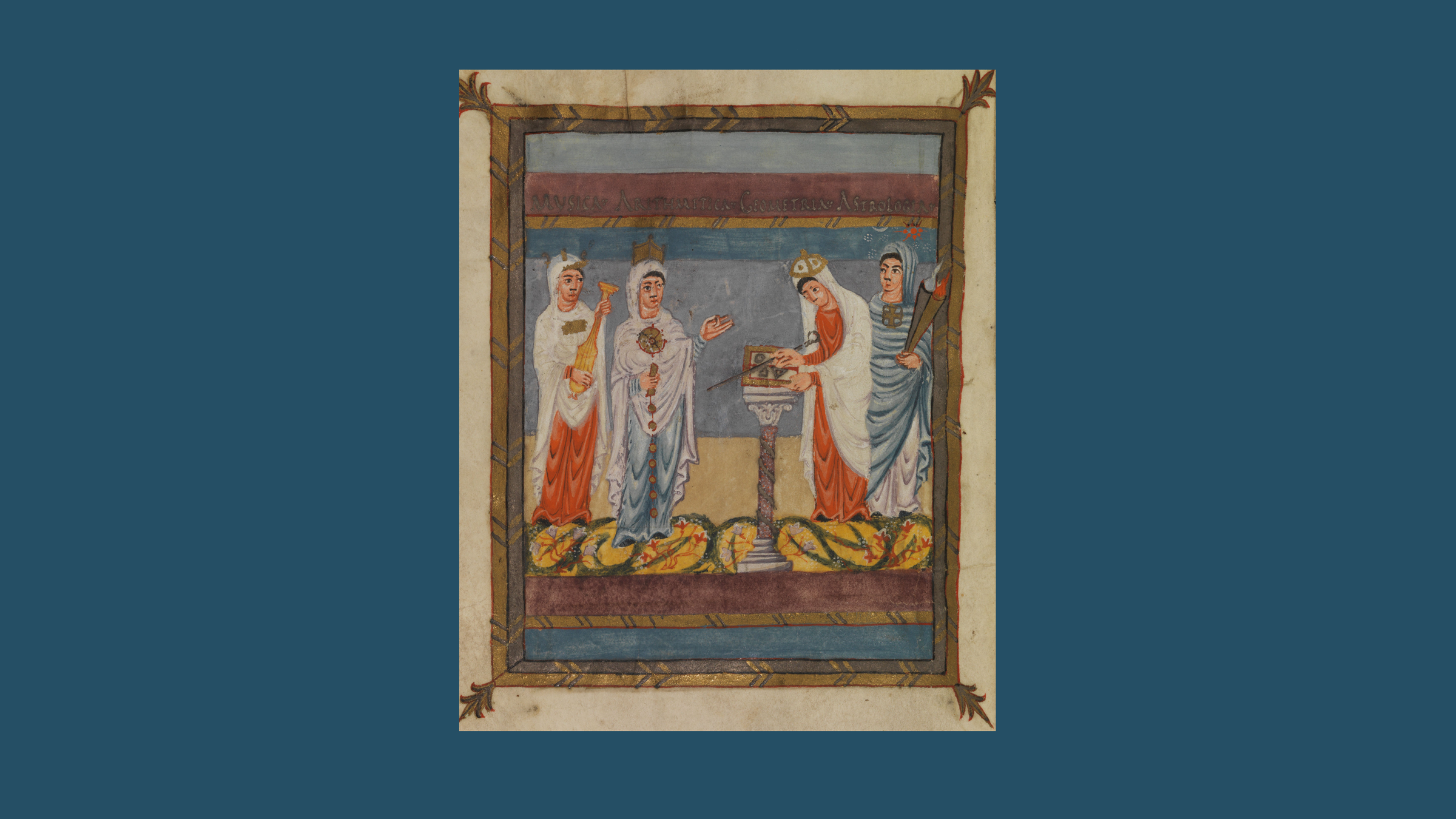
The older one is Bamberg, Staatsbibliothek, Msc.Class.5, a copy of Boethius's De institutione arithmetica on 139 leaves. Across its purple-painted pages, in alternating lines of silver and gold, runs a poem of forty-four lines, broken into three sections and set at the front of the book, in its middle, and at its end. A reader working through the text meets it three times. On one leaf four women stand in a row. One holds a stringed instrument, one counts beads and reckons on the fingers of her left hand, one draws figures with a measuring rod, and the fourth holds two torches with the sun and moon and stars above her. The medieval art historian Laura E. Cochrane identifies this as the earliest surviving depiction of the liberal arts as human figures.1 The book supplies no explicit date or place of manufacture. Its decoration resembles the First Bible of Charles the Bald closely enough for scholars to place it at Tours around 845. The dedication poem addresses a Caesar powerful through the undefeated name of his grandfather, which points to Charles, whose grandfather was Charlemagne. The manuscript is understood as a gift for a king.2
The text under all that gold is a Latin adaptation of Greek arithmetic. Boethius worked closely from the Introduction to Arithmetic of Nicomachus of Gerasa, making its material available to Latin readers. Cassiodorus, writing within a generation of him, records that service. The purple and the silver went onto a copy more than three centuries after Boethius had been executed by his own government.3
The second copy is Msc.Class.8, the same text in the same language on ninety-two leaves. Between the lines and out in the margins there are glosses in a small, pointed hand, written partly in Tironian notes, the Roman shorthand. Somebody was working in this book. Who, and in what year, cannot be recovered from the records consulted here. The library now dates the manuscript to the third quarter of the ninth century and places its origin in north-east France. The older printed catalogues put it a century or two later. These objects are dated by inference, and the inferences get revised. The date of the copy does not, by itself, date the writing added to it.4
The decorated copy associated with Charles the Bald is annotated too, so the distinction is not between a book made to be admired and a book made to be used. Prestige and study could occupy the same object. What the second copy makes especially visible is the work of reading, a hand between the lines, some of it in shorthand, on a text somebody else had made.
Set against those two books is a different survival, the fragmentary remains of a logical system once taught and argued over in antiquity.
Diogenes Laertius's ancient catalogue credits Chrysippus of Soli, who died between 208 and 204 BCE, with 311 books on logic. These were ancient book units, often closer to substantial articles or chapters than to modern volumes, and several could make up a single treatise. Chrysippus developed a deductive system working from whole statements rather than from terms, and wrote on negation, disjunction, conditionals, logical consequence, modality, tense, knowledge, ambiguity, and the paradoxes. Diogenes Laertius preserves the ancient judgment that if the gods used dialectic, they would use Chrysippus's. What survives directly of his logical writings is fragmentary papyrus material. Much of what can be reconstructed depends on quotations and arguments preserved by other authors.5
Those fragments are evidence that somebody copied him. The quotations are evidence that somebody read him, and the ancient discussions show teaching and argument. His logic did not lack custodians. What failed to survive was the larger body of texts and the continuous command of the system that would have made those texts usable.
A Latin arithmetic adapted from a Greek model remains available in decorated and working copies. A major original logic has to be reconstructed from remnants. The comparison cannot tell us which work was better or isolate why one survived. The works differ in genre, period, language, and use. It does make intellectual achievement alone an insufficient explanation of what reaches us.
A Reader's Compass
The last station of this series was Euclid, whose opening definitions, postulates, and common notions made the grounds of demonstration available for inspection. How does a body of reasoning retain its force while its assumptions are examined and its uses change? The next station is Boole's 1847 attempt to bring the methods of symbolic algebra to logic in The Mathematical Analysis of Logic. He changes the means by which an inference can be expressed and worked through. He does not invent algebra, and formal reasoning before him was not merely prose. This is a chosen turn in the series, not the inevitable destination of the history.6
About twenty-two centuries separate Euclid from Boole, and this interlude crosses them in two parts. This one stays with the people who held the material and with what holding it required. The second opens on Ramon Llull, a Majorcan who built an art of combinations, and follows attempts to reorganize reasoning and its instruments. The division is one of emphasis. Translation, commentary, and teaching were already changing the material they carried.
Four activities recur through the record. People copied texts, translated them, argued with them in writing, and taught them to students who taught others. Editing, patronage, searching, and acquiring also mattered.
I organized a comparison of people and works around the evidence for the earliest recorded activities involving them. It is a working instrument, not a census. The note gives the date bands, exclusions, and calculations.7 Late surviving evidence can create an apparent wait where work was being copied or read all along. An ontology could distinguish those relationships in their historical settings, allowing an inference reasoner to derive further conclusions under stated rules and assumptions. It cannot establish that institutional responsibility caused a historical break at Boethius, or that a change in writing technology did not matter.8
I. The load
The thing that entered the later chain was already an edited object.
Aristotle's logical writings were gathered by later hands into the group known as the Organon, the instrument, and arranged in an order that reflects a teaching sequence rather than a composition sequence.9 The Categories comes first, on what a term can be. Then On Interpretation, on what a statement is. Then the Prior Analytics, which contains the syllogistic, a formal system that specifies which combinations of premises force which conclusions. Then the Posterior Analytics, on what makes a demonstration count as knowledge rather than as persuasion. Then the Topics and the Sophistical Refutations, on argument in practice and on the ways it goes wrong.
The syllogistic is the piece of the load that matters most. It is a term logic. Its atoms are things like human and mortal, and its rules govern how statements built from those atoms combine. That is a different design from Chrysippus, whose atoms are whole statements. Chrysippus set five basic argument forms at the head of his introduction to syllogisms, and the Stoics called them indemonstrable because they need no proof. The first runs, in the example Diogenes Laertius preserves, if it is day, it is light, and it is day, so it is light. Nothing in that argument turns on what day or light is. It turns on the word if, which joins two whole statements and licenses the step from one to the other, and the syllogistic has no place to put such a word, because its rules act on the terms inside a statement and never on the joint between two statements.10
The syllogistic also offers a teacher a finite set of valid forms that can be listed and learned. That is a practical advantage in a course, though the five Stoic indemonstrables show that teachable forms were not Aristotle's monopoly.11 Ease of copying or teaching may help a text travel. It does not tell us why one school kept paying for that work and another ceased to do so.
Behind the Organon stands an editorial act. Plutarch reports that Andronicus of Rhodes published copies of Aristotle's works and compiled their catalogues. The surviving accounts do not settle every question about the edition. They do show that arranging and making the writings available were acts performed by later hands.12
The writings traveled in copies and editions, arranged in an order somebody chose.
II. The logic that lost its continuity
Chrysippus was the head of the Stoa in the late third century BCE. The Stoics built a different kind of deductive system from Aristotle's. Where the syllogistic analyzes terms inside statements, Stoic logic asks how whole statements entail one another. Its five indemonstrable forms and four rules called the themata supplied the means of reducing more complex arguments to basic ones. In modern terms this is a propositional logic, though its ancient concepts should not simply be equated with ours.13
The scholar of ancient logic Susanne Bobzien reconstructs how those procedures worked. She compares Stoic analysis with backward proof search in certain sequent logics inspired by the mathematician Gerhard Gentzen's work of the 1930s. Such a procedure starts with a proposed conclusion and works backward toward premises that would establish it. The comparison concerns the structure of the procedures. It is not evidence of a line of transmission from Chrysippus to Gentzen.14
Between the third and sixth centuries CE, Stoic logic lost its position as a living school tradition. The schools that came to dominate late antique philosophical education organized the preliminary study of logic around Aristotle, in a curriculum Porphyry helped to establish.15 Boethius's later treatment of hypothetical syllogisms shows how difficult the relation between the traditions had become. John Marenbon argues that Boethius lacked the conceptual means to grasp a genuinely propositional logic. Marenbon also draws on Anthony Speca's study of hypothetical syllogistic, which emphasizes that Peripatetic material was later mistaken for Stoic logic. These are accounts of conceptual reception, not a documented itinerary of fragments passing from one set of hands to another.16
Modern reconstructions use the tools of propositional logic to recover the system from surviving testimony. That testimony had not simply remained unread. What later readers lacked was an adequate understanding of how its parts worked together.17
A school made a choice about what a beginner should learn. Keeping that choice in force required books, teachers, and repeated occasions of study. That continuing work is what I mean by custody. It gives an inherited method a place in someone's ordinary responsibilities, though no syllabus can guarantee that the place will last.
The custody was narrower than the word school suggests. Under the early empire Stoic logic was still taught and discussed. Epictetus defended its study, while Seneca objected to some of its refinements.18 The historian of logic Sten Ebbesen describes the later elementary course as Porphyry's Isagoge, the Categories, On Interpretation, and the first seven chapters of the Prior Analytics.19 That was not even the whole of Aristotle's logic, much less the whole logical inheritance of antiquity. Curriculum selected within a tradition as well as between traditions.
III. The cell
Boethius was born around 475 to 477 into the Roman senatorial aristocracy. He lived most of his life under the Ostrogothic king Theoderic. His education gave him access to Greek philosophical works that were becoming less accessible to Latin readers. He set out to move a great deal of that material into Latin.
No later than 516, in the second of his two commentaries on Aristotle's On Interpretation, he wrote down the plan. He would translate every work of Aristotle he could find and every dialogue of Plato, and write commentaries on them. When that was done, if life and leisure permitted, he would show where the two philosophers agreed. It was an enormous program, undertaken by a man with the resources and obligations of a Roman aristocrat. The surviving statement tells us the ambition.20
He got some of it done. The Categories, On Interpretation, the Prior Analytics, the Topics, and the Sophistical Refutations, plus Porphyry's Isagoge, with commentaries on several of them.21 Alongside the translations he wrote monographs of his own on categorical and hypothetical syllogisms, on division, and on the kinds of topical argument, this last drawing on both Aristotle's Topics and the rhetorical and legal setting of Cicero's work.22 And he wrote the textbooks on arithmetic and music, one of which is the book in both those Bamberg copies.
The completed logical works are a substantial part of that announced program, not evidence that he had abandoned it for a distraction. The larger plan remained unfinished. Its subsequent importance cannot tell us what Boethius thought of the balance between the work he completed and the work he still meant to do.23
Then the court turned on him. He had become Master of Offices under Theoderic, one of the most senior posts in the administration. Accusations of treason and magic followed, and he was placed under guard. He was executed at some point between 524 and 526, with the sources disagreeing about the year.24
During his confinement he wrote the Consolation of Philosophy, a dialogue in which a personified Philosophy visits a fallen public man and argues with him about fortune, providence, and what a person can actually be deprived of. It became one of the most widely read works of the medieval Latin tradition and circulated in many translations. Jean de Meun put it into Old French, and Chaucer later put it into Middle English.25
The Consolation and the logical works had overlapping but different afterlives. A dialogue about suffering could find readers beyond the logic classroom. Translations and textbooks could acquire recurring demand wherever logic was taught.
In the Latin West, Boethius's versions of the Categories and On Interpretation became central school texts. His other translations circulated much less widely before the twelfth century. Students generally learned syllogistic through his own monographs rather than through the Prior Analytics itself. The inheritance was selective even within the work of the man who had translated it.26
The Posterior Analytics, Aristotle's account of demonstration and scientific knowledge, presents the sharpest uncertainty. Boethius refers to a translation, but no surviving Latin text has been securely identified as his version. Marenbon interprets the reference as evidence of a translation that was subsequently lost. That remains a reconstruction of a gap in the record, not a surviving book we can inspect.27
IV. The other custody
The Latin transmission was only one part of the history. Greek texts were also studied and translated in Syriac and Arabic, within intellectual communities that had their own purposes for them.
In ninth-century Baghdad, a translation movement brought Greek scientific and philosophical works into Arabic, often by way of Syriac. Hunayn ibn Ishaq and the circle around him worked across medicine, mathematics, and philosophy. His son Ishaq ibn Hunayn translated Aristotle's On Interpretation and the Physics among much else, and contributed to the Arabic transmission of Euclid and Ptolemy. This was work distributed across people and generations, rather than the achievement of one translator.28
Hunayn reported searching northern Mesopotamia, Syria, Palestine, and Egypt as far as Alexandria for a single work of Galen, On Demonstration. In Damascus he found about half of it, in disorder and incomplete. Before a translation could be commissioned or taught, somebody had to locate a text worth translating. Here the search itself is documented.29
In the tenth century Abu Bishr Matta ibn Yunus translated the Posterior Analytics into Arabic from Syriac, along with the Poetics. The Fihrist, a catalogue of Arabic books compiled in the same century, says that the leadership of the logicians of his period culminated with him.30 Al-Farabi wrote commentaries and treatises across the enlarged Organon used in that tradition, which included the Rhetoric and the Poetics.31 Avicenna subsequently recast the inherited material so extensively that his system became a principal point of reference for later Arabic logicians, whether they followed or opposed it.32
Avicenna changed the questions a logical system could ask. In the syllogistic of his Book of the Cure, he gave sustained treatment to arguments composed of conditional statements. If one condition leads to a second, and the second to a third, what can be inferred about the first and the third? He also distinguished what holds at some time from what holds always or necessarily. “Every human is a sleeper” can be true if it means that every human sleeps at some time, without meaning that everyone is always asleep. Such distinctions change which statements contradict one another and which conclusions follow.33
The Latin reception was selective. The introductory book of Avicenna's logic, including material on the division of the sciences, reached the Latin West through the twelfth-century translations associated with Dominicus Gundissalinus at Toledo. Most of his logical innovations did not accompany it. The traditions remained in partial contact, with different texts and problems determining much of their subsequent work.34
The Aristotelian commentaries of Averroes, 1126 to 1198, from Cordoba, crossed into Latin on a larger scale. Translation accelerated in the 1220s, and much of the commentary corpus was available to Latin readers by the middle of the thirteenth century. His readings of Aristotle entered university debate with enough authority that Latin writers called him simply the Commentator. A philosopher writing in Arabic in Europe had become an authority for readers studying in Latin.35
A detailed commentary worked through a passage, decided what it meant, supplied distinctions and examples, and exposed disagreements. A later teacher could begin with those accumulated readings rather than solve every difficulty afresh. The commentary was also a place where the inherited argument could be changed.
In mathematics, al-Khwarizmi's ninth-century algebra made a different kind of generality teachable. He classified equations into six forms involving positive quantities and gave procedures for solving them. In one example, a square and ten of its roots equal thirty-nine. Halve the ten, square the resulting five, and add twenty-five to thirty-nine. The square root of sixty-four is eight. Subtract five, and the unknown root is three. He also supplied a geometrical demonstration, arranging areas so that an incomplete square could be completed. A reader was given both a repeatable operation and an account of why it worked.36
The Arabic-language tradition did not end when Latin translators had taken what interested them. Logicians continued to write, teach, and disagree within it for centuries. The historian Khaled El-Rouayheb traces substantial developments from 1200 to 1800, with commentary serving as a principal form of inquiry. A history organized around what reached Latin Europe can make those later arguments disappear from view. Their absence from that history is not evidence that the intellectual work had stopped.37
V. Recovery
The piece that finally arrived came from James of Venice, who translated the Posterior Analytics from the Greek. His documented life comes down to one date beyond dispute and one further document. The date is 1136, when he stood among the Latins at a theological debate in Constantinople, and the witness is one of the debaters. The document is a legal opinion he wrote for the archbishop of Ravenna in a quarrel over precedence with Milan, which the pope decided in 1148.38
The translation has a far larger historical presence than the translator.
In the early twelfth century the set of logical texts available to students in the Latin West began to expand. The familiar core included Boethius's versions of the Categories and On Interpretation, with Porphyry's Isagoge before them and Boethius's own logical writings around them. This was the logica vetus, the old logic. Three further Boethian translations, the Prior Analytics, Topics, and Sophistical Refutations, now gained wider circulation. With James's version of the Posterior Analytics, they formed the logica nova. New meant newly available for sustained study in those schools. Three of the four had been translated centuries before.39
At the same time, in Toledo and elsewhere in Spain, a sustained translation effort was moving Arabic scientific and mathematical texts into Latin, including Euclid's Elements and the work of al-Khwarizmi.40
Peter Abelard, 1079 to 1142, worked largely from the older inheritance, with limited use of the Prior Analytics and no attested access to the Posterior Analytics. He wrote on terms, propositions, conditionals, and entailment, developing arguments that went beyond a summary of the texts available to him. The incomplete library constrained his starting materials without setting the limit of his thought.41
VI. The textbook
In the thirteenth century, a compact treatise on logic was written that came to be called the Summulae logicales. The author is known as Peter of Spain. Who he was remains disputed. The traditional identification with Pope John XXI has been challenged, and a Dominican author has been proposed. The uncertainty about the person is much greater than the uncertainty about the book's reach.42
The evidence is the surviving copies. L. M. de Rijk reported more than three hundred manuscripts and about a hundred and sixty printed editions between 1474 and 1639.43 Those are a scholar's published counts, not a new census, but they establish the scale of a schoolbook's afterlife. Generations of students learned from a text whose author's identity they did not need to settle.
A course creates recurring demand for a book. It also puts the method inside people who may go on to teach it. Once a text belongs to a syllabus, its survival depends less on any one reader's enthusiasm. It still depends on judgments about what should be taught, and on institutions able to keep teaching it.
William of Ockham wrote his Summa logicae in the early 1320s as a working instrument for philosophy.44 John Buridan substantially rewrote material inherited from Peter of Spain in his own Summulae de dialectica. A textbook became the site of further logical work. Its later place in the curriculum is documented in university statutes.45
Alongside the university logic curriculum, texts and practices of calculation moved through schools, courts, and commerce. The title of al-Khwarizmi's algebra gives us the word algebra. His name, Latinized in the transmission of his arithmetic, gives us algorithm. Gerbert of Aurillac studied mathematics in Catalonia under Hatto, bishop of Vich, and later taught calculation at Rheims on an abacus divided into twenty-seven columns, with counters bearing nine numeral signs. He would become pope. Fibonacci's Liber abaci, dated 1202 in its text and reissued with a dedication in 1228, presented calculation in Latin with extensive commercial applications. These were different ways of making a method available for repeated use.46
The arithmetic had an Indian history as well. In his Sanskrit Brahmasphutasiddhanta of 628, Brahmagupta set out rules for operating with positive quantities, negative quantities, and zero. Opposite quantities of equal size sum to zero. Adding zero leaves a quantity unchanged, and multiplying by zero yields zero. His treatment was not a complete statement of modern arithmetic, but these were general rules, not instructions for one transaction. Indian astronomy and calculation later entered Arabic scholarship, and al-Khwarizmi wrote on Indian calculation. The broader connection is documented more securely than a route from each particular rule in Brahmagupta's book to a particular Arabic author.47
The practices were not kept apart by the people. Gerbert taught Boethian logic and abacus calculation in the same school, as his pupil Richer records. The Toledo list of Gerard of Cremona's translations includes dialectic and geometry under separate headings.48 Books, oral teaching, and practiced procedures could carry both kinds of knowledge. Calculation might be learned at a board or a counting table. Logic might be learned in a disputation as well as from a page. Copying, translation, commentary, and teaching remain useful categories here, provided they do not become a claim that nothing else transmitted knowledge.49
Outside these connected routes, Liu Hui's commentary of 263 on the Chinese Nine Chapters on the Mathematical Arts offers a revealing comparison. He used figures and the dissection of solids to explain why procedures worked, including the extraction of a cube root. The inherited procedure became an occasion for demonstration. His commentary was transmitted with the mathematical text, not merely alongside it as an unrelated work. This is a parallel history of commentary doing mathematics, not evidence of a route from Liu Hui to Baghdad or Toledo.50
VII. The page now
The history leaves me with three practical questions about what allows people to keep working with an inherited argument. Who is responsible for keeping it available? What recurring use will reveal its absence? Who bears the cost? An anonymous gloss establishes work on a text, not an office, a timetable, or a budget. The evidence for Peter of Spain is more institutional. A master teaching at Toulouse was glossing the book by the 1240s, and the earliest Cologne statutes prescribe Peter's or Buridan's Summulae for bachelors.51 Such records show how repeated use could acquire an institutional place. They do not make survival automatic.
The connected routes followed here run chiefly through Greek, Syriac, Arabic, and Latin learning, with an Indian contribution to the history of calculation. The Chinese comparison shows a related kind of intellectual work without establishing a connection between the routes. This is not a history of every logical tradition or an account of where the human capacity to reason formally began.52 Nor does it make every route lead to Boole. The next part's opening figure, Ramon Llull, pursued an art of combinations with purposes and assumptions of its own.53
The two Bamberg copies remain in the same library. In one, four figures carry the mathematical arts, Music with her instrument, Arithmetic counting, Geometry with her rod, Astronomy with her torches. In the other, annotations occupy the spaces around the same arithmetic text. The books preserve different kinds of attention to it.
At folio 86 recto of the glossed copy, the text works through arithmetic, geometric, and harmonic means between ten and forty. Writing has been added above the lines and in the margin. Some additions appear to supply words, numerals, or corrections. The individual marks are not all securely read, and the proposed readings remain provisional. The visible fact does not depend on resolving every mark. Someone returned to the arithmetic closely enough to write into the spaces the copyist had left.54
The manuscript's ninth-century date and north-east French origin do not establish when or where those additions were made. The reader's name is missing. The work on the page remains.
Stephen DeAngelis
Princeton, NJ
September 2026
I write as an interested lay reader, not as a specialist in classics, medieval studies, or paleography. I welcome corrections from scholars in these fields, particularly where the evidence is fragmentary or its interpretation disputed.
About the Author
Stephen F. DeAngelis is the founder, president, and CEO of Enterra Solutions and Massive Dynamics, two companies that apply artificial intelligence and advanced mathematics to complex enterprise challenges. His work spans international relations, national security, and commercial technology, with visiting research affiliations at Princeton University, Department of Chemistry, the Computing and Computational Sciences and National Security Directorates of the Oak Ridge National Laboratory, the Software Engineering Institute at Carnegie Mellon University, and the MIT Computer Science and Artificial Intelligence Laboratory. He holds patents in autonomous decision science.
Endnotes
1 Bamberg, Staatsbibliothek, Msc.Class.5. Laura E. Cochrane, “Secular Learning and Sacred Purpose in a Carolingian Copy of Boethius's De institutione arithmetica (Bamberg, Staatsbibliothek, Msc. Class. 5),” Peregrinations: Journal of Medieval Art and Architecture 5, no. 1 (2015), pp. 1–35, supplies the manuscript's 139 leaves, the forty-four-line dedication in three sections, the quadrivium figures, and the attribution to Tours around 845. The proposed recipient and the claim for the earliest surviving human personifications of the liberal arts are scholarly interpretations reported here as such, not statements in a dated colophon. Martin Hellmann's Tironian-notes inventory, entry 28, also records annotations in this royal copy. The illustration is on folio 9v; the personifications represent Music, Arithmetic, Geometry, and Astronomy. https://digital.kenyon.edu/cgi/viewcontent.cgi?article=1066&context=perejournal https://www.digitale-sammlungen.de/de/details/bsb00140841 http://www.martinellus.de/index/indexti_2019_07_25.htm
2 Cochrane, “Secular Learning and Sacred Purpose,” especially the opening discussion of the dedication and attribution to Tours around 845. https://digital.kenyon.edu/cgi/viewcontent.cgi?article=1066&context=perejournal
3 Cassiodorus, Institutiones II.4, credits Boethius with making Nicomachus's arithmetic available in Latin. The relation is an adaptation, not a word-for-word translation. https://faculty.georgetown.edu/jod/texts/cassinst2.html
4 Bamberg, Staatsbibliothek, Msc.Class.8. The current catalogue assigns the ninety-two-leaf manuscript to north-east France in the third quarter of the ninth century. Friedrich Leitschuh and Hans Fischer's Katalog der Handschriften der Königlichen Bibliothek zu Bamberg, vol. 1, part 1, describes the interlinear and marginal glosses and Tironian notes but dates the copy to the tenth century; Friedlein's older edition assigned it to the eleventh. These older datings are not used as the present catalogue date. Hellmann, inventory entry 29, identifies the Tironian annotations. None of these descriptions by itself establishes when each annotating hand worked. https://www.digitale-sammlungen.de/de/details/bsb00140708 https://archive.org/stream/katalogderhands01fiscgoog/katalogderhands01fiscgoog_djvu.txt http://www.martinellus.de/index/indexti_2019_07_25.htm
5 Diogenes Laertius, Lives of Eminent Philosophers VII.180 and 184, reports Chrysippus's death and the ancient judgment about divine dialectic; VII.198 gives the total of 311 logical books. An ancient “book” was a textual unit associated with a papyrus roll, often comparable to a substantial article or chapter rather than a modern volume; a larger treatise could comprise several such books. Stephen White, “Our Sources for Hellenistic Philosophy,” The Oxford Handbook of Hellenistic Philosophy (2025), explains this distinction. https://academic.oup.com/edited-volume/59902/chapter/512421924 For the directly surviving papyri and the distinction between secure and proposed attributions, see Christian Vassallo and Fabian Ruge, “Reconstructing Chrysippus' Logical Investigations: The Case of P.Herc. 307, Col. 64 (= Col. 3 Crönert/Marrone),” Analecta Papyrologica 37.1 (2024), pp. 49–78, especially pp. 49–51. PHerc. 307 is securely attributed; other proposed witnesses require qualification. For the system's formal reconstruction, see Susanne Bobzien, “Stoic Sequent Logic and Proof Theory,” History and Philosophy of Logic 40.3 (2019), pp. 234–265. https://penelope.uchicago.edu/Thayer/E/Roman/Texts/Diogenes_Laertius/Lives_of_the_Eminent_Philosophers/7/Chrysippus*.html https://iris.unito.it/retrieve/cee3d5b8-c2f5-4ad8-8dcf-cca37df800d4/Analecta%20Papyrologica,%2037.1%20(2024)%2049-78.pdf https://ora.ox.ac.uk/objects/uuid:fdf28773-4164-4396-ae09-570a178258f1
6 George Boole, The Mathematical Analysis of Logic, Being an Essay towards a Calculus of Deductive Reasoning (Cambridge: Macmillan, Barclay, & Macmillan; London: George Bell, 1847), introduction, especially original p. 3. Boole proposes applying the methods of symbolic algebra to logic. The book does not claim to invent algebra itself. In the postscript, original p. 81, he credits Augustus De Morgan and relinquishes a discovery claim. https://math.uwaterloo.ca/~snburris/htdocs/MAL_Nov_20_2022.pdf
7 Author's analytic roster, version 2, seventy main rows and twenty-two comparison rows. The separate review overlay preserves the frozen source. Of fifty-three main rows with stored finite death bands, al-Khwarizmi remains excluded because his band is constructed. Pappus and Hypatia are also excluded from interval calculations: Pappus's stored death and witness-life bands do not establish the interval, and Hypatia's editorial credit does not establish the assigned 350–400 date window. Their historical contributions remain in the roster. This leaves four earlier cases and forty-six from Boethius forward. An event counts as within a lifetime only if its upper date precedes the lower death date; overlapping bands are not thereby proved posthumous. The provisional later counts are 37/46 for the first qualifying recorded activity and 21/43 for another person's qualifying activity. Three later cases lack a measurable second-person event. Hunayn's second Arabic circulation in March 864 is documented by John C. Lamoreaux, Hunayn ibn Ishaq on His Galen Translations (2016), introduction, pp. xxii and xxvii. It replaces a metadata range that did not establish publication. Barrow's 1660 English Euclid is his own translation, following Yibao Xu, Historia Mathematica 32 (2005), p. 10. Another person's work is independently attested by 1669: Barrow's Epistola ad lectorem credits Newton with reviewing and correcting the copy and supplying additions, and Collins with managing the edition. See The Mathematical Works of Isaac Barrow, ed. W. Whewell (1860), vol. II, p. 6, reprinting the 1669 Lectiones opticae preface. The printed acknowledgment supplies the year of attestation, not the exact date of revision. The four earlier cases are Aristotle, Archimedes, Chrysippus, and Proclus. Their working event bands are, respectively, 100–86 BCE; 240–212 BCE for authorial publication and 50–150 CE for Hero's citation; 75–50 BCE; and 486 CE. These are not equally precise: the first three use broad inferred limits, while the last follows Dominic J. O'Meara, Phronesis 51 (2006), p. 74. The Chrysippus witness is Philodemus, PHerc. 1018, col. XI.4–6, discussed by Tiziano Dorandi, Storia dei filosofi: La Stoà da Zenone a Panezio (1994), p. 145. Using the midpoint of each event band minus the midpoint of its death band, the early medians are 72.25 and 186.25 years. Negative values mean activity before death. Restoring both excluded early proxies would give 72.25 and 154.25; excluding Pappus alone would give 1 and 143.5. This sensitivity precludes treating the early medians as a stable historical estimate. For the excluded cases, see John B. Little, Pappus of Alexandria, Book III of the Mathematical Collection (2023), introduction, p. 2, and Alan Cameron, “Isidore of Miletus and Hypatia,” Greek, Roman, and Byzantine Studies 31 (1990), pp. 106–110. Joan L. Richards, Isis 78 (1987), identifies De Morgan's own translation from Bourdon in 1828 as his first published work. It replaces his 1830 Arithmetic in the review without changing either lifetime count. Unknown dates are not zero, and earliest located evidence is not necessarily first historical use. This is a descriptive calculation on a selected working roster, not a census or an independent audit of every event in all ninety-two rows. https://wellcomecollection.org/works/bfx8kyea https://media.journals.elsevier.com/content/files/hm4-23044046.pdf https://archive.org/stream/mathematicalwor00whewgoog/mathematicalwor00whewgoog_djvu.txt http://web.dfc.unibo.it/buzzetti/SFMcorso2007-08sp/materiali/omeara.pdf https://bpb-us-e1.wpmucdn.com/sites.tufts.edu/dist/8/3572/files/2015/11/richards-demorgan.pdf https://penelope.uchicago.edu/Thayer/E/Roman/Texts/Diogenes_Laertius/Lives_of_the_Eminent_Philosophers/7/Chrysippus*.html https://archive.org/details/storiadeifilosof0000phil https://crossworks.holycross.edu/cgi/viewcontent.cgi?article=1062&context=hc_books https://grbs.library.duke.edu/article/viewFile/4171/5587 https://penelope.uchicago.edu/Thayer/E/Roman/Texts/Strabo/13A3*.html https://archive.org/stream/historyofgreekm02heat/historyofgreekm02heat_djvu.txt
8 The roster's earliest recorded activity is an evidentiary threshold, not the first activity that necessarily occurred. Loss, late testimony, and uneven documentation affect the apparent intervals. The comparison therefore cannot separate institutional responsibility from writing technologies or establish a causal break at Boethius. For the importance and difficulty of relating logical texts to their social setting, see John Marenbon, “Logic before 1100: The Latin Tradition,” in Dov M. Gabbay and John Woods, eds., Handbook of the History of Logic, vol. 2, Mediaeval and Renaissance Logic (Amsterdam: Elsevier, 2008), pp. 1–63, especially pp. 1–2. https://faculty.fordham.edu/klima/MLM/HHL-Volume2.pdf
9 The Organon sequence named in the body is the received teaching arrangement, not an authorial chronology. Sten Ebbesen, “Logic, the Foundation of Medieval Philosophy,” Cahiers de l'Institut du Moyen-Âge Grec et Latin 93 (2024), pp. 1–18, especially pp. 1–3, distinguishes the full Aristotelian logical corpus from the much narrower elementary course. John Marenbon, “Logic before 1100,” pp. 4–10, treats the late antique inheritance and Boethius's translations. https://cimagl.saxo.ku.dk/download/93/93ebbesen1-18.pdf https://faculty.fordham.edu/klima/MLM/HHL-Volume2.pdf
10 Diogenes Laertius, Lives VII.79–81, lists the five indemonstrables and gives the day-and-light example. The comparison concerns Aristotle's categorical syllogistic and the Stoic treatment of whole statements. It does not claim that Aristotle never discussed hypothetical reasoning or that every later Aristotelian logic was confined to categorical forms. Bobzien, “Stoic Sequent Logic and Proof Theory,” reconstructs the ancient system without treating it as identical to modern propositional logic. https://penelope.uchicago.edu/Thayer/E/Roman/Texts/Diogenes_Laertius/Lives_of_the_Eminent_Philosophers/7/Zeno*.html https://ora.ox.ac.uk/objects/uuid:fdf28773-4164-4396-ae09-570a178258f1
11 Diogenes Laertius, Lives VII.72 and 79–81, enumerates the five Stoic indemonstrables and explains the disjunction used in them. “Indemonstrable” means that these basic arguments do not need demonstration. Using A and B for whole statements, the forms can be rendered as follows. (1) If A, then B. A. Therefore B. (2) If A, then B. Not B. Therefore not A. (3) Not both A and B. A. Therefore not B. (4) Either A or B, but not both. A. Therefore not B. (5) Either A or B, but not both. Not A. Therefore B. These are modern-letter paraphrases, not quotations. The exclusive meaning of “either/or” is essential to the fourth form. https://penelope.uchicago.edu/Thayer/E/Roman/Texts/Diogenes_Laertius/Lives_of_the_Eminent_Philosophers/7/Zeno*.html
12 Plutarch, Life of Sulla 26, reports that Tyrannion arranged much of Aristotle's material and that Andronicus acquired copies, published them, and compiled the catalogues. The report is testimony about editorial and bibliographical work, not a contemporary record of a securely dated single act creating the Organon. https://penelope.uchicago.edu/Thayer/E/Roman/Texts/Plutarch/Lives/Sulla*.html
13 Bobzien, “Stoic Sequent Logic and Proof Theory,” pp. 234–265, on the indemonstrables, themata, and the reconstruction of Stoic deduction. https://ora.ox.ac.uk/objects/uuid:fdf28773-4164-4396-ae09-570a178258f1
14 Bobzien, “Stoic Sequent Logic and Proof Theory.” The comparison with Gentzen-style sequent systems is structural, not a transmission claim. https://ora.ox.ac.uk/objects/uuid:fdf28773-4164-4396-ae09-570a178258f1
15 Ebbesen, “Logic, the Foundation of Medieval Philosophy,” pp. 1–3, describes the late antique elementary curriculum and Porphyry's role. Marenbon, “Logic before 1100,” especially pp. 4–10 and 15–18, places Boethius within that inheritance. A decline in the continuous command of Stoic logical theory does not imply that its testimony was never copied or read. https://cimagl.saxo.ku.dk/download/93/93ebbesen1-18.pdf https://faculty.fordham.edu/klima/MLM/HHL-Volume2.pdf
16 John Marenbon, Boethius (Oxford: Oxford University Press, 2003), especially pp. 50–61, examines hypothetical syllogisms and topical argument; his “Logic before 1100,” pp. 15–18, explicitly discusses Anthony Speca, Hypothetical Syllogistic and Stoic Logic (Leiden: Brill, 2001). Speca is cited here through Marenbon's scholarly discussion, not represented as an independently inspected edition. The issue is how ancient logical traditions were understood and classified, rather than a documented physical chain of copies. https://doi.org/10.1093/0195134079.001.0001 https://faculty.fordham.edu/klima/MLM/HHL-Volume2.pdf
17 Bobzien, “Stoic Sequent Logic and Proof Theory,” for a modern reconstruction from ancient testimony. Marenbon, “Logic before 1100,” pp. 15–18, discusses the problems in later reception. https://ora.ox.ac.uk/objects/uuid:fdf28773-4164-4396-ae09-570a178258f1 https://faculty.fordham.edu/klima/MLM/HHL-Volume2.pdf
18 Epictetus, Discourses II.25, argues that logic is necessary even to assess an argument about its necessity. Seneca, Moral Letters to Lucilius 48.5–9, criticizes verbal sophisms, including the mouse-and-syllable puzzle, in contrast with philosophy's practical obligations. These primary passages support the contrast in the body. Jonathan Barnes, Logic and the Imperial Stoa (Leiden: Brill, 1997), supplies the scholarly context; its treatment was checked through the linked review, not a complete independent reading of the book. https://constitution.org/1-History/rom/epicdisc2.htm https://en.wikisource.org/wiki/Moral_letters_to_Lucilius/Letter_48 https://bmcr.brynmawr.edu/1997/1997.07.27/
19 Ebbesen, “Logic, the Foundation of Medieval Philosophy,” p. 2. The elementary course comprised Porphyry's Isagoge, Aristotle's Categories and On Interpretation, and Prior Analytics I.1–7. It should not be conflated with the entire Organon or with all later medieval curricula. https://cimagl.saxo.ku.dk/download/93/93ebbesen1-18.pdf
20 Boethius, In librum Aristotelis Peri hermeneias commentarii, second commentary, ed. Karl Meiser, vol. 2 (Leipzig: Teubner, 1880), pp. 79.16–80.6, checked directly in the digitized Latin edition. The program is also quoted and discussed by Marenbon, Boethius, p. 18, who dates this commentary no later than 516. The plan includes translation, commentary, and eventual reconciliation of Plato and Aristotle, conditional on life and leisure. The Aristoteles Latinus edition catalogue identifies the surviving logical translations; its De interpretatione volume is dated 1965. https://doi.org/10.1093/0195134079.001.0001 https://hiw.kuleuven.be/dwmc/research/al/editions https://archive.org/stream/commentariiinlib00boetuoft/commentariiinlib00boetuoft_djvu.txt
21 Aristoteles Latinus, edition catalogue, for Boethius's surviving translations and their critical editions. https://hiw.kuleuven.be/dwmc/research/al/editions
22 Marenbon, Boethius, pp. 50–61, on hypothetical syllogisms and the relation of Boethius's topical work to Aristotle and Cicero. https://doi.org/10.1093/0195134079.001.0001
23 Boethius's program as quoted and discussed by Marenbon, Boethius, p. 18. Its partial fulfillment is distinguishable from abandonment. https://doi.org/10.1093/0195134079.001.0001
24 Marenbon, Boethius, introduction and opening biographical chapters, treats the approximate birth date, Theoderic's administration, the prosecution, and the uncertain execution date within 524–526. Boethius's own account of the accusations is in Consolation I, prose 4; it is an interested participant's account. https://doi.org/10.1093/0195134079.001.0001
25 Marenbon, Boethius, discussion of the medieval Consolation and its vernacular reception, including Jean de Meun and Chaucer. https://doi.org/10.1093/0195134079.001.0001
26 Marenbon, “Logic before 1100,” pp. 7–18, and Pasnau, “The Latin Aristotle,” p. 666, on the selective availability of Boethius's logical translations. https://faculty.fordham.edu/klima/MLM/HHL-Volume2.pdf https://spot.colorado.edu/~pasnau/inprint/pasnau.latinaristotle.pdf
27 Marenbon, Boethius, p. 18, interprets Boethius's reference as evidence of a lost Posterior Analytics translation. This distinguishes an argued reconstruction from an identified surviving version. https://doi.org/10.1093/0195134079.001.0001
28 Ibn al-Nadim, The Fihrist, trans. Bayard Dodge, vol. 2 (New York: Columbia University Press, 1970), chapter VII, records the Greek-to-Syriac and Greek/Syriac-to-Arabic translations, including Ishaq ibn Hunayn's work on Aristotle and Ptolemy. Menso Folkerts, “Euclid in Medieval Europe,” treats the Arabic versions of Euclid and the Ishaq–Thabit tradition. These witnesses support a distributed translation history, not an attribution of the whole movement to Hunayn alone. https://wellcomecollection.org/works/ss46u33r https://personal.math.ubc.ca/~cass/euclid/folkerts/folkerts.html
29 Hunayn ibn Ishaq, Risala, entry 115, ed. Gotthelf Bergsträsser, Hunain ibn Ishaq über die syrischen und arabischen Galen-Übersetzungen (Leipzig, 1925), pp. 47.12–48.6. The Arabic passage and an English translation are reproduced in Uwe Vagelpohl and Ignacio Sánchez, “Why Do We Translate? Arabic Sources on Translation,” in Why Translate Science? (Leiden: Brill, 2022), document III.2. The translation there adapts Dimitri Gutas, Greek Thought, Arabic Culture (London: Routledge, 1998), p. 179. The passage directly supports the itinerary, the Damascus discovery, and the incomplete, nonconsecutive state of the books. This checks the published text and scholarly translation, not the underlying manuscripts. https://brill.com/display/book/edcoll/9789004472648/BP000005.xml?language=en https://www.graeco-arabic-studies.org/view/hunayn.risalah-orig-ar1
30 Ibn al-Nadim, Fihrist, trans. Dodge, vol. 2, chapter VII, the entries for the Posterior Analytics, Poetics, and Matta ibn Yunus. The catalogue says that Matta translated Ishaq's Syriac version of the Posterior Analytics into Arabic and records his translation of the Poetics. It also says that the leadership of the logicians of his period culminated with him. This describes authority among logicians, not a charter or foundation record for a named academy. https://wellcomecollection.org/works/ss46u33r
31 Ibn al-Nadim, Fihrist, vol. 2, chapter VII, lists al-Farabi's works and discussions of Aristotle's logical books, including the Rhetoric and Poetics. Khaled El-Rouayheb, The Development of Arabic Logic (1200–1800) (Basel: Schwabe, 2019), prologue, supplies the background to the Arabic Aristotelian and Avicennian traditions. The enlarged Organon is a curricular grouping within this history, not a claim that rhetoric and poetry are identical to demonstrative science. https://wellcomecollection.org/works/ss46u33r https://api.pageplace.de/preview/DT0400.9783796539374_A37694292/preview-9783796539374_A37694292.pdf
32 El-Rouayheb, The Development of Arabic Logic, prologue, especially pp. 22–24, explains Avicenna's departures from earlier Arabic Aristotelian logic and his importance for later logicians. The book's central evidence concerns the tradition's continuing arguments rather than a terminal decline after translation into Latin. https://api.pageplace.de/preview/DT0400.9783796539374_A37694292/preview-9783796539374_A37694292.pdf
33 El-Rouayheb, The Development of Arabic Logic, pp. 23–24, discusses Avicenna's treatment of wholly hypothetical syllogisms and the temporalization of propositions, including the sleeper example. The prose example paraphrases the operation. “Every human is a sleeper” here means that each human sleeps at some time, not that all humans sleep simultaneously. The primary work discussed is the syllogistic book, al-Qiyas, of Avicenna's al-Shifa, the Book of the Cure. https://api.pageplace.de/preview/DT0400.9783796539374_A37694292/preview-9783796539374_A37694292.pdf
34 El-Rouayheb, The Development of Arabic Logic, pp. 22–24, on Avicenna's innovations and their limited Latin reception; Lagerlund, “The Assimilation of Aristotelian and Arabic Logic,” pp. 284–286, on the translated introductory material. https://api.pageplace.de/preview/DT0400.9783796539374_A37694292/preview-9783796539374_A37694292.pdf https://faculty.fordham.edu/klima/MLM/HHL-Volume2.pdf
35 Henrik Lagerlund, “The Assimilation of Aristotelian and Arabic Logic up to the Later Thirteenth Century,” in Handbook of the History of Logic, vol. 2 (2008), pp. 281–346, especially pp. 284–286, treats the Latin reception of Avicenna and Averroes. The translation chronology requires a distinction: Hermann the German translated Aristotle's Rhetoric from Arabic, incorporating passages from commentators, and separately completed his Latin translation of Averroes's middle commentary on the Poetics at Toledo on 17 March 1256. The Rhetoric translation does not have the same securely established completion date. See Frédérique Woerther, “Citer/traduire. La traduction arabo-latine de la Rhétorique d'Aristote par Hermann l'Allemand et les citations d'al-Fārābī et Averroès,” Documenti e studi sulla tradizione filosofica medievale 28 (2017), pp. 177–218. https://faculty.fordham.edu/klima/MLM/HHL-Volume2.pdf https://hal.science/hal-04037574/document
36 Al-Khwarizmi's algebra, in Robert of Chester's Latin translation, edited with English translation and commentary by Karpinski (1915), the six equation forms and the example “a square and ten roots equal thirty-nine,” with the geometrical demonstration, especially pp. 79–81. The example is given in words rather than attributing modern symbolic notation to al-Khwarizmi. His classification uses positive quantities; it is not a modern classification allowing arbitrary signed coefficients. This is an original systematic treatment of algebra, not a claim that he invented every algebraic procedure. https://archive.org/stream/robertofchesters00khuw/robertofchesters00khuw_djvu.txt
37 El-Rouayheb, The Development of Arabic Logic, introduction, especially pp. 15–18, and the book's organization across 1200–1800. Commentary continued to carry original logical inquiry and remained connected to teaching and other intellectual disciplines. https://api.pageplace.de/preview/DT0400.9783796539374_A37694292/preview-9783796539374_A37694292.pdf
38 Sten Ebbesen, “Jacques de Venise,” in Max Lejbowicz, ed., L'Islam médiéval en terres chrétiennes: Science et idéologie (Villeneuve-d'Ascq: Presses universitaires du Septentrion, 2009), pp. 115–132, discusses the secure 1136 appearance in Constantinople and the legal opinion associated with the Ravenna–Milan dispute decided in 1148. The latter dates the dispute's resolution, not necessarily the precise day the opinion was written. The Aristoteles Latinus catalogue identifies James's Posterior Analytics translation in volume IV.1–4 (1968). https://books.openedition.org/septentrion/13980 https://hiw.kuleuven.be/dwmc/research/al/editions
39 Robert Pasnau, “The Latin Aristotle,” in Christopher Shields, ed., The Oxford Handbook of Aristotle (Oxford: Oxford University Press, 2012), pp. 665–690, especially p. 666, distinguishes the logica vetus from the four works of the logica nova. The three further Boethian translations and James's Posterior Analytics should not be described as four newly made twelfth-century translations. https://spot.colorado.edu/~pasnau/inprint/pasnau.latinaristotle.pdf
40 Charles Burnett, “The Coherence of the Arabic-Latin Translation Program in Toledo in the Twelfth Century,” Science in Context 14.1–2 (2001), pp. 249–288, prints and analyzes the Commemoratio of Gerard of Cremona and the list of his translations. The range includes logical, geometrical, astronomical, and other scientific works. Al-Khwarizmi's algebra also reached Latin through Robert of Chester's translation, completed at Segovia in 1145, edited by Louis Charles Karpinski in 1915. This is not an attribution of every Arabic–Latin mathematical translation to one school at Toledo. https://sidoli.w.waseda.jp/Burnett_2001.pdf https://archive.org/stream/robertofchesters00khuw/robertofchesters00khuw_djvu.txt
41 Ian Wilks, “Peter Abelard and His Contemporaries,” in Handbook of the History of Logic, vol. 2 (2008), pp. 83–156, especially the opening account of Abelard's sources and the discussions of conditionals and entailment. Pasnau, “The Latin Aristotle,” places the expansion of the logical library in the twelfth century. Limited access to texts did not prevent original logical arguments. https://faculty.fordham.edu/klima/MLM/HHL-Volume2.pdf https://spot.colorado.edu/~pasnau/inprint/pasnau.latinaristotle.pdf
42 Stephen Read's scholarly review of Peter of Spain, Summaries of Logic: Text, Translation, Introduction, and Notes, by Brian P. Copenhaver, Calvin G. Normore, and Terence Parsons (Oxford: Oxford University Press, 2014), discusses the disputed identity and the proposed Dominican authorship. The body uses the broad thirteenth-century date rather than a falsely exact composition window. For the older manuscript and print counts, see L. M. de Rijk, “On the Life of Peter of Spain, the Author of the Tractatus, Called Afterwards Summulae logicales,” Vivarium 6 (1968), pp. 1–34. https://www.st-andrews.ac.uk/~slr/Review-Copenhaver.pdf https://archive.org/stream/Vivarium_201807/VIVARIUM%20-%20VOL.%206,%20NOS.%201-2,%201968_djvu.txt
43 De Rijk, “On the Life of Peter of Spain,” Vivarium 6 (1968), pp. 1–34, reports more than three hundred manuscripts and about a hundred and sixty printed editions from 1474 to 1639. These are published historical counts, not newly compiled totals. https://archive.org/stream/Vivarium_201807/VIVARIUM%20-%20VOL.%206,%20NOS.%201-2,%201968_djvu.txt
44 William of Ockham, Summa logicae, prefatory letter, describes logic as useful to the other disciplines. Paul Vincent Spade's introductory account in The Cambridge Companion to Ockham (Cambridge: Cambridge University Press, 1999), p. 8, dates the Summa to about 1323. The phrase “working instrument for philosophy” is the essay's characterization, not a quotation from Ockham. http://home.riise.hiroshima-u.ac.jp/~akyah59/ock.sl_1epist.html https://assets.cambridge.org/97805215/82445/sample/9780521582445wsn01.pdf
45 John Buridan, Summulae de dialectica, trans. Gyula Klima (New Haven: Yale University Press, 2001), translator's introduction, especially pp. xxix–xxxi, discusses Buridan's revision of Peter of Spain and the university statutes. The Cologne prescription concerns bachelors' study of Peter's or Buridan's Summulae. It is evidence of curricular use, not a census of every classroom's practice. https://faculty.fordham.edu/klima/Files/Intro.pdf
46 Louis Charles Karpinski, Robert of Chester's Latin Translation of the Algebra of al-Khowarizmi (New York: Macmillan, 1915), introduction, distinguishes the algebraic title from the Latin transmission of the author's name in arithmetic. Richer of Saint-Remi, Historiae III.43, 46–47, and 54, records Gerbert's study under Hatto, his teaching, and the abacus's twenty-seven divisions and nine numeral signs. Giuseppe Germano, “New Editorial Perspectives on Fibonacci's Liber Abaci,” Reti Medievali Rivista 14.2 (2013), pp. 157–173, distinguishes the 1202 and 1228 versions. The surviving manuscript tradition should not be treated as a surviving autograph of 1202. https://archive.org/stream/robertofchesters00khuw/robertofchesters00khuw_djvu.txt https://www.thelatinlibrary.com/richerus3.html http://www.serena.unina.it/index.php/rm/article/download/4987/5566/
47 Kim Plofker, Mathematics in India (Princeton: Princeton University Press, 2009), §5.1.3, especially p. 151, translates Brahmagupta's Brahmasphutasiddhanta 18.30–35 and discusses his rules for positive and negative quantities and zero. His division-by-zero rules are not modern ones, including his erroneous treatment of zero divided by zero. The essay selects the valid addition and multiplication rules, not the entire rule set as complete modern arithmetic. For Indian astronomy and calculation in Arabic scholarship, see §8.1.1, pp. 256 onward. Plofker cautions against identifying the early Arabic Sindhind simply with a translation of this particular Sanskrit work. https://sanskrit.uohyd.ac.in/Algorithms_in_Ancient_India/Material/Kim_Plofkar_Maths_in_India.pdf
48 Richer, Historiae III.46–47 and 54, on Gerbert's teaching; Burnett, “Coherence,” including the edited list of Gerard's translations under subject headings. https://www.thelatinlibrary.com/richerus3.html https://sidoli.w.waseda.jp/Burnett_2001.pdf
49 Copying, translation, commentary, and teaching are organizing categories, not an exhaustive classification. The essay also describes searching, editing, patronage, collecting, and practiced calculation. The categories describe recurring activities rather than establishing a numerical distribution of all transmission.
50 Karine Chemla, “Canon and Commentary in Ancient China: An Outlook Based on Mathematical Sources,” Max Planck Institute for the History of Science, Preprint 344 (2008), discusses Liu Hui's commentary dated 263, transmitted with the Nine Chapters, and its demonstrations using diagrams and solids, including cube-root extraction. Chemla quotes and analyzes the primary commentary. This provides a scholarly basis for the comparison, not evidence of a transmission link to the Arabic or Latin works discussed here. https://www.mpiwg-berlin.mpg.de/Preprints/P344.PDF
51 Mauricio Beuchot's introduction to Pedro Hispano, Tractatus (Mexico City: UNAM, 1986), pp. XIII and LII, summarizes de Rijk's evidence for Guillelmus Arnaldi at Toulouse in 1235–1244; the witness is transmitted in a later copy. Klima's introduction to Buridan, Summulae de dialectica, pp. xxix–xxxi, discusses the Cologne statutes. These are distinct witnesses with distinct dates. https://www.filosoficas.unam.mx/docs/431/files/Tractatus-summule-logicales-Corregido.pdf https://faculty.fordham.edu/klima/Files/Intro.pdf
52 The scope is deliberately selective. Plofker's Mathematics in India documents Indian mathematical work and its contacts with Arabic scholarship. Chemla's study of Chinese canon and commentary documents a separate setting in which commentary explains and extends mathematical procedures. Their inclusion does not establish that every rule or proof followed a single east-to-west line, and it does not substitute for a history of Indian or Chinese logic. https://sanskrit.uohyd.ac.in/Algorithms_in_Ancient_India/Material/Kim_Plofkar_Maths_in_India.pdf, https://www.mpiwg-berlin.mpg.de/Preprints/P344.PDF
53 Anthony Bonner, The Art and Logic of Ramon Llull: A User's Guide (Leiden: Brill, 2007), especially the opening account of the Art and its purposes. Llull's combinations will be treated on their own terms in Part Two, not as an early attempt at Boole's nineteenth-century project. https://uberty.org/wp-content/uploads/2015/12/Anthony_Bonner_The_art_and_logic_of_Ramon_Llull.pdf
54 Bamberg, Staatsbibliothek, Msc.Class.8, folio 86r, digitized image 175. The base text treats the arithmetic, geometric, and harmonic means between ten and forty. The writing in the interlinear spaces and margin is visible, but this working essay does not certify individual paleographic readings, an annotated-line count, the identity of a hand, or the date of the additions. https://api.digitale-sammlungen.de/iiif/image/v2/bsb00140708_00175/full/full/0/default.jpg
Share this post