How does reasoning endure as its assumptions, uses, and instruments evolve?
Stephen DeAngelis
The Pages That Carried followed the material lives of reasoning, and this companion returns to a surviving page to ask how an inherited argument can be examined and put to work again. On folio 86r of a Bamberg manuscript of Boethius’s De institutione arithmetica, his work on arithmetic, small additions occupy spaces between the larger lines of text. Some sit above individual words. Others reach into the margin. The digitized leaf of the manuscript preserves them alongside the arithmetic they accompany.1 Something of the attention given to the text remains visible on the page.
I began the Fundamental Mathematicians series to follow the evolution of ideas across the ages through the fundamental contributions of leading mathematicians. Several throughlines run together, interwoven like strands of DNA. How does a body of reasoning retain its force, acquire new uses, and evolve under scrutiny while remaining answerable for its conclusions? The material histories in The Pages That Carried give that inquiry its human conditions. Someone must preserve the work and make it available. Someone else must still be able to enter the argument. What happens there can change the inheritance without destroying it.
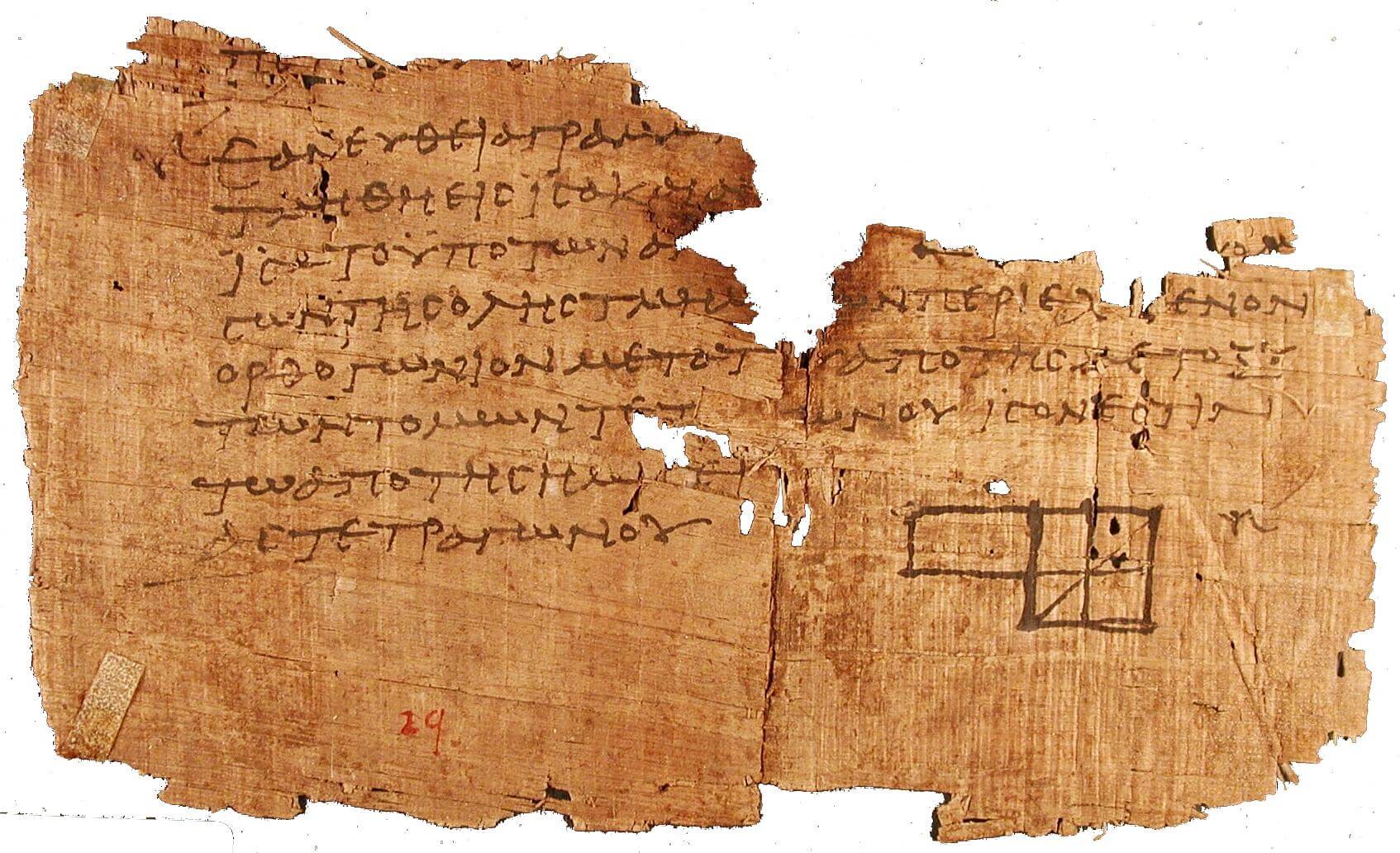
One thread returns us to Euclid’s Page That Held, the first essay in this series, through a familiar result from the Elements. In Euclid’s geometry, the three angles of a triangle add up to two right angles, or 180 degrees. His proof in Proposition I.32 begins by extending one side beyond a corner. Through that same corner he draws a line parallel to the opposite side.2
At the corner where the side was extended, three angles now sit side by side along a straight line. One belongs to the triangle. Euclid shows that the other two match its remaining angles. Together they make 180 degrees. The drawing makes the result easier to see, but the matching still needs a reason.
Why must those angles match? In Proposition I.29, Euclid considers a line crossing two parallel lines. Suppose the two inside angles on opposite sides of the crossing line did not match. He shows that two inside angles on the same side would then add up to less than 180 degrees. His fifth postulate says the lines would have to meet on that side. But we began with parallel lines, which do not meet. The assumption that the angles were unequal has led to a contradiction. They must therefore match.3
Behind the triangle’s 180 degrees lies a route through two proofs to an assumption. I.32 uses I.29, and I.29 calls on the fifth postulate. That is the route these proofs take, not proof that no other route could exist.4 If we set that postulate aside, this argument needs further justification. We have found a question about the proof, not shown that its conclusion is false.
In Foundations of Geometry, the mathematician David Hilbert makes the assumptions themselves an object of investigation. His stated aim is to choose independent axioms and deduce the important geometrical theorems in a way that brings out the significance of the different groups of axioms and the “scope of the conclusions to be derived from the individual axioms.”5 The question has moved inside the foundation. What work is each assumption doing?
There might be another proof. An assumption used in one argument might itself follow from the others, making its separate statement unnecessary. To establish independence requires a different kind of warrant. The task is to show that the other commitments can hold without forcing the one under examination.
He takes the points, straight lines, and planes of the ordinary geometry developed in section 9 of Foundations of Geometry and restricts their extent to the interior of a fixed sphere. He also defines congruence, the relation by which segments and angles count as matching, through linear transformations that carry the sphere into itself. These transformations rearrange points within the sphere while keeping straight lines straight, and Hilbert uses them to define when two line segments or two angles count as equal. In a plane within this setting, more than one line through a point outside a given line can avoid meeting it. Ordinary extensions that would intersect beyond the sphere’s boundary do not meet within the model. The conventions matter as much as the boundary. The measuring rules have not simply been left unchanged. Under the specified interpretation, Hilbert obtains a geometry satisfying the other axioms while the uniqueness requirement in the parallel axiom fails.6
If the disputed requirement followed from the remaining axioms, it would have to hold wherever they were satisfied. Yet in the constructed geometry they hold without it. The alternative therefore supplies a way to establish that the requirement is not a consequence of the others. This is more than tracing the steps of the earlier proof.
Further, in section 9, Hilbert relates the compatibility of his geometrical axioms to the arithmetic used to construct a model of them. A contradiction arising in the geometry would also arise in that arithmetic. The subsequent non-Euclidean construction works through this established setting.7 Its warrant is relative to the mathematical resources used. The construction has grounds of its own, available for examination.
Euclid’s proof has not disappeared under this scrutiny. What changes in the comparison is the question we can ask of its commitments. Following a deduction tells us how a particular conclusion is reached. Examining independence tells us something different about the assumptions from which reasoning begins. Reading the two texts together reveals an inheritance capable of being examined at more than one depth.
That is what I would want a knowledge model of this history to help us pursue. The comparison so far is a reader’s work. To extend it with a computer, the knowledge would need to preserve more than the association of a mathematician with a book. The proposition about a triangle would have to remain distinguishable from the proof presented for it. An assumption used in that proof would need its own identity, along with the setting in which it is accepted.
I would use a commonsense ontology to state those distinctions and the relationships that matter to the inquiry. A proof could be connected to the propositions it uses, the method it follows, and the problem it addresses. Definitions would fix what its terms mean in that setting. A later formulation could be related to an earlier one without treating the two as identical. The ontology would keep definitions and concepts in their relevant contexts, allowing the reasoning to distinguish meanings and assumptions that should not be treated as interchangeable. Applications would retain their conditions of use. Each assertion would lead back to a source passage, so that the model could be challenged at the place where its account of the history began.
The Manifold view of the part of my library that I have catalogued so far offers a first visual approach to this multiplicity. With the Organon selected, the surrounding view makes room for different kinds of relationship, including authorship and theme. A work need not surrender one relationship to become visible through another. That is the intuition worth carrying from the picture into the harder inquiry about reasoning across time.
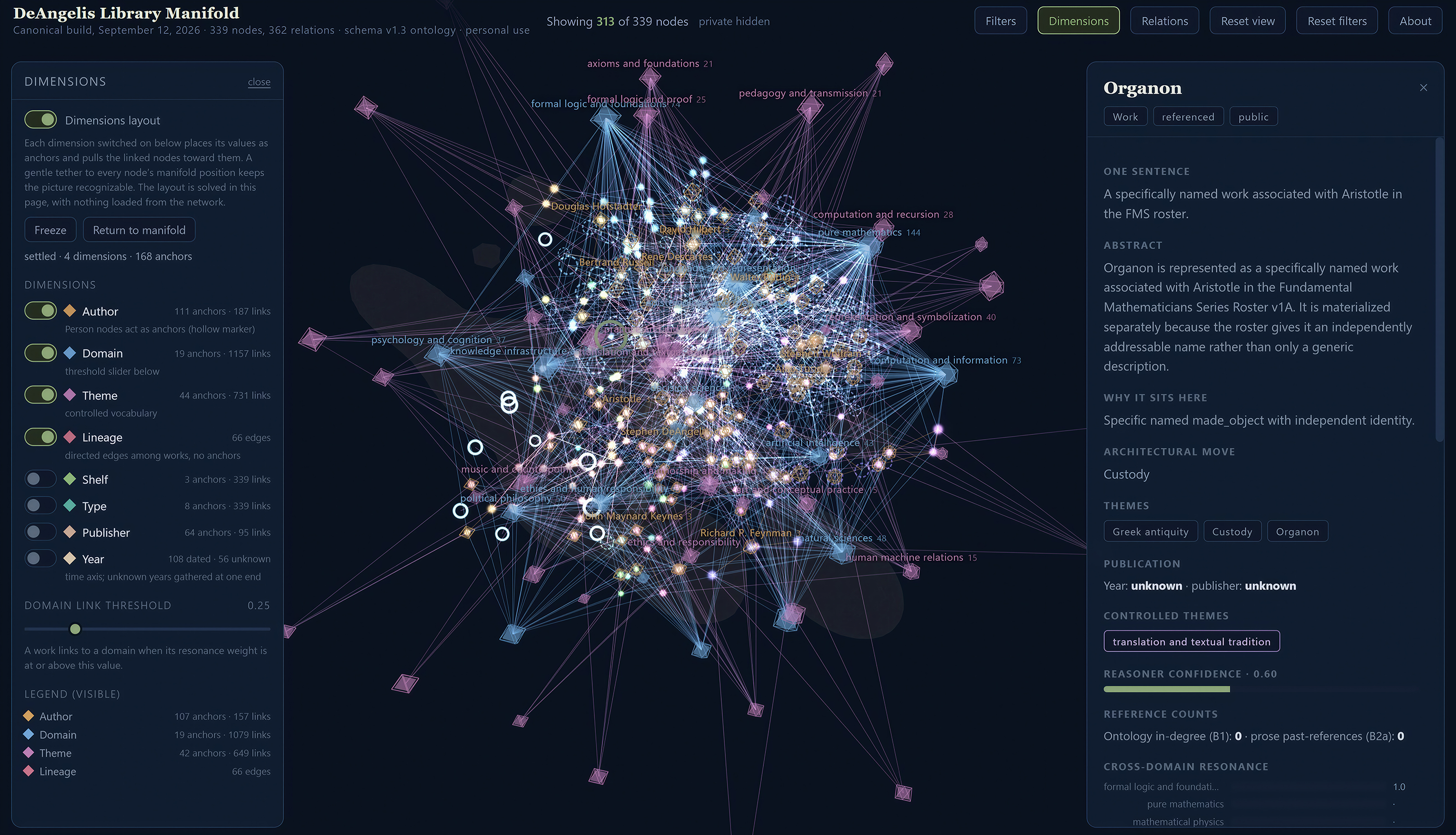
One work, several kinds of relationship. The library’s Manifold view provides a visual orientation, not a result of the historical reasoning proposed here.8
A connection recording that one proof uses a proposition is different from an editorial judgment that two works address a similar problem. A graph can represent both assertions, provided their meanings remain distinct. A reasoner would then need rules appropriate to those meanings and contexts to derive consequences or expose conflicting assertions within a context. The proximity of two points on a display cannot do that work.
If a particular parallel assumption were no longer accepted, what would need to be reconsidered? In a populated model, a search could locate the proofs recorded as using it, including those reached through intermediate propositions. An explicit rule could then identify arguments whose existing justification is no longer sufficient in the changed setting. The consequence would concern the status of their support there.
A conclusion could still have support if another proof had been independently reviewed under the remaining assumptions. A conclusion whose only reviewed proof used the withdrawn assumption would need a new justification. Where the dependency record was incomplete, the question would remain open. The model could direct attention to the work required rather than treating an entire inherited theory as either secure or obsolete.
A changed interpretation creates a different problem. In Geometry and Experience, an expanded version of his 1921 address, Albert Einstein distinguishes purely axiomatic geometry from practical geometry, in which geometrical concepts are coordinated with physical objects. The deductive system alone cannot settle whether those objects behave as the geometry describes. “The question whether the practical geometry of the universe is Euclidean or not has a clear meaning,” he writes, “and its answer can only be furnished by experience.”9
The solid bodies he considers are not perfectly rigid. Their behavior depends on temperature and external forces. Measuring rods and clocks do not correspond exactly to the ideal concepts assigned to them. Yet he argues that a measuring body’s physical state can be determined sufficiently well for its behavior relative to other measuring bodies to be unambiguous enough for the intended use. He then asks the reader to imagine two bodies, each bearing a tract marked between boundaries. The tracts count as equal when their boundaries can be brought to coincide permanently. Einstein goes on to assume that equality established once and anywhere holds always and everywhere. The apparently simple business of measuring has acquired conditions that must be satisfied outside the proof.10
Here the connection under scrutiny runs from a mathematical conception to a physical procedure. The point is not merely that instruments are imperfect. The claim that an instrument measures what the theory says it measures has grounds of its own. Its failure would call for examination of that connection and the physical account supporting it. It would not, by itself, contradict a theorem deduced within a specified geometry.
The knowledge model could now make a comparison that a common subject label would conceal. A changed parallel assumption sends the inquiry through proofs and their dependencies. A changed account of measuring bodies sends it through interpretations, physical conditions, and applications. Both developments concern geometry, but they do not require the same reconsideration. A theorem might retain its justification while an application loses its warrant. Elsewhere, a result might be preserved through a different proof after an earlier justification ceased to be available.
What counts as a line in a mathematical model cannot silently become a claim about a physical measuring procedure. Nor can the word “equal” be carried from one setting into another without its conditions. The model’s value would lie partly in holding those differences long enough to reason across them. It could reveal where a proposed comparison requires another premise, and where the available evidence already supports a consequence.
An additional application might help explain why a revised formulation found a use. So might a new method of calculation, or a change in what teachers could make intelligible. Those are historical hypotheses requiring evidence about particular people and circumstances. They should not inherit the certainty of the mathematical argument to which they happen to be connected.
A calculation that cannot be completed with the time or instruments available can keep a justified result out of practical reach. A new procedure could make that calculation possible without changing the theorem. Today, systems I work with combine several methods of formal reasoning, model tasks, and carry out specified steps autonomously while keeping their assumptions and reasoning available for inspection. The history would then concern an expansion of what people can do with a result, rather than a correction of what the result says.
Across these questions, a theory’s endurance becomes more demanding and more interesting than a verdict that it survived. Its reasoning must remain open to transparent inspection. Its formulation may need greater precision. Uses have to answer to the conditions in which they are attempted, while people must retain the capacity to understand the distinctions. The primary texts make that work visible. They preserve conclusions together with ways of asking what those conclusions require.
The small additions on the Bamberg leaf return us to the scale at which an inheritance is taken up. An inherited result can find new uses while closer scrutiny gives us a more exact account of what supports it. The capacity to do that work is itself part of what carries reasoning forward. The assumptions supporting a result and the conditions governing its use must remain available both to the person who needs to understand it and to another system equipped to check the reasoning.
A preserved page leaves an argument for another reader. An executable procedure can carry its consequences into the world. What must remain open to scrutiny as an inherited argument finds new uses, whether another person examines it or a machine acts on it?
Stephen DeAngelis
Princeton, NJ
September 2026
About the Author
Stephen F. DeAngelis is the founder, president, and CEO of Enterra Solutions and Massive Dynamics, two companies that apply artificial intelligence and advanced mathematics to complex enterprise challenges. His work spans international relations, national security, and commercial technology, with visiting research affiliations at Princeton University, Department of Chemistry, the Computing and Computational Sciences and National Security Directorates of the Oak Ridge National Laboratory, the Software Engineering Institute at Carnegie Mellon University, and the MIT Computer Science and Artificial Intelligence Laboratory. He holds patents in autonomous decision science.
Endnotes
1 Staatsbibliothek Bamberg, Msc.Class.8, catalogued as Boethius, De institutione arithmetica, fol. 86r, digital image 175. Collection record at https://www.digitale-sammlungen.de/de/details/bsb00140708. The primary visual evidence is the digitized leaf at https://api.digitale-sammlungen.de/iiif/image/v2/bsb00140708_00175/full/full/0/default.jpg. The institutional image sequence identifies the folio at https://api.digitale-sammlungen.de/iiif/presentation/v2/bsb00140708/manifest. The description is confined to the visible larger text and small additions between lines and in the margin. It assigns neither a date nor an identified reader to the additions and makes no claim that this manuscript was used in teaching.
2 Euclid, Elements, Book I, proposition 32, statement and proof, translated text at http://aleph0.clarku.edu/~djoyce/elements/bookI/propI32.html. In the construction, BC is extended to D and CE is drawn through C parallel to AB. The angles BAC and ACE are equal, as are ABC and ECD. The exterior angle ACD therefore equals the two opposite interior angles. Adding ACB yields the triangle’s three angles equal to two right angles. This account uses Euclid’s proof text, not the modern Guide or added corollaries on the page.
3 Euclid, Elements, Book I, proposition 29, proof at http://aleph0.clarku.edu/~djoyce/elements/bookI/propI29.html, and postulate 5 at http://aleph0.clarku.edu/~djoyce/elements/bookI/post5.html. I.29 supposes unequal alternate angles, obtains interior angles less than two right angles, and invokes the meeting of the lines to contradict their assumed parallelism. The fifth postulate is already an explicit postulate in this text. It is not being described as something that only later became an axiom.
4 The limited dependency identified here is the use of the parallel-angle relations in I.32, established in I.29 through the fifth postulate. Primary passages are http://aleph0.clarku.edu/~djoyce/elements/bookI/propI32.html, http://aleph0.clarku.edu/~djoyce/elements/bookI/propI29.html, and http://aleph0.clarku.edu/~djoyce/elements/bookI/post5.html. This is not a complete audit of either proof’s dependencies, nor an independence proof excluding every alternative derivation.
5 David Hilbert, Foundations of Geometry, authorized translation by E. J. Townsend, translation copyright 1902, 1950 reprint, introduction, printed p. 1, https://math.berkeley.edu/~wodzicki/160/Hilbert.pdf. The quoted aim is Hilbert’s introduction, not Townsend’s preface. His program concerns the choice of axioms and investigation of their relations as well as deduction from them.
6 Hilbert, Foundations of Geometry, section 10, printed pp. 19 to 20, https://math.berkeley.edu/~wodzicki/160/Hilbert.pdf. He distinguishes the existence statement in the parallel axiom from its uniqueness statement. The sphere-interior construction addresses the latter. Points, lines, and planes are restricted to the interior, while congruences are defined through transformations carrying the sphere into itself. He states that suitable conventions satisfy all the other axioms without the Euclidean parallel axiom, which belongs to group III in this edition. The paragraph in the essay explains the structure of that model argument without claiming to reproduce its full verification.
7 Hilbert, Foundations of Geometry, section 9, printed pp. 17 to 18, and section 10, pp. 19 to 20, https://math.berkeley.edu/~wodzicki/160/Hilbert.pdf. Section 9 constructs a geometrical interpretation using an arithmetic domain and states that any resulting geometrical contradiction must also appear in the related arithmetic. Section 10 uses the ordinary geometry already constructed. The relevant consistency warrant is relative to those resources, not an unconditional proof of the consistency of mathematics.
8 Author-provided screenshot of the DeAngelis Library Manifold, supplied September 12, 2026, original file Screenshot_12-9-2026_111038.jpg. The image shows the Organon selected with authorship, domain, theme, and lineage controls enabled. It is a private visual supplied for illustration, not a public research source with a stable URL. No inference execution, proof verification, historical transmission, or mathematical embedding is established by the displayed arrangement. The proposed historical knowledge-model inquiry in the surrounding paragraphs is not represented as a function demonstrated by this image.
9 Albert Einstein, “Geometry and Experience,” expanded address of 1921, in Sidelights on Relativity, translated by G. B. Jeffery andW. Perrett, 1922, printed pp.30 to 32, quotation on p.32; unpaginated online transcription at https://www.gutenberg.org/files/7333/7333-h/7333-h.htm. The distinction is Einstein’s stated distinction between purely axiomatic geometry and practical geometry coordinated with objects of experience. It is not offered as an empirical finding established by this essay
10 Einstein, “Geometry and Experience,” printed pp. 34 to 37; unpaginated online transcription at https://www.gutenberg.org/files/7333/7333-h/7333-h.htm. The discussion qualifies the relation of geometry to solid bodies through temperature, external forces, the idealization of rods and clocks, and determination of a measuring body’s physical state. Page 37 introduces marked tracts on practically rigid bodies, their comparison by coincidence of boundaries, and the assumption that equality found once and anywhere holds always and everywhere. The essay describes Einstein’s proposed measuring comparison, not an experiment witnessed or performed by the author
Share this post