Note to Readers Before Station 2
Before the Symbols Begin
From here on, the men in these essays wrote in symbols. Euclid's proofs could be followed by looking at a figure while reading the words. The interludes followed the page into symbols. The subjects now wrote in equations, and the equations are the evidence. There is no way to tell what they did without showing what they wrote, so the essays from here on will carry more mathematics than the ones before, not less.
Euclid drew a figure beside his proof and asked the reader to hold both in view. The two interludes followed them through the copyists, translators and teachers who carried them across languages and empires, and saw the page allowed to do more, until the operation on the page became the inference itself. That took two thousand years. Here Boole puts two propositions of geometry into letters, works them by rules anyone could learn to run, and reads off a right answer. The problem is finished before he goes back for what the answer did not keep, the conclusions either proposition could prove alone. What follows took one century. A proof was asked to show every step, with no gap. A whole subject was asked to rest on what was written down and nothing else, and two men paid the full price. A system was asked what it could not see about itself. Truth was asked for a place outside the language that states it. Procedures were asked what no procedure can decide. Each page held what it was asked to hold until it was asked for more, and then the next was written, and the next was never far behind. Then the reasoning met the machine, and in 1956 the whole inheritance was handed over to it. Two thousand years, then one century, then one year. We are at the second station, where Boole made the working a matter of symbols and rules.
I will keep mathematical formula and notation in the body of each essay to a minimum, or to what is necessary. What the mathematics did, what went in, what came out and what the man then made of it, will be told in plain English, with the working kept in the notes and in the figures. When a page of algebra turns up, you are not being asked to solve it. It is there the way a photograph of a manuscript is there, so that you can see what the man wrote. You can see that two terms on Boole's page carry a 2 in front of them without knowing how they came to be there. Where a formula is necessary to say what a man did, it will stand in the body with a plain sentence beside it saying what it says.
The promise covers how the body is written, and it does not make the subjects any easier. The hardest theorem in the series is mathematics and nothing else, and if you want to know what the man proved, you are owed the shape of the proof. The notes will carry that shape for anyone who wants it, with the sources and the pages, and the body will carry what it meant and what it cost. You can read the body alone and lose nothing the essay is about. You can read the notes and find the working.
Three things carry the promise. The first is the writing, with the plain sentence before the source's words and each unfamiliar term defined as it enters. The second is the DeAngelisReview Glossary, where each station's terms will be entered under that station, to be found again where they were first made plain. The third is the working figures, including short films, under the mark DeAngelis Explainers, drawn in code from the equations and definitions cited in the notes, their numerical results independently recomputed and their scripts kept, so that each can be reproduced without generative imagery. A figure that cannot be traced to a page does not appear. Each essay tells what a man did and what he made of it. The road matters because it ends where reasoning was handed to machines.
The work was hard for the men who did it. I would like the reading of it to be as plain as I can make it.
The Fundamental Mathematicians, Station Two.
In An Investigation of the Laws of Thought, published in London in 1854, George Boole sets down two propositions of elementary geometry. The first says that figures are similar exactly when corresponding angles are equal and corresponding sides proportional. The second says that in triangles either of those properties brings the other with it. "Similar figures consist of all whose corresponding angles are equal, and whose corresponding sides are proportional." "Triangles whose corresponding angles are equal have their corresponding sides proportional, and vice versa." He writes the premises as two equations and, by the method he uses for any premises, works out an answer for the figures that are not similar. The answer takes the form he calls a development, a list of every combination that can be made from the three properties in play, being a triangle, having equal angles and having proportional sides, each combination with a number in front of it, and Figure 1 shows it as he printed it.1
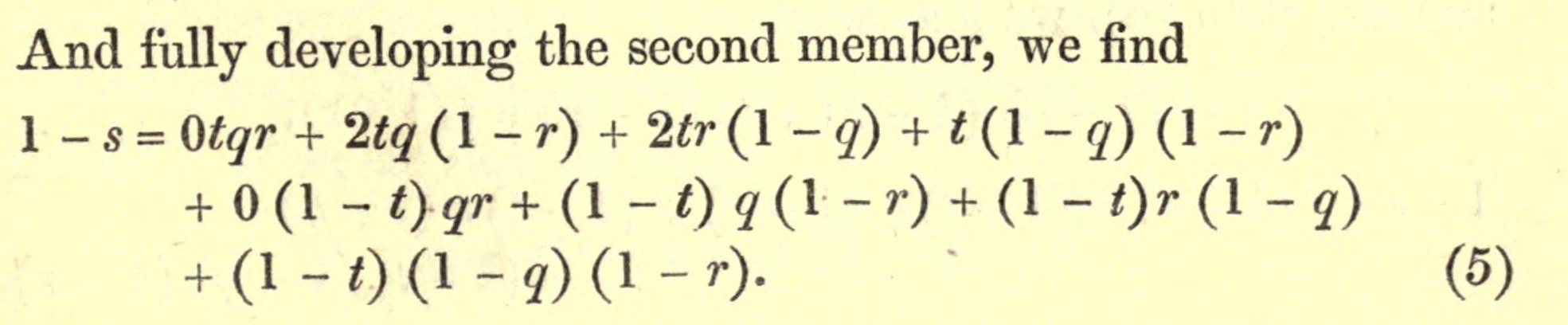
Two of the terms come out with the number 2 in front of them, and the number in front of a term is what he calls its coefficient. HisRule says that a term with such a coefficient is to be set equal to zero and taken out of the answer, and he applies it at once. "In the above development two of the terms have the coefficient 2, these must be equated to 0by the Rule," he writes at the top of the next page, which sets the two terms aside as statements of their own. Then he reads the answer in three sentences. Dissimilar figures are all triangles that lack both properties and all figures other than triangles that lack at least one. The two statements set aside say that no triangle has equal angles without proportional sides, or proportional sides without equal angles. The answer is correct, and by his own account the problem is finished.
He does not leave it there. On the following pages, after a remark about how the description could be put more briefly, he goes back for the twos and finds two conclusions that either premise can prove alone. He observes that two terms of the development carried the coefficient 2 and that this, as he puts it, "indicates that the two premises were not independent." He takes the premises up again in the shortened form his method gives them, multiplies them together, and finds in the product two conclusions about similar triangles that are "equally deducible from either premiss singly." Nothing in the answer had asked him to do this. It was right before he went back and no more right after. What he went back for was something the answer had never needed and the premises had carried the whole time, that each of them, alone, had already proved part of what they proved together. A file that says yes, and is asked months later what the yes was made of, has the same question put to it. What should a correct answer keep of the working that produced it?
A Reader's Compass
Behind this station stands The Pages That Carried, which followed methods from Llull's wheel to the book of 1847, where the operation on the page became the inference itself. The series enters instead through the book of 1854, because the question is first visible there, on a page where the answer is already right. The road runs from a figure looked at while the proof was read, through this page, where anyone who learned the rules could run the steps again, past proofs of what such systems cannot see or decide, to 1956, when the inheritance passed to machines. This is not a history of Boolean algebra and not an account of who read whom. It follows one choice, made on Boole's page and made again in 1864, in a paper of 1936, in a thesis of 1937, and in a handful of papers published since 2007, about what a written answer keeps of the working behind it, and it puts that choice to one test by taking a record away and asking what the answer can still say.
From this station forward the subjects worked in symbols, and the symbols are the evidence, so there is more mathematics ahead, not less. I will keep formula and notation in the body of this essay to a minimum, or to what is necessary. What Boole's algebra did, what he put into it and what he read out of it, is told in plain English, and the working stands in the notes and in the figures, which are there to be looked at and not solved. In the essays ahead, the notes will carry the shape of the mathematics for any reader who wants it.
I. The two on the page
The Rule that sends the twos to the side is older in the book than the triangles, and it rests on a fact about sorting. Someone who sorts a heap of figures for the triangles, and then sorts the triangles he holds for triangles again, holds what he held. Choosing twice is choosing once. Boole reasons about classes, his word for any collection a description picks out, and he writes each class as a letter, here s for the similar figures, t for the triangles, q for the figures whose corresponding angles are equal and r for those whose corresponding sides are proportional. The picking of one class out of another is written as multiplication, so that tq is the triangles with equal angles. Written 1 minus a letter, a class is everything that letter leaves out, so 1 minus s is the figures that are not similar, the class Figure 1 develops. For any of his letters, then, xx = x, the law he calls fundamental and builds the book on, and it says no more than the heap did. Ordinary numbers break that law, and only 0 and 1 keep it. A term with a 2 in front of it therefore has no reading as a class, and the Rule, laid down earlier in the book, is that any such term is set equal to zero on its own, as a statement that the class it names is empty.
The second premise is the equation tq = tr, the triangles with equal angles are the triangles with proportional sides. The two terms marked 2 in Figure 1, set to zero, are tq(1 - r) = 0 and tr(1 - q) = 0, and they say that there are no triangles with equal angles and sides not proportional, and none with proportional sides and angles not equal, which is the second premise saying itself again, in two halves. The answer to the question asked, the description of the figures that are not similar, does not contain these two statements. They stand beside it. They are facts about how triangles, equal angles and proportional sides stand to one another, and the premises guarantee them whether or not anyone asks for a description of dissimilar figures. That is the first of two senses in which Boole uses the word independent in these pages, and it is the sense in which he calls them "the independent relations which exist among those elements in virtue of the same premises." The side statements can be used to say the answer more briefly, and he insists that "this is not superfluous information." Working Figure 1 shows the development, its two terms with the coefficient 2 set aside by the Rule and the four terms that remain as the answer.
Working Figure 1. The development of 1 minus s, redrawn for this essay from equations (1) to (8) of AnInvestigation of the Laws of Thought (London, 1854), pp. 125 to 126, with Boole's letters. The two terms withthe coefficient 2 are set equal to zero by the Rule and stand to the side as the statements (7) and (8), and the four terms with the coefficient 1 remain as the answer. The moving version, with narration, runs 3 minutes 7seconds. Tap the figure watch it.
The second sense is about the premises themselves, and Boole reaches it by working them again. He takes the two premises back up, s = qr, the similar figures are the ones with both properties, and tq = tr, each in the shortened form the method gives it, multiplies them together, and finds two statements in the product. Similar triangles whose corresponding angles are equal have their corresponding sides proportional, and similar triangles whose corresponding sides are proportional have their corresponding angles equal. Either premise, taken alone, proves both of them. That is what he means when he writes, on the page after the answer, that the two premises were not independent, and the definition he gives later in the book says in general what the triangles show in particular. A set of premises is independent when no part of it proves anything that another part also proves. In his words, "A system of propositions may be termed independent, when it is not possible to deduce from any portion of the system a conclusion deducible from any other portion of it." The 2 in the development was his sign that the premises fail this test, and it said no more than that. Which conclusions they shared, and how, he found only by going back to the premises and working them again.
The order on the page matters, because it is a choice. Interpretation comes first. The answer is read and the problem declared done before the overlap is mentioned, and when it is mentioned it comes as a further observation under its own number. A reader in a hurry stops at the three sentences of the answer, and loses nothing the question asked for. A reader who follows Boole one page further learns something the answer could not have told him, that the two propositions of elementary geometry he began with shared two conclusions about similar triangles, each of which either premise could have supplied on its own. Between the two passages, having shown that the side statements can shorten the answer, he writes that the fullness of his solution is no waste, since it gives everything that was asked and the means to say it best. "The fulness of the general solution is therefore not a superfluity. While it gives us all the information that we seek, it provides us also with the means of expressing that information in the mode that is most advantageous." He had kept the 2 on the page long enough to read what it said.
Then, in the next chapter, he writes a rule that discards such a number. If two copies of a class add up to nothing, that class is empty. One copy would say the same. The chapter is about shortening the work, and its first proposition concerns one common form of equation, which he writes V = 0, a list of classes, each with a positive number in front, that adds up to nothing. When such a list adds up to nothing every class on it must be empty, so it makes no difference how often a class appears or what number stands before it, and from such an equation, he writes, we are permitted "to change every positive coefficient to unity." So a class written twice may be written once, and he draws the consequence himself. "Thus, if the term x is repeated, the aggregate 2x may be replaced by x." The development in Figure 1 is not an equation of that form, and its 2 fell under the earlier Rule, which sets such a term aside as a statement of its own. He read it, and explained what it signified. This is one man in one book, keeping a number long enough to learn from it, and then, for equations of one common form, giving everyone, himself included, permission to throw such a number away. Nothing in the logic forced either act. Both were decisions about what a correct answer should be allowed to forget, and he made them two pages apart.
The answer does not record which premise supported which conclusion, and it does not record that two of them had been supported from both sides. The premises, kept separately, were where the fact was found.
A different later question shows the same gap without any geometry. Two people apply for one thing through two qualifying routes each, and both are told yes. Then one record is withdrawn, and one of them still qualifies while the other does not, and whether anyone can say which of them it is, without starting over from the beginning, depends on what the yes was allowed to keep.
II. The permission and its price
In The Mathematical Analysis of Logic, published at Cambridge in 1847, Boole gives his symbols three laws of selecting. Each symbol stands for picking a class out of whatever is in view, so x picks out the x's and xy picks the y's out of the x's. Selecting from a whole is selecting from each of its parts, the order of two selections does not matter, and selecting the x's from the x's gives the x's, the heap of figures once more, which he writes xx = x. The rule that selecting again changes nothing is his index law, and he calls it the one law that belongs to these symbols and not to numbers. The laws govern selection from a whole and the combining of successive selections. None says that adding a class to itself leaves it unchanged.2
Yet the book already has a rule for a number in front of a term. A term with a 2 before it is set equal to zero, as the triangles' twos would be in 1854. If x and y name the same class, there can be no x outside y and no y outside x. Boole writes that as the starting equation x - y = 0 and expands it into those two classes, with coefficients 1 and minus 1, which he calls moduli. Each class must be empty.
His general theorem covers any expression that, like x - y, is set equal to zero and expanded into classes that do not overlap. It gives at = 0, a number a other than zero standing before a class t, which can only hold if the class is empty. The reading turns only on which coefficients vanish, and he prefers to replace the others by 1. A separate theorem gives the earlier form of the triangles' Rule, removing any term whose numerical coefficient fails the index law.
Boole also said what he wanted of the user of such symbols. The validity of the processes, he writes near the start of the book, does not depend on what the symbols mean but only on the laws by which they combine. The symbols may be used with a full understanding of their meaning and an ability to unfold the shortened reasoning they stand for, or they may be used without understanding on someone else's authority, as "mere unsuggestive characters, the use of which is suffered to rest upon authority," and in the second case, he says, the mind gets no discipline from them at all. The person who holds a file that says yes cannot check its working from the file and may have to accept the result on someone else's authority.
Boole names a further cost, one that comes even to the user who understands. From y = z, two classes with the same members, one may multiply both sides by x and obtain xy = xz, which says only that the members x shares with y are the members it shares with z, a step he calls perfectly legitimate and whose result he calls a less general fact than the one it began from. A step can be lawful and lose something. He also put the syllogism, an argument drawing a conclusion from two premises linked by a common term, into equations. He combined them to remove the shared symbol, leaving an equation for the conclusion and nothing of the term that had joined them. The example of 1854 raises a different question. Its final equations lose none of what the two premises say together, but they do not record which premise supports which conclusion.
By 1854 he had changed the question. The chapter of the Laws of Thought on the principles of symbolical reasoning asks whether the symbols may be used past the point where their steps can be read, and it answers yes, under three conditions. The symbols are given a fixed interpretation at the start, with the laws of their combination derived from it. The formal processes are then to run by those laws whether or not the results along the way can be read, in his words, "conducted throughout in obedience to all the laws determined as above, without regard to the question of the interpretability of the particular results obtained." And the final result must be interpretable in form and interpreted in the sense fixed at the start.3 Just before that he states the standard the permission departs from. In common life, he says, people are not content that formal steps should connect their premises and their conclusions, and each link must make sense as well. In his words, "every step of the connecting train, every mediate result which is established in the course of demonstration, must be intelligible also. And without doubt, this is both an actual condition and an important safeguard, in the reasonings and discourses of common life." The 2 of Figure 1 is a middle result of this kind, appearing in the development under the second condition and discharged under the third, and what the permission settles is its standing, that a term with no reading as a class may appear in the working so long as the answer is read without it.
Nine years later he was trying to do without it. Among his papers is a manuscript headed On the Nature of Thought, which its editor, who published it in 2025, places most likely in late 1863, by inference from its contents and from Boole's letters of that year to a younger logician, William Stanley Jevons.4 In it Boole keeps the symbols and the laws of 1854, 0 for Nothing and 1 for the Universe, and he sets himself one restriction, that no form may be used which cannot be read, in his words, "under the express condition that no forms are to be employed which are not interpretable." He says at once that the condition is not a necessary one but a restriction he is choosing. In August 1863 he had written to Jevons, as the edition prints the letter, that he had once worked the problem through to find out how far his system could be made intelligible to people who knew no mathematics. The editor reads the manuscript as a reworking of that earlier attempt. Near its end Boole says that he can do everything the formal logic of classes asks while making each step readable, but that the condition restricts his freedom. "But it is seen that the freedom of our procedure is restrained by these conditions." Equations that do not already meet the condition need preparation before addition, and the steps must be taken in a restricted order. A user can say what each line means, but may have to do more work to make that possible. Boole did not take the permission of 1854 back. He showed what it would cost to live without it.
Jevons, who had been corresponding with him, made a different choice and published it first. Pure Logic came out in 1864, and it states a law Boole's three had not, which Jevons calls the Law of Unity, that a thing offered as an alternative to itself means no more than the thing, so that A or A is the same as A. In his notation, A + A = A, and his plus means or. He calls the law a self-evident truth, and adds that it "was not recognised by Professor Boole, when laying down the principles of his system." On the pages of 1847 that is so. In 1854 Boole had written the rule that replaces 2x by x in a zero equation of positive class terms, so the thing Jevons made a first principle Boole had made an abbreviation, permitted after the fact.5
These choices give the 2 in Figure 1 a different standing in each system. Under the theorems of 1847 a number other than 0 or 1 before a term sends that term to zero, and nothing more is asked of it. Under the permission of 1854 the same number can form in the middle, and Boole read what it signaled about the premises after the answer had been interpreted. Under the condition of 1863 no form that could not be read as a thought was to be employed, so a term with no reading as a class had no place in the working. Under Jevons's law of 1864 a repeated term collapses into one as it is written, and no coefficient forms.
III. The circuit answers its question
Two switches stand open, one after the other on a single wire, and nothing passes. In the thesis Claude Shannon signed at the Massachusetts Institute of Technology on August 10, 1937, that fact is written as a sum.6 He attaches a symbol to any stretch of circuit between two terminals and calls it the hindrance of that stretch, spelling the word his own way, and he fixes its two values first, 0 for a stretch that lets current through and 1 for one that does not. "The symbol 0 (zero) will be used to represent the hinderance of a closed circuit, and the symbol 1 (unity) to represent the hinderance of an open circuit." Then he lets plus mean wiring two stretches end to end, so that their hindrances add, the sign being "defined to mean the series connection of the two terminal circuits whose hinderances are added together," and the second of the rules he lays down at the start follows from the wire. 1 + 1 = 1, which he puts into words. "An open circuit in series with an open circuit is an open circuit." One plus one equals one because 1 is a state and not a count, and two open switches on a wire leave it in the same state as one. This one departure from ordinary arithmetic lets Shannon shorten the calculations. "The only one of these postulates which differs from ordinary algebra is 1b. However, this enables great simplifications in the manipulation of these symbols." Among his theorems, X = X + X = X + X + X, and so on, where X names one hindrance, since a stretch in series with stretches in the same state leaves the whole in that state. Boole read his coefficient 2 as a sign about his premises, not as the state of a wire. Working Figure 2 shows the four cases of two switches in series, with one open switch and two leaving the terminals in the same state.
Working Figure 2. Two switches in series, drawn for this essay with a schematic contact from the definitions and postulates of Claude Shannon's thesis, A Symbolic Analysis of Relay and Switching Circuits (MassachusettsInstitute of Technology, 1937), pp. 4 to 7, and Theorem 14a, p. 14. The hindrance of a stretch is 0 when closed and 1 when open, the sum is series connection, and in the four cases of two switches one open switch and two leave the terminals in the same state. The moving version, with narration, runs 2 minutes 31 seconds.
A circuit forgets by design, and for a circuit that is right. The question a wire answers is whether current will pass between two terminals, and the terminal state answers it completely. It does not count the open contacts in the path, because the count makes no difference to the current. Asked which of two open switches is to blame for the dark lamp, the state at the terminals cannot say, since one open switch and two produce the same state, and the question has to go back to the drawing and the observed states of its named contacts. Shannon's written functions keep those names. X plus Y says that two particular contacts stand in series. The state they produce keeps neither name nor count. The terminal cannot by itself say which contact is open.
Shannon says where the algebra came from, and he gives Boole the credit for it. The algebra of logic, he writes, "originated by George Boole, is a symbolic method of investigating logical relationships," and the numbers he attaches to it point to his references, a bibliography of symbolic logic and the books of Couturat and Whitehead, so that the sentence reports the origin of the method and not a reading of Boole's logical pages. The one book of Boole's on his list is the treatise on finite differences. What the thesis makes plain is that the algebra he needed was the one in which a thing added to itself is itself, and that this choice answered the question he put to the wire.
The year before, in a paper printed in 1936, Marshall Stone had made the opposite choice for a different purpose. He wanted the structures of Boole's algebra to be handled by the methods of modern algebra, and to do that he changed what addition meant. His sum of two classes is the class of things in one or the other but not in both, so a thing added to itself is nothing. Selecting a class from itself still gives that class, aa = a, but under his new addition a class added to itself gives nothing, a + a = 0. A class in Stone's sum is kept or canceled according to whether it came in an odd or an even number of times. He changed the operation and corrected no one.7 By 1937 the same written sum, a thing added to itself, had been made to equal two, one and zero under different operations, each serving its own purpose, and only the first of the three results could be read, as Boole read his, as a sign about the premises behind it.
The terminal reports open or closed. That is its whole report, and for a wire it is enough.
IV. The answer meets a withdrawal
An application for a license, a benefit or a place is approved on the strength of records. Months later one of the records behind the yes is withdrawn, because the office that issued it has found a fault in it, and the person who now holds the file has to decide whether the yes still stands. The file says yes. It does not say what the yes was made of. This is an invented case, small enough to be worked by hand. If the original records and the rule remain available, the answer can be worked again, and the question is what it has to keep if it is to answer without that.
An applicant qualifies if some record on file attests the required fact, and a record may attest it in more than one capacity, say as a filing and again as a certificate, each capacity counting as a separate route. There are two records, A and B, and two applicants. The first applicant's file is supported by A in one capacity and by B in one capacity, two routes, each using one record. The second applicant's file is supported by A alone, in both of its capacities, two routes, each using A once. Under the rule both qualify, and if anyone asks how many routes each had, each had two. Now A is withdrawn. Anyone who stops here can say which applicant still qualifies, because the routes have just been told. A file that kept only yes and the number two could not, and that is the test.
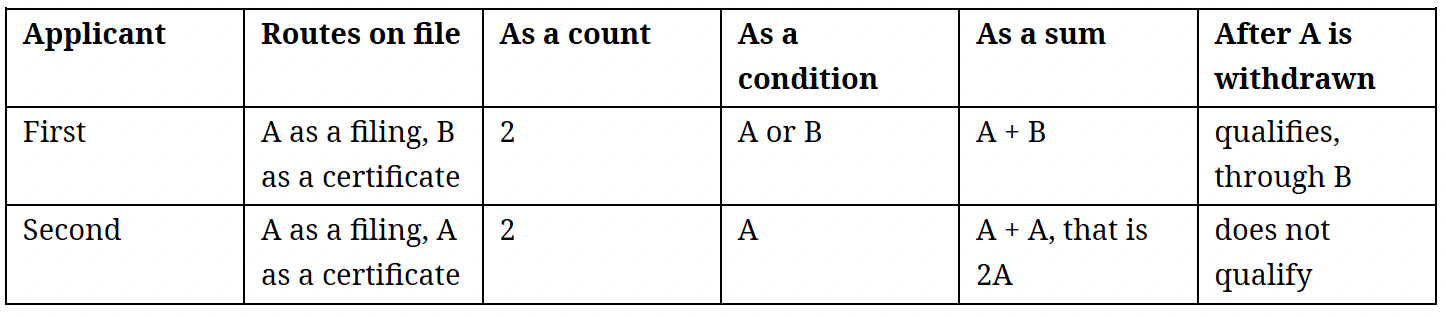
The first applicant still qualifies, through B. The second does not. The files as kept are identical, yes and 2 in each, and nothing in them distinguishes the case that survives from the case that falls. To distinguish them the file must retain how its records supported the yes. A condition, a count and a named sum keep different parts of that information. Kept as a condition, A or B for the first applicant and A for the second, the yes can answer the withdrawal of A directly, since the first condition still holds through B and the second does not. The condition has already forgotten that the second applicant had two routes, because A or A says no more than A, which is Jevons's law doing in a file what it does on a page. Kept as a count, two for each, the yes cannot answer the withdrawal at all, because the count has forgotten which records it counted. Kept as a sum that names the records and keeps their multiplicity, the number of times each record was used, A + B for the first and A + A, that is 2A, for the second, the yes answers the withdrawal directly. With A set to zero, the first sum leaves B standing while the second leaves nothing. Only this third form answers both questions, whether the yes survives and how many routes it had, and in this form the 2 in front of A is a count of routes.
The arithmetic of the case is not invented. A paper read at the Principles of Database Systems conference in 2007 gave each record of a database an annotation, a note kept with the record and carried along as records are combined, so that when two routes to the same answer are combined their annotations are added and when records are joined their annotations are multiplied. It showed that the familiar ways of keeping an answer's support are special cases of the one scheme. In one case the annotation is a condition in the records' names, and A added to A gives A. In another it is a count, and gives 2. For the combinations studied in that paper, the most general case keeps sums of products of record names, with the number of routes in their coefficients. For routes that each use A once, A added to A gives 2A. The authors give one answer with three routes, two of which use the same input record twice, unlike the routes in Table 1, each of which uses its record once.8 Working Figure 3 shows the routes of the two files combining under that arithmetic and the withdrawal of A meeting each of the three forms.
A paper of 2009 by two of its authors and a colleague extended the counts to negative numbers, so that the withdrawal of a record is itself a record, with a count of minus one, and can be carried through an answer by the same arithmetic that built it, and a paper of 2010 allowed negative multiplicities on the same ground. With the records kept by name, the second applicant's 2 meets a minus 2 and falls to nothing while the first applicant's 2 meets a minus 1 and stands at one, and the answer is brought up to date from the withdrawal itself instead of being rebuilt from the start.9 These papers ask what survives a withdrawal. Boole's coefficient had marked something else, conclusions his premises shared. His answer and the two bare files belong side by side because they did not keep how their premises had supported them.
Working Figure 3. Two applicants, two records and a withdrawal, drawn for this essay from Definition 3.2,Proposition 4.2 and Theorem 4.3 of Green, Karvounarakis and Tannen, "Provenance Semirings" (Principles of Database Systems, 2007), on the invented case of Table 1. The routes combine by addition, the yes is stored asa count, as a condition and as a named sum, and record A is withdrawn. The moving version, with narration, runs 2 minutes 44 seconds.
Boole had run a test of withdrawal himself, after examining two famous works of metaphysics, a portion of Samuel Clarke's demonstration of the being and attributes of God and a portion of Spinoza's Ethics. A chapter of the Laws of Thought takes them up and opens by saying what it is for. Having drawn the conclusions a set of premises supports, the method should also let him alter the premises by leaving out something they contain, in his words, "modify the premises by the omission of some fact or principle which is contained in them," and see how the conclusions change. He then states what assessing a conclusion's validity requires, that every premise it rests on be found and set down. "It is impossible, employing the method of this treatise, to form even a conjecture as to the validity of a conclusion, without a distinct apprehension and exact statement of all the premises upon which it rests." Then he runs the test. Having worked Clarke's argument through, he says that if the premise recording the existence of motion is suppressed, with the rest left standing, "some remarkable conclusions follow," and in the next chapter he suppresses it, asking the reader "to suppose ourselves ignorant of the fact of the existence of motion," and adding that the example has been taken up again with other ends in view. For this withdrawal he restates the remaining premises and calculates from their equations again, as he had gone back to the premises for the triangles.10
Three things are being asked of an answer here. One is whether it is correct relative to the premises it was given, and both applicants' answers were. Another is whether what the answer kept is enough to answer this withdrawal without reworking, and here the forms part company. The last is whether the premises were true, which none of the three forms can tell, since a record kept by name is still a record and not a fact.
I have put the question to answers I asked for, more than once. The research came back complete, with the analysis built on it, and the analysis was the part that mattered. When I asked what the answer rested on, which records, what working, it could not say. Until then it had read the same as a right one, and when it proved wrong nothing in it showed where. That is not the applicants' case. Both of them were right. It is the case beneath theirs, an answer that had kept nothing, and so could not be asked.
The two files lie side by side with A gone, each saying yes and 2. In one the yes is still true and in the other it is now false, and nothing in either file tells which is which.
V. What remains to answer for
On Boole's page of 1854 two terms of the working came out with the number 2 in front of them, his Rule set them aside as statements of their own, and he read his answer about the triangles without them. What the 2 had signaled, that his two premises overlapped in what they proved, the answer did not carry, and he had to go back for it. The two applicants' files, each saying yes and 2 for its two routes, met a different question. A record behind both was withdrawn, one yes survived and one did not, and the files still read the same. On the page and in the files, a correct answer had a fact in its working that the answer was not built to keep, and in both the fact was the one the later question needed.
Whoever chooses the form of an answer chooses what it will be able to say when a premise goes, and that choice is made before the answer is given, by someone, whether or not anyone notices it being made. Boole made it in the open, because the whole working was his. Jevons made it a first principle, that A or A says no more than A, and Shannon's wire made it for him, since one open switch and two leave the wire in the same state. Not one of these choices was wrong. Each kept what its question needed, and each would have failed a question it was not built for. The one who is answerable for what an instrument does after it leaves the room has more to answer for than the arithmetic. He is answerable for the question that was named before the arithmetic began, and for the ones that were not, the withdrawal among them.
An answer that will never be asked anything may keep nothing, and the person who decides that it will never be asked anything has decided something about the people who will sit at the table where it is acted on. The mathematics will serve any of the forms with equal rigor and does not make the decision.
Eight years after the triangles Boole was at a different question, in a paper read to the Royal Society in 1862.11 Behind him the page of 1854 stood as printed, the two terms at its foot with the 2 still in front of them, the answer read without them at the top of the next page and the problem called finished. One page further he went back for what the answer had not kept.
The two terms are on the page because the working is. Of them he had written, overleaf, that they must be equated to 0 by the Rule, and lower on that page, of what they said, that "this is not superfluous information." Both sentences are his, and he wrote them in that order.
Euclid's reader held figure and words in view together. Aristotle's forms of argument were carried in words for two thousand years. Boole's two premises were propositions of geometry, Euclid's subject, and he wrote them as letters and worked them by rule, so that anyone who learned the rules reached the same answer without a triangle in sight. He took the two terms out of the answer and left them on the page, where anyone who opens the book can still put a finger on the 2.
Stephen DeAngelis
Princeton, NJ
September 2026
About the Author
Stephen F. DeAngelis is the founder, president, and CEO of Enterra Solutions and Massive Dynamics, two companies that apply artificial intelligence and advanced mathematics to complex enterprise challenges. His work spans international relations, national security, and commercial technology, with visiting research affiliations at Princeton University, Department of Chemistry, the Computing and Computational Sciences and National Security Directorates of the Oak Ridge National Laboratory, the Software Engineering Institute at Carnegie Mellon University, and the MIT Computer Science and Artificial Intelligence Laboratory. He holds patents in autonomous decision science.
Endnotes
Terms this essay defines as they enter, development, coefficient, class, independent in its two senses, moduli, hindrance, route, annotation and multiplicity among them, are entered in the DeAngelisReview Glossary, each traced to the station where it entered.
The working figures are rendered in code from the equations and definitions cited in these notes, their numerical results independently recomputed and their scripts and checks kept with the essay's records so the drawings can be reproduced without generative imagery.
1. The calculation, from George Boole, An Investigation of the Laws of Thought (London, Walton and Maberly, 1854), Chapter VIII, paragraphs 10 to 13, pp. 125 to 128, read in the digitized copy at archive.org, with the formulas on pp. 125 and 126 checked against the page images and reworked by hand. The two premises quoted in the opening become s = qr and tq = tr, with s for similar figures, t for triangles, q for having corresponding angles equal and r for having corresponding sides proportional. Boole reduces them "by the Rule, or, which amounts to the same thing, bringing the terms of these equations to the first side, squaring each equation, and then adding," which gives his equation (3), s + qr - 2qrs + tq + tr - 2tqr = 0. The squares lose nothing, since every class symbol satisfies xx = x, so the square of s - qr is s - 2sqr + qr, and likewise for tq - tr. He then solves (3) for s, s = (tq + qr + rt - 2tqr) divided by (2qr - 1), forms 1 - s = (qr - tq - rt + 2tqr - 1) divided by (2qr - 1), his equation (4), and develops its second member with respect to t, q and r, his equation (5), which Figure 1 reproduces. A development lists the eight constituents t, q and r can form, each with a coefficient found by giving the symbols the values 1 and 0 in every combination. Here tq(1 - r) and tr(1 - q), triangles with angles equal and sides not proportional and triangles with sides proportional and angles not equal, take the coefficient 2, four constituents take 1, and tqr and (1 - t)qr take 0 and drop out. Chapter VI, paragraphs 11 and 12, pp. 90 to 92, supply the justification. A coefficient of 1 takes the whole constituent, 0 takes none of it, the indefinite symbol 0/0 takes some, none or all, and any other coefficient means that the constituent "must be separately equated to 0," so a term 2t in a development yields the side equation t = 0. Applying it, p. 126, "In the above development two of the terms have the coefficient 2, these must be equated to 0 by the Rule," Boole obtains (6), 1 - s = t(1 - q)(1 - r) + (1 - t)q(1 - r) + (1 - t)r(1 - q) + (1 - t)(1 - q)(1 - r), with (7), tq(1 - r) = 0, and (8), tr(1 - q) = 0, interpreted on p. 126 as "There are no triangles whose corresponding angles are equal, and sides not proportional" and "There are no triangles whose corresponding sides are proportional and angles not equal." The law xx = x on which the Rule rests is derived at Chapter II, paragraph 9, p. 31, "we thus get xx = x," and is called "the fundamental law of thought, whose expression is xÇ = x" at Chapter III, Proposition IV, p. 49. Paragraph 11, p. 126, calls (7) and (8) "the independent relations which exist among those elements in virtue of the same premises," says "this is not superfluous information," and uses them to shorten the description. Paragraph 12, p. 127, "The fulness of the general solution is therefore not a superfluity," quoted in the body. Paragraph 13, pp. 127 to 128, "Another observation, illustrative of a principle which has already been stated, remains to be made. Two of the terms in the full development of 1 - s in (5) have 2 for their coefficients," then "It will hereafter be shown that this circumstance indicates that the two premises were not independent." He resumes the premises in reduced form, s(1 - qr) + qr(1 - s) = 0 and tq(1 - r) + tr(1 - q) = 0, multiplies them, and obtains stq(1 - r) + str(1 - q) = 0, whence stq(1 - r) = 0 and str(1 - q) = 0, "these being equations which are deducible from either of the primitive ones," interpreted in the two sentences on similar triangles given in the body, "And these conclusions are equally deducible from either premiss singly. In this respect, according to the definitions laid down, the premises are not independent." Checked over the sixteen assignments of 0 and 1 to s, t, q and r, (6), (7) and (8) together hold exactly when both premises hold, (7) and (8) together say what the second premise says, the two shared conclusions follow from either premise alone, and (6) fails under either premise alone, so the dependence Boole finds is an overlap in what the premises prove and not a redundancy of either premise. The word independent carries two senses here, relations among the elements on p. 126 and a property of the premises on p. 128, and Chapter X, paragraph 5, p. 154, defines the second. "A system of propositions may be termed independent, when it is not possible to deduce from any portion of the system a conclusion deducible from any other portion of it." Chapter IX, paragraph 2, pp. 130 to 131, Proposition I, is the abbreviation. "From any equation, V = 0, in which V consists of a series of class terms having positive coefficients, we are permitted to reject any term which contains another term as a factor, and to change every positive coefficient to unity," since the significance of such a series depends "not at all upon the actual values of the coefficients," so that "if the term x is repeated, the aggregate 2x may be replaced by x." It applies to an equation of that one form, which the development (5) is not. The coefficient alone never names what the premises share. Boole learns that by resuming the premises, and this note reports his working, not a modern derivation of a count.
2. The Mathematical Analysis of Logic (Cambridge, Macmillan, Barclay and Macmillan, 1847) is cited by the pagination of the original printing, 82 pages, read in the digitized copy at archive.org, rather than by the Project Gutenberg transcription, whose Postscript falls at p. 86. The three laws, with the index law named and called "peculiar to elective symbols," pp. 16 to 18. The sentence on validity and interpretation, p. 3, "the validity of the processes of analysis does not depend upon the interpretation of the symbols which are employed, but solely upon the laws of their combination," introduced as known to those acquainted with "the present state of the theory of Symbolical Algebra." The distinction, p. 10, between symbols used with a full understanding of their meaning and "an ability to expand the abbreviated forms of reasoning which they induce" and symbols used as "mere unsuggestive characters, the use of which is suffered to rest upon authority," the latter quoted in the body, with the verdict "In the latter case there is no mental discipline whatever." The inference from y = z to xy = xz and its cost, p. 19, "This is a perfectly legitimate inference, but the fact which it declares is a less general one than was asserted in the original proposition." The moduli, pp. 64 to 66, where Proposition 2, stated for the first member of a general equation set equal to 0 and "expanded in a series of terms, each of which is of the form at, a being a modulus of the given function," says that "for every numerical modulus a which does not vanish, we shall have the equation at = 0," worked on p. 65 for the equation x - y = 0, "Xs and Ys are identical," whose expansion x(1 - y) - y(1 - x) = 0 yields x(1 - y) = 0, "All Xs are Ys," and y(1 - x) = 0, "All Ys are Xs," that interpretation depends "solely upon the number and position of the vanishing moduli," and that unity is the preferred value, and Proposition 3, stated for a class equated to a completely expanded expression, permits every term whose modulus fails the index law to be equated separately to 0, the 1847 form of the Rule of 1854. The sentence on the syllogism reports the Introduction, where Boole says that with the premises of a syllogism expressed by equations, "the elimination of a common symbol between them leads to a third equation which expresses the conclusion, this conclusion being always the most general possible, whether Aristotelian or not." On the 1847 book as Boole's first and not his settled view, see John Corcoran and Susan Wood, "Boole's Criteria for Validity and Invalidity," Notre Dame Journal of Formal Logic 21 (1980), pp. 609 to 638, at p. 611 and in their section 4, doi 10.1305/ndjfl/1093883246. Part Two of The Pages That Carried quoted pp. 3, 9 to 10 and 18 to 19 in its notes 50, 52 and 54, and this station takes up the book where that one left it.
3. Laws of Thought, Chapter V, paragraphs 3 and 4, pp. 67 to 68. The three conditions are numbered on p. 68, the second reading in full that the formal processes be "conducted throughout in obedience to all the laws determined as above, without regard to the question of the interpretability of the particular results obtained," the third requiring that the final result "be interpretable in form" and interpreted under the fixed interpretation. The standard it departs from is on p. 67, quoted in the body. The permission's later career in mathematics is left out on purpose. Oliver Heaviside, defending unreadable middle steps of his own in "On Operators in Physical Mathematics, Part II," Proceedings of the Royal Society of London 54 (1893), pp. 105 to 143, at p. 122, doi 10.1098/rspl.1893.0059, wrote that an earlier "authoritative rejection of direct divergent series led me away from the truth for many years," and his Part III was declined in 1894, as J. L. B. Cooper records in "Heaviside and the Operational Calculus," The Mathematical Gazette 36 (1952), pp. 5 to 19, at pp. 13 to 14, doi 10.2307/3610762. That story concerns whether a middle step may be trusted. This essay asks what the final answer keeps of it.
4. George Boole, "On the Nature of Thought," edited and introduced by David Waszek in "Boole's Late Manuscript 'On the Nature of Thought.' A Rewriting of the Laws of Thought Without Uninterpretables," History and Philosophy of Logic 47 (2026), pp. 373 to 422, published online in 2025, doi 10.1080/01445340.2025.2550132. The dating to late 1863 is the editor's inference, section 3.2, from the manuscript's reference to the 1862 paper and from Boole's letters to Jevons of August 1863, quoted from I. Grattan-Guinness, "The correspondence between George Boole and Stanley Jevons, 1863 to 1864," History and Philosophy of Logic 12 (1991), pp. 15 to 35. The letters are cited only as the edition prints them, and manuscript pages by the editor's bracketed numbers. "The office of the symbol + is that of aggregation," B.15. 0 for Nothing and 1 for the Universe "adopted from the 'Laws of Thought,'" B.16 to B.17. "The express condition that no forms are to be employed which are not interpretable" and "is not a necessary one," B.42. The letter to Jevons of August 1863, as the edition quotes it from Grattan-Guinness, p. 26, says that Boole had once worked the system under such restrictions "in order to determine, for my then satisfaction, and prospectively with a view to publication, how far my system could be made intelligible to those who knew nothing of mathematics." The body's "published it first" rests on the same edition, section 3.2, where Boole's reply to Jevons's letter of November 5, 1863 says he has delivered the proof sheets of Pure Logic unopened to the Vice-President of Queen's College, Cork, and is disposed to put his own views before the public, a bid for priority in the editor's reading, and where Boole's letter of January 30, 1864 says he has thrown his unpublished papers on logic aside, both letters quoted from Grattan-Guinness, p. 32. Equations that do not already satisfy the condition "must undergo a previous preparation" before addition, B.49. The closing passage, "These propositions enable us to accomplish every object which lies within the scope of the formal Logic of class" through "interpretable into actual representative thought," B.49 to B.50. The editor's judgment, section 5.3 and conclusion, is that the attempt is "largely successful," reported here as his.
5. William Stanley Jevons, Pure Logic, or the Logic of Quality apart from Quantity (1864), in the reprint Pure Logic and Other Minor Works (London, Macmillan, 1890), paragraph 69, p. 25, for the Law of Unity, "It is in the nature of thought and things that same alternatives are together same in meaning, as any one taken singly," written A + A = A and called "a self-evident truth," with the sentence on Boole quoted in the body, and paragraph 173, p. 66, for the comparison with Boole's system, where Jevons claims three advantages, that "Every process is of self-evident nature and force," that the process "gives no uninterpretable or anomalous results" and that inferences "may be drawn with far less labour than in Professor Boole's system, which generally requires a separate computation and development for each inference." Jevons was not alone. Charles S. Peirce, in "On an Improvement in Boole's Calculus of Logic," a paper presented to the American Academy of Arts and Sciences on March 12, 1867, and printed in its Proceedings, vol. 7, pp. 250 to 261, defined an addition in which what is common to a and b "is not taken into account twice over, as it would be in arithmetic," so that a + a = a, p. 250, and two pages later, having defined subtraction from it, noted that the summand it recovers "is not completely determinate. It may vary from a to a with b taken away," p. 252. His question was not this essay's withdrawal, but the price he names is of the same kind. Susanne Langer's textbook states the consequence plainly, "if a + a = a, we can never arrive at 2a," An Introduction to Symbolic Logic (London, 1937), p. 215, her postulates taken from Huntington's paper of 1904 and not from Boole's book, p. 354. These three are not a complete list. The passages cited here concern repeated alternatives, not Boole's reading of the 2 in his triangle example.
6. Claude Elwood Shannon, A Symbolic Analysis of Relay and Switching Circuits, thesis for the degree of Master of Science, Massachusetts Institute of Technology, 1940, MIT Libraries, handle 1721.1/11173. The title page carries the year 1940 and the author's signature line the date August 10, 1937, used here. Definitions of 0 and 1 and of plus as series connection, pp. 4 to 5, where "hinderance" is Shannon's spelling throughout. Postulate 1b, p. 5, quoted in its verbal form. "The only one of these postulates which differs from ordinary algebra is 1b. However, this enables great simplifications in the manipulation of these symbols," p. 6. "The algebra of logic (1), (2), (3) originated by George Boole, is a symbolic method of investigating logical relationships," p. 8. Theorem 14a, p. 14, X = X + X = X + X + X, quoted in the body. The first five references on p. 69 are, in order, a bibliography of symbolic logic in the Journal of Symbolic Logic for December 1936, Couturat's The Algebra of Logic, Whitehead's Universal Algebra, Huntington's postulates of 1933, and Boole's Finite Differences, and the sixth is Dickson's History of the Theory of Numbers. The thesis therefore attributes the algebra to Boole and gives no evidence of a reading of either of his books on logic, and none is claimed.
7. M. H. Stone, "The Theory of Representations for Boolean Algebras," Transactions of the American Mathematical Society 40 (1936), pp. 37 to 111, presented in part February 25, 1933, received by the editors October 10, 1935, doi 10.1090/S0002-9947-1936-1501865-8. The gloss on addition, "the class of objects belonging to one or the other, but not to both, of those classes," is on p. 38. The footnote citing both of Boole's books by title and year is on p. 37. Definition 1, "A ring in which every element is idempotent, satisfying the law aa = a, is called a Boolean ring," and Theorem 1, that such a ring "obeys the two equivalent laws a + a = 0, a = -a," are on p. 39. Stone's footnote on p. 38 names Gegalkin's paper in Matematicheskii Sbornik 35 (1928) for the earlier use of this addition, and that paper is cited here through Stone only.
8. Todd J. Green, Grigoris Karvounarakis and Val Tannen, "Provenance Semirings," Proceedings of the 26th ACM Symposium on Principles of Database Systems (PODS 2007), pp. 31 to 40, do 10.1145/1265530.1265535. Definition 3.2 gives the algebra on annotated relations, union adding the annotations of a tuple's two sources and join multiplying them. Figure 5(c) gives one answer the annotation 2sÇ + rs, and the sentence after it says the answer "is computed by q in three different ways," two of them using the input tuple s twice and the third using r and s. Proposition 4.2 and Theorem 4.3 fix the generality of the polynomials for positive relational algebra. The two applicants are an invented case worked under that definition, each route a separate derivation using one record once, never one derivation using A twice, which would square its annotation as the example's 2sÇ does. The first applicant's annotation is therefore A + B and the second's A + A, that is 2A. Read as conditions, these are A or B and A, since A or A is A. Read as counts, both are 2. Read as polynomials and evaluated with A set to 0 and B to 1, they are 1 and 0. The paper shows these readings, among others, to be images of the one polynomial, the body's special cases of one scheme.
9. Todd J. Green, Zachary G. Ives and Val Tannen, "Reconcilable Differences," Proceedings of the 12th International Conference on Database Theory (ICDT 2009), pp. 212 to 224, doi 10.1145/1514894.1514920, introduces relations "where tuples are annotated with positive or negative integers" as "a natural representation for the updates to source relations (collections of tuple insertions and deletions, a.k.a. deltas)," section 3 and Appendix A. Christoph Koch, "Incremental Query Evaluation in a Ring of Databases," Proceedings of the 29th ACM Symposium on Principles of Database Systems (PODS 2010), pp. 87 to 98, doi 10.1145/1807085.1807100, Definition 3.1, "Tuples can have negative multiplicities," and section 8. The correspondence between these signed counts and the 2007 paper's structures holds for one schema over a fixed finite universe of tuples, with operations taken pointwise, and no identification of whole algebras is asserted. Theodore Hailperin read Boole's own algebra as an algebra of signed multisets, "one in which negative multiplicities are allowed," in "Boole's Algebra Isn't Boolean Algebra," Mathematics Magazine 54 (1981), pp. 172 to 184, at pp. 177 to 178, JSTOR 2689628. That is a reconstruction of what Boole's laws admit. Gastaldi says that Boole did not exploit the possibilities of the richer structure Hailperin reconstructs, writing that Hailperin "is forced to acknowledge that Boole never made use of the possibilities of his richer formal structure," Juan Luis Gastaldi, "Boole's Untruth Tables. The Formal Conditions of Meaning Before the Emergence of Propositional Logic," in Jean-Yves Béziau, Jean-Pierre Desclés, Amirouche Moktefi and Anca Christine Pascu, eds., Logic in Question. Talks from the Annual Sorbonne Logic Workshop (2011 to 2019) (Cham, Birkhäuser, 2022), pp. 119 to 149, section 2, doi 10.1007/978-3-030-94452-0_7. A further reconstruction, cited for the reader and not relied on in the body, is Frank Markham Brown, "George Boole's Deductive System," Notre Dame Journal of Formal Logic 50 (2009), pp. 303 to 330, sections 1.1, 1.5 to 1.6 and 2.10 to 2.12, doi 10.1215/00294527-2009-013.
10. Laws of Thought, Chapter XIII, on a portion of Samuel Clarke's Demonstration of the Being and Attributes of God and a portion of Spinoza's Ethics, paragraph 1, p. 185, paragraph 2, p. 186, and paragraph 9, p. 197, where w stands for "Motion exists" and the premise to be suppressed is "the concluding premiss, expressing the fact of the existence of motion," and Chapter XIV, paragraph 1, p. 219, which resumes the system "suppressing the 6th premiss" and restates the remaining premises before working them anew. Paragraph 1, p. 185, also says the method is to "determine how by such change the ultimate conclusions are affected." Paragraph 2, p. 186, describes the usual course of reading as forming "a vague general impression of the scope of the whole." Chapter XIV, paragraph 1, p. 219, adds that "it is with other views that the present example has been resumed." The complete reference lists of the three database papers in notes 8 and 9 were read, and none cites Boole, Jevons, Venn, Peirce, Schröder, Hailperin or Blizard. The citation trail prepared for this essay found the same pattern a layer down. The database papers of the 1990s that gave SQL's duplicate rows a formal footing cite one another, a 1982 conference paper, an unpublished report and SQL itself for the idea of a bag, and none of the eleven, from 1982 to 1997, whose complete reference lists were inspected cites Hailperin, Blizard or Boole. Wayne D. Blizard, "The Development of Multiset Theory," Modern Logic 1 (1991), pp. 319 to 352, describes Hailperin's reading at pp. 329 to 330 and quotes Hailperin's own caution that he is "not attributing the idea of a calculus of multisets to Boole." Venn also read repeated denials as evidence that premises overlap. John Venn, Symbolic Logic (London, Macmillan, 1881), Chapter XI, pp. 244 to 245, found in an example that "two of the denials are twice repeated, thus indicating that, to that extent, the given equations were not altogether independent of one another," and on p. 246 added that "except for purposes of mere arrangement, such as symmetry or brevity or clearness, it is a matter of entire indifference in how many propositions or equations any given stock of logical information is conveyed." These findings are bounded to the sources examined, and no priority is asserted for anyone.
11. George Boole, "On the Theory of Probabilities," Philosophical Transactions of the Royal Society of London 152 (1862), pp. 225 to 252, read June 19, 1862, doi 10.1098/rstl.1862.0015. Page 225 names the Edinburgh memoir, and p. 229 says the method for the conditions of possible experience given in Chapter XIX of the 1854 book "may be advantageously replaced by the following one, which is taken from the 'Memoir on the Combination of Testimonies and of Judgments.'" The memoir is "On the Application of the Theory of Probabilities to the Question of the Combination of Testimonies or Judgements," Transactions of the Royal Society of Edinburgh 21 (1857), pp. 597 to 653, per the Boole bibliography at georgeboole.com, so the body claims no first for 1862. The conditions, p. 229, "When satisfied they indicate that the data may have, when not satisfied they indicate that the data cannot have, resulted from actual observation." Page 231 derives them for a problem with three given probabilities p, q and r, "Such are the conditions of possible experience in the data," and gives a medical example in which two fifths, two thirds and four fifths of the cases showed three pairings of three symptoms, where the formulae "would show that the evidence was contradictory." Page 250 is the hinge of the paper. In the system the method produces, "all the coefficients which appear in the function V are equal to unity," and "precisely when the data represent a possible experience, the probabilities of the ideal events from which in the process of solution the problem is mentally constructed admit of determination as positive proper fractions." The 1854 book announced a "Calculus of Statistical Conditions" at Chapter I, paragraph 16, pp. 17 to 18, and the comparison with this essay's question is the essay's own. Itamar Pitowsky, "George Boole's 'Conditions of Possible Experience' and the Quantum Puzzle," British Journal for the Philosophy of Science 45 (1994), pp. 95 to 125, doi 10.1093/bjps/45.1.95, read in abstract only, connects some of these conditions to the Bell inequalities. That connection is his, and the full treatment is held for a later Thought Probe.
The DeAngelisReview Glossary Version 1.2:
The Words This Station Adds
A development is Boole's list of every combination the properties in play can make, each with a number in front. A coefficient is that number, and two of his come out as 2. The Rule sets such a term to zero and takes it out of the answer as a statement of its own. Withdrawal is this station's test, taking a record away and asking what the answer can still say. A class is Boole's word for any collection a description picks out. The index law, xx = x, says selecting twice is selecting once, which ordinary numbers break and only 0 and 1 keep. Independent carries two senses here, the side statements the Rule sets apart, and a set of premises no part of which proves anything that another part also proves. Moduli is his word of 1847 for the same numbers. The permission of 1854 lets the symbols run past where their steps can be read, if their meaning is fixed at the start, its laws are obeyed throughout, and the answer is read in that meaning. The condition of 1863 is his later rule for himself, that no step be taken which cannot be read. Hindrance is Shannon's word for the state of a stretch of wire, 0 if current passes and 1 if not, so 1 + 1 = 1. A route is one way a record supports a yes, and a record can carry several. The forms of the yes are a count, a condition in the records' names, or a sum naming them. Multiplicity is how many times each record was used, which only the named sum keeps. An annotation is a note kept with a record and carried along as records combine. Each stands under its station in the Glossary, Version 1.2.
The Work of Naming Our Present Tense. Version 1.2
A note on this glossary
This is a working glossary, not a finished dictionary. It sets out the load-bearing words the Review has been building across its essays, one at a time, with what each word does and where it entered. The list is not complete and is not meant to be. Every subsequent essay is expected to add to it, and some entries here will be sharpened as the writing continues. Version 1.2 adds eighteen entries from the second station of The Fundamental Mathematicians, "What the Answer Keeps," to the thirty-eight of Version 1.1, fifty-six in all.
The Glossary is the standing record of a practice the Review has taken up. Every essay in the Review that names a new instrument, a returning pattern, or a shift the inherited words will not describe leaves its terms here, in public, open to test and revision. What is kept is kept because it did real work. What is added is added because a new essay found the older words insufficient. From Version 1.2 the register at the end lists each essay's and each station's terms together, so that a reader of one essay can find its words in one place. The work continues.
Annotation. A note kept with a record of a database and carried along as records are combined, so that when two routes to the same answer are combined their annotations are added and when records are joined their annotations are multiplied, the support of an answer traveling with it through the arithmetic that built it. In one case the annotation is a condition in the records' names, and A added to A gives A. In another it is a count, and gives 2. For the combinations studied in the paper that introduced the scheme, the most general case keeps sums of products of record names, with the number of routes in their coefficients, so that for routes that each use A once, A added to A gives 2A, and the familiar ways of keeping an answer's support turn out to be special cases of the one scheme. Distinct from a note that stays where it was written, because the annotation is combined whenever the records are and obeys the arithmetic of the question. Named in Station Two of The Fundamental Mathematicians, "What the Answer Keeps," Movement IV, from a paper read at the Principles of Database Systems conference in 2007, whose word for a record is tuple (see The forms of the yes (count, condition, and named sum), Multiplicity, Route, and Withdrawal (the test of)).
Answerable. The specific weight a maker carries for what the instrument does after it leaves the room, the obligation that stays with him even when he is outvoted or absent, distinct from responsibility in the loose everyday sense because it does not release when the hand is removed. Central to Essay 4, where being outvoted does not release the maker from the obligation he took on by designing the system. Station Two of The Fundamental Mathematicians, "What the Answer Keeps," extends the weight to the question named before the arithmetic began and to the ones that were not, the withdrawal among them, since whoever chooses the form of an answer chooses what it will be able to say when a premise goes (see The forms of the yes (count, condition, and named sum) and Withdrawal (the test of)).
Arrangement. The act of taking existing material and setting it in an order that lets that material do work it could not do before, distinct from invention, which makes new material, and from curation, which selects from existing material without changing its order (see Arrangement (as labor), the primary entry). Restored as a standalone load-bearing word in the closing beat of Essay 5, which leaves the reader with the work of arrangement in front of them, and named as the building block of what all five exemplars did.
Arrangement (as labor). The work of taking the ordinary words a people already has and setting them in an order that lets that people see, all at once, the thing it has been living inside without a name for, which is composition of what is already there rather than invention or coinage from nothing. Named in Essay 5 as the single species of labor all five exemplars perform from their five different positions.
Autonomous Decision-Making. Cousins used interchangeably in the working vocabulary are Autonomous Decision Science and Autonomous Decisioning. The coordinated capability that fuses intelligent decision-making, explainable mathematical analysis, and complex real-world optimization, held in one instrument that operates at a speed no human deliberating body can match, under human oversight. It has become necessary as three conditions have converged in the present, the amount of data available exceeding what human deliberation alone can hold in mind, the amount of computing power available making it possible to reason across that data at machine speed, and the technology available creating the machinery for coordinated reasoning under those conditions. The three cousin terms are not competing candidates but one name spoken at three registers, the plain form for general use, the disciplined form for the analyst, and the operational form for the floor. Named as a working vocabulary in Stephen DeAngelis’s lineage of practice, developed across decades of building systems that reason and act, and not a first-time coinage in Essay 5. The essay reports the term as already in working use rather than releasing it, marking the gap between the words a lineage of practice already has and the shared civilizational vocabulary a broader conversation has not yet built. See Essay 5, “Naming the Present,” Section VII, the close. In Autonomous Decision-Making, several kinds of mathematical and symbolic machinery are integrated into one instrument and one scientific approach, as set out in the glossary's launch essay, 'The Work That Names Our Present Tense' (see The glass box (and the black box)).
Axioms. The stated assumptions a deductive argument declares before it begins, set where any reader, and now any machine, can inspect them, so that every later step can be traced back to a commitment made in the open. On Euclid's page those commitments divide into three kinds, definitions, postulates, and common notions, thirty-three in all, and modern usage gathers the whole declared list under one word. This is the sense in which Moritz Pasch demanded in 1882 that every step follow from the stated axioms and from nowhere else. Distinct from a theorem, which must be earned by argument from what has been declared, and from a tacit assumption, which does its work unstated and cannot be examined because it cannot be found. From Essay 6, "Euclid's Page That Held," Sections I and V, where the page declares its commitments before the first proposition and where Pasch's rule closes the gap between what Euclid declared and what his diagrams quietly supplied (see Common Notions, Definitions, Postulates, Theorems, The declared commitment, and Pasch's rule (nothing from the figure as drawn)).
The chain of hands. The transmission of a declared text across centuries by individually mortal carriers, no office charged with protecting it and every hand free to trim the front matter away, so that what survives whole survives because each carrier in turn judged the whole worth the labor of copying. Distinct from institutional preservation, which assigns the keeping to an office that outlives its clerks, and from mere survival, which luck alone can supply, because the chain is made of choices, a scribe paid in gold for a dated copy, a caliph commissioning translations, a printer who took the trouble to set the figures beside the words they support. From Essay 6, "Euclid's Page That Held," Section II, whose itinerary runs from a rubbish mound at Oxyrhynchus through Baghdad, Constantinople, Venice, and Paris to the desk copy named in the closing section (see The declared commitment and The Theonine edition).
Class. Boole's word for any collection a description picks out, the collection a later reader would call a set, written as a single letter, s for the similar figures, t for the triangles, q for the figures whose corresponding angles are equal and r for those whose corresponding sides are proportional. The picking of one class out of another is written as multiplication, so that tq is the triangles with equal angles, and written 1 minus a letter, a class is everything that letter leaves out, so 1 minus s is the figures that are not similar. For any of his letters xx = x, since choosing twice is choosing once, and ordinary numbers break that law while only 0 and 1 keep it. Distinct from a number, which can be added to itself and changed, because a term with a 2 in front of it has no reading as a class. Named in Station Two of The Fundamental Mathematicians, "What the Answer Keeps," Movement I (see Coefficient, The index law, and The Rule (Boole's)).
Coefficient. The number in front of a term in one of Boole's developments, found by giving the symbols the values 1 and 0 in every combination, which the permission of 1854 lets stand in the working even when it has no reading as a class, so long as the answer is read without it. A coefficient of 1 takes the whole of a class and 0 takes none of it, the indefinite symbol 0/0 takes some, none or all, and any other numerical coefficient, the 2 of the triangles among them, marks a term that has no reading as a class and that his Rule sets equal to zero as a statement of its own. Boole read such a 2 as a sign about the premises behind it, that they were not independent, and it said no more than that. Distinct from what forms under Jevons's law of 1864 or on Shannon's wire, where a thing added to itself is itself and no coefficient forms, and from the moduli of 1847, which are the same numbers under an older name. Named in Station Two of The Fundamental Mathematicians, "What the Answer Keeps," the opening (see Class, Development, Moduli, and The Rule (Boole's)).
Common Notions. The five plainest of Euclid's declared commitments, rules of reasoning itself rather than of geometry, the moves any argument in any subject would want, of which the first reads, "Things which equal the same thing also equal one another." Distinct from the postulates, which ask permission for moves particular to the subject at hand, and from the definitions, which fix words, because the common notions declare the logic every subject shares, and their presence on the page carries the discipline at its strictest, nothing beneath declaration, not even statements no reader could imagine disputing. From Essay 6, "Euclid's Page That Held," Section I (see Axioms, Definitions, Postulates, and The declared commitment).
The condition (of 1863). Boole's self-imposed restriction, in a manuscript headed On the Nature of Thought that its editor, who published it in 2025, places most likely in late 1863, that no form may be used which cannot be read, in his words "under the express condition that no forms are to be employed which are not interpretable." Under it he keeps the symbols and the laws of 1854 and requires every step to be readable, so that a term with no reading as a class has no place in the working, equations that do not already meet the condition need preparation before addition, and the steps must be taken in a restricted order. He says at once that the condition is not a necessary one but a restriction he is choosing, and near the end that the freedom of his procedure is restrained by it. Distinct from the permission of 1854, which the manuscript does not take back, since what it shows is what it would cost to live without the permission. Named in Station Two of The Fundamental Mathematicians, "What the Answer Keeps," Movement II (see The Law of Unity, The permission (of 1854), and The Rule (Boole's)).
Coordinated vocabulary. A set of terms held in an order that a group of people knows how to use together, with a place for each word and a set of moves each word makes possible, not a list but a working set that lets a civilization pick up its own condition and read it. Named in Essay 5, which takes the later Wittgenstein’s language-game as the operational condition of a vocabulary that is actually doing work. The glossary's launch essay names the condition under which such a vocabulary is kept, in the open, where readers can test it, extend it, and revise it (see Public vocabulary (as invitation)).
The declared commitment. A commitment set down in the open, in words the person who will check the reasoning can read, and set down before the reasoning is allowed to begin. It covers Euclid's twenty-three definitions, five postulates, and five common notions, and it covers the assumptions a working model states about itself, distinct from a commitment buried in the phrasing or carried unwritten inside the model, which can be argued about forever because no two readers are certain they dispute the same thing. What is declared gives scrutiny a site, and the openness buys the possibility of that scrutiny and buys nothing further, since preservation and repair take hands and institutions besides. Central to Essay 6, "Euclid's Page That Held," whose account runs from the first page of the Elements to the systems now producing results at machine speed (see The examiner, The glass box (and the black box), and Pasch's rule (nothing from the figure as drawn)). For the kinds of commitment the page declares and the later rule that keeps unstated knowledge out of the proof, see Axioms, Common Notions, Definitions, Postulates, and Pasch's rule (nothing from the figure as drawn). Station Two of The Fundamental Mathematicians, "What the Answer Keeps," finds the same discipline on Boole's page of 1854, where assessing a conclusion's validity requires that every premise it rests on be found and set down, and where he restates the remaining premises before working them again once one has been withdrawn (see Withdrawal (the test of)).
Definitions. The declared fixing of what a word will mean every time it appears, performed at the front of the document before the word is allowed to do any work, of which Euclid's first is the model, "A point is that which has no part," eight words that owe nothing to the pencil. A definition under this discipline does not explain how to find the thing or how to draw it, since fixing meaning is the whole of the job, and it is distinct from a meaning smuggled in through the phrasing, which can be fought over forever because the fight has no fixed site. Anyone who has argued over one word in a contract or a specification knows the value of that front-of-document fight, held once in the open rather than repeated throughout the work. From Essay 6, "Euclid's Page That Held," Section I, where twenty-three definitions open the page and the fixing has held so long that the point, the line, the right angle, the parallel read as common speech rather than as one writer's choices (see Common Notions, Postulates, The declared commitment, and Public vocabulary (as invitation)).
Development. The form Boole's answers take, a list of every combination that can be made from the properties in play, each combination with a number in front of it, so that for the triangles the list runs over being a triangle, having equal angles and having proportional sides, eight combinations in all, each with a coefficient found by giving the symbols the values 1 and 0
in every combination. The answer to the question asked is read from the combinations the Rule leaves standing, each combination being what the essay's notes call a constituent, and a combination carrying a number such as 2 is set equal to zero and taken out as a statement of its own. Distinct from the answer itself, since the development is the whole list and the answer is what remains of it once the Rule has done its work. Named in Station Two of The Fundamental Mathematicians, "What the Answer Keeps," the opening, where Figure 1 shows the development of 1 minus s as Boole printed it (see Coefficient, Moduli, and The Rule (Boole's)).
The edge (where the words run out). The place where the inherited vocabulary has run out and the next arrangement has to be built, where a civilization can feel that something is happening to it and cannot yet name it, distinct from the frontier, which implies discovery, and from the boundary, which implies fixity, because the edge moves as the moment moves. From Essay 5, Section VI, drawing on the Tractatus 5.6 constraint that the limits of a person’s language are the limits of that person’s world, named as the place where the labor of naming becomes necessary.
Euclidean Geometry. The geometry that follows when all five of Euclid's postulates are granted, the familiar geometry in which parallel lines keep their distance and the angles of every triangle sum to two right angles, the plane behaving the way surveyors and builders need it to behave. Distinct from a doctrine overthrown, because the nineteenth-century departures caught Euclid in no mistake. They showed instead that the familiar geometry rests on a choice while remaining sound for the surfaces it was written for, one road from a fork the page had honestly marked. From Essay 6, "Euclid's Page That Held," Sections III and IV (see Non-Euclidean Geometry, Postulates, and The marked doubt).
The examiner. The person who checks the reasoning against what was declared, whether seated at the table where the answer has to be given or reading long after every hand that made the document has died. He is distinct from the believer, who takes the result whole, and from the maker, who produced the result and cannot audit his own say-so, because the examiner takes the argument apart and assents only to what holds. From Essay 6, "Euclid's Page That Held," where a retailer opens a machine's recommendation at the week it proposes to delete, and where Peyrard uses a remark left by the fourth-century editor Theon to identify an older page fourteen centuries later (see The declared commitment and The table). Station Two of The Fundamental Mathematicians, "What the Answer Keeps," hands him a file after one of its records has been withdrawn, a file from which he cannot check the working and on which he must decide whether the yes still stands (see Withdrawal (the test of)).
The exponent. The intensifier that makes a returning pattern its own event rather than another instance of an old one, so that the pattern meets new material and new scale as it recurs and its meaning changes in the recurrence. Carried in the superscript N of Essay 1 (“The Pattern Returning^N”) and used across the Review, where Pattern Returning without the exponent would be mere repetition and the exponent is what makes each return new.
The five positions. The taxonomy of distances from which arrangement labor can be done, comprising the poet’s distance held by Virgil who arranged a people’s words into a room they could stand inside, the practitioner’s distance held by Smith who walked the workshops and named what commerce was doing, the theorist’s distance held by Marx who built a total system readable from inside its own logic, the statesman’s distance held by Keynes who rebuilt coordinates when the classical vocabulary had gone blind, and the philosopher’s distance held by Han who diagnosed the present pathology from beside the people living inside it. Developed across Essay 5, Sections II through V, and set side by side in Section VI.
The forms of the yes (count, condition, and named sum). The three ways an answer of yes can be kept, each keeping a different part of how the records on file support it, set out in the essay's invented case of two applicants, two records and a withdrawal. Kept as a condition, A or B for the first applicant and A for the second, the yes answers the withdrawal of A directly, since the first condition still holds through B and the second does not, and it has already forgotten that the second applicant had two routes, because A or A says no more than A, which is Jevons's law doing in a file what it does on a page. Kept as a count, two for each, the yes cannot answer the withdrawal at all, because the count has forgotten which records it counted. Kept as a sum that names the records and keeps their multiplicity, A + B for the first and A + A, that is 2A, for the second, the yes answers the withdrawal directly, since with A set to zero the first sum leaves B standing while the second leaves nothing, and only this third form answers both questions, whether the yes survives and how many routes it had, the 2 in front of A being a count of routes. Distinct from the answer's correctness, which all three forms share, because the forms differ only in what a later question can still get out of them. Named in Station Two of The Fundamental Mathematicians, "What the Answer Keeps," Movement IV, Table 1 (see Annotation, The Law of Unity, Multiplicity, Route, and Withdrawal (the test of)).
The glass box (and the black box). The sorting of systems by explainability and transparency, according to whether the analysis inside can be opened and interrogated or arrives as a result that must be taken whole. A glass box, in the mathematical sense, uses high-dimensional mathematics to generate an explainable analysis. Its model is assembled from readable parts, and every recommendation arrives with the contributions that produced it. Most machine-learning algorithms instead generate a learned pattern that offers no analysis a person can open. A black box is a machine-learning or generative-artificial-intelligence approach whose internal analysis cannot be interrogated, whatever the quality of its outputs. Symbolic artificial intelligence and symbolic logic stand on the glass side because they can perform axiomatic theorem proving and explain their analysis step by step against stated rules. The test of declared commitments follows from explainability. A system's reasoning can be examined against its commitments only when the analysis itself can be opened. From Essay 6, "Euclid's Page That Held," Section V, where a model built from readable parts lets an examiner open a recommendation at the week it proposes to delete (see The declared commitment, The examiner, and Pasch's rule (nothing from the figure as drawn)). Station Two of The Fundamental Mathematicians, "What the Answer Keeps," adds a test an opened analysis must still pass, since a correct answer can carry a fact in its working that the answer was not built to keep, and an answer that kept nothing cannot be asked what it rested on (see Withdrawal (the test of)).
Good will (built in). The quality a maker owes the world engineered into how the instrument behaves and present in its outputs where the people acted upon can reach it, so the instrument carries the maker’s care forward on its own once he has left the room. Named in Essay 4 as what a maker owes the world when the instrument keeps working after he leaves the room, and named there as something an engineer can actually implement.
The hand (being removed). The maker’s hand coming off the instrument on purpose as the thing moves from prototype he is still adjusting to shipped product that now acts on its own, distinct from Smith’s invisible hand and from a hand that slips by accident because this removal is deliberate. From Essay 4, where the hand is removed on purpose and the obligation to what the instrument then does travels with the maker even though the hand is off.
Hindrance. Shannon's name for the symbol he attaches to any stretch of circuit between two terminals, spelled hinderance throughout the thesis he signed at the Massachusetts Institute of Technology on August 10, 1937, which takes only two values, 0 for a stretch that lets current through and 1 for one that does not, and which adds when two stretches are wired end to end, so that 1 + 1 = 1 because "An open circuit in series with an open circuit is an open circuit." One plus one equals one because 1 is a state and not a count, and two open switches on a wire leave it in the same state as one. Distinct from a count of the open contacts in a path, which the state at the terminals does not keep, since the question a wire answers is whether current will pass and the terminal state answers it completely, keeping neither name nor count. Named in Station Two of The Fundamental Mathematicians, "What the Answer Keeps," Movement III (see The Law of Unity and Stone's sum).
Independent (in two senses). A word Boole uses in two senses on the pages of the triangles. In the first, the independent relations are the side statements his Rule sets apart from the answer, facts about how triangles, equal angles and proportional sides stand to one another that the premises guarantee whether or not anyone asks for a description of dissimilar figures, of which he says "this is not superfluous information," because they let the answer be said more briefly. In the second, a set of premises is independent when no part of it proves anything that another part also proves, in his definition, "A system of propositions may be termed independent, when it is not possible to deduce from any portion of the system a conclusion deducible from any other portion of it," and the 2 in his development was his sign that the two premises failed this test, and it said no more than that. Distinct from the everyday sense of standing alone, because the first sense concerns statements beside an answer and the second an overlap in what the premises prove, not a redundancy of either premise. Named in Station Two of The Fundamental Mathematicians, "What the Answer Keeps," Movement I (see Coefficient, The Rule (Boole's), and Withdrawal (the test of)).
The index law. Boole's name, in the book of 1847, for the rule that selecting again changes nothing, xx = x, the one law he says belongs to his symbols and not to numbers, resting on the fact that someone who sorts a heap of figures for the triangles and then sorts the triangles he holds for triangles again holds what he held. Choosing twice is choosing once. Ordinary
numbers break the law and only 0 and 1 keep it, which is why a term with a 2 in front of it has no reading as a class, and in 1854 the same law is the one he calls fundamental and builds the book on. The law governs selection and says nothing about adding a class to itself, the gap that Jevons's Law of Unity fills. Distinct from the Law of Unity, which concerns a thing offered twice rather than selected twice, and from Stone's algebra of 1936, in which selecting a class from itself still gives that class, aa = a, while addition has been changed. Named in Station Two of The Fundamental Mathematicians, "What the Answer Keeps," Movements I and II (see Class, Coefficient, The Law of Unity, The Rule (Boole's), and Stone's sum).
The instrument. Anything a maker designs and ships that will act on people after he has left the room, not only software but the reasoning system, the decision instrument, and the applied-mathematics artifact, taken as the made thing that keeps working on timetables the maker did not choose. Central to Essay 4, where the pairing of the maker and the instrument is the spine of the argument.
The language-game (as operational condition). The condition under which a vocabulary actually works, in which a set of terms in a specific arrangement is one a group of people knows how to use together, so that a word without its game around it is a word that does not do work. Introduced in Essay 5 through the later Wittgenstein (Philosophical Investigations, sections 7, 23, and 65) but used operationally rather than as a borrowed term, and separated out from the Coordinated vocabulary entry because it names the specific mechanism by which coordinated vocabulary functions or fails.
The Law of Unity. Jevons's name, in Pure Logic of 1864, for the law that a thing offered as an alternative to itself means no more than the thing, so that A or A is the same as A, written A + A = A with plus meaning or, which he calls a self-evident truth and says "was not recognised by Professor Boole, when laying down the principles of his system." Under it a repeated term collapses into one as it is written and no coefficient forms, and in a file it is the law by which a yes kept as a condition forgets how many routes it had, since A or A says no more than A. Distinct from Boole's rule of 1854 that replaces 2x by x in a zero equation of positive class terms, since Jevons made a first principle of what Boole had made an abbreviation permitted after the fact, and distinct from the index law, which concerns selecting twice rather than offering twice. Named in Station Two of The Fundamental Mathematicians, "What the Answer Keeps," Movement II (see The forms of the yes (count, condition, and named sum), The index law, and The permission (of 1854)).
The maker. The person who builds instruments that act on the world and runs the firm answerable for them, distinct from the theorist who works at architectural remove, the practitioner who observes his own workshop, the philosopher who diagnoses from beside the people acted upon, and the statesman who redesigns coordinates from inside institutions. Central to Essays 4 and 5, and the stance the whole warm first-person register is written from.
The maker’s desk. A working position from which arrangement labor can be done, held by someone who builds instruments that act on the world and remains answerable for what those instruments do after they act. Named in Essay 5 as the vantage the Review is trying to work from, drawing on the pathway laid down by the five exemplars and the adjacent tradition of technologist self-accounting, the line of makers who have tried to give an honest account of their own machinery from Norbert Wiener onward, through Alan Kay and Douglas Lenat and others. This is the primary anchor for the adjacent-tradition reference used by The seam and The room where the instruments are designed.
The marked doubt. Doubt given an exact location in the document rather than suppressed, the practice of setting the costliest assumption in the front list with the plain ones, its awkwardness in the open, instead of folding it into the phrasing where assumptions go to hide. A located doubt can be besieged, because everyone who attacks it across the centuries is attacking the same words in the same position on the same page, and when the departure finally comes it comes through the marked spot, as the new geometries came through the fifth postulate and at no other place on the page. From Essay 6, "Euclid's Page That Held," Sections I, III, and IV, where the forty-five words of the fifth postulate draw twenty-one centuries of attempted proofs to one location (see The declared commitment). For the geometries separated by the marked assumption and the entries carrying what followed from the attempted proofs, see Euclidean Geometry, Non-Euclidean Geometry, Postulates, Theorems, and Pasch's rule (nothing from the figure as drawn).
Moduli. Boole's name, in the book of 1847, for the coefficients that stand before the classes when an expression in his symbols is expanded, so that x - y = 0, two classes with the same members, expands into the x outside y and the y outside x with the moduli 1 and minus 1, and each such class must be empty. His general theorem covers any expression that is set equal to zero and expanded into classes that do not overlap, and it gives at = 0, a number a other than zero standing before a class t, which can only hold if the class is empty, so the reading turns only on which moduli vanish, and he prefers to replace the others by 1. Distinct from the coefficient of 1854, which is the same number under a plainer name, because in 1847 the word comes with the theorem, and a separate theorem there gives the earlier form of the Rule, removing any term whose numerical coefficient fails the index law. Named in Station Two of The Fundamental Mathematicians, "What the Answer Keeps," Movement II (see Coefficient, Development, The index law, and The Rule (Boole's)).
Multiplicity. The number of times each record was used in supporting an answer, kept in the named sum, so that a file supported by A in two capacities keeps A + A, that is 2A, while a file supported by A and B keeps A + B, and a yes that keeps multiplicity can say how many routes it had as well as whether it survives a withdrawal. A paper of 2010 allowed negative multiplicities on the same ground, so that a withdrawal carries a count of its own through the answer. Distinct from a bare count of routes, which has forgotten which records it counted, and from a condition, which has forgotten how many routes there were. Named in Station Two of The Fundamental Mathematicians, "What the Answer Keeps," Movement IV (see Annotation, The forms of the yes (count, condition, and named sum), Route, and Withdrawal (the test of)).
The naming (as part of the making). The discipline by which the maker of a new instrument supplies the words for it, taken not as a courtesy performed after the real work is done but as part of the work itself, since the notation and the instrument are made in the same act or the instrument does not fully exist. Distinct from branding, which decorates a thing already understood, and from coinage for its own sake, which asks nothing of the words it makes, because a name under this discipline must carry the function and refuse the misleading picture. Named in the glossary's launch essay, "The Work That Names Our Present Tense," which carries the discipline from Faraday's letters to Whewell through Lavoisier, Wiener, Shannon, and Feynman to the present instrument (see Naming the present and Public vocabulary (as invitation)).
Naming the present. The labor of finding coordinated vocabulary equal to a moment while the moment is still moving, distinct from historical naming that arrives after the moment has settled and from prophecy that announces what has not yet occurred. The title concept of Essay 5, carried through Han as the living instance of the same labor done while the moment it names is still happening. The glossary's launch essay, 'The Work That Names Our Present Tense,' carries the same labor back through Faraday, Lavoisier, Wiener, Shannon, and Feynman (see The naming (as part of the making)).
New Models for New Realities™. The working phrase for the categorial insight that new realities require decision-science models built for them rather than old models adapted to them, carried as a bridge term between Stephen’s corporate vocabulary and the Review lexicon. Trademarked and native to Enterra’s corporate vocabulary, it enters the Review as the bridge that lets the corporate discipline and the essays’ vocabulary read each other.
Non-Euclidean Geometry. Coherent geometry in which Euclid's fifth postulate fails while the other declared commitments hold, with no contradiction anywhere, built between 1826 and 1854 by three men who stopped trying to get the expensive assumption cheaper and built where the page had marked the cost. The first departure belongs to Lobachevsky in Kazan, whose papers of 1829 and 1830 carried the first systematic published development. Bolyai reached the same departure independently in Transylvania, and his work appeared in 1832. Their geometries admit more parallels than one through a point beside a line and triangles whose angles sum to less than two right angles. Riemann's Göttingen lecture of 1854 then widened the question past anything Euclid or Lobachevsky had asked, treating flat space and curved spaces alike as members of one family, with the choice among them answerable to measurement. Distinct from a refutation, since the old geometry stands for the surfaces it was written for, and distinct from a discovery that could have arrived anywhere, since the departure entered through the one location the page had marked, which is why the field's very name, defining a whole subject by its distance from one man's book, measures the page rather than convicting it. From Essay 6, "Euclid's Page That Held," Section IV (see Euclidean Geometry, Postulates, and The marked doubt).
Pasch's rule (nothing from the figure as drawn). The discipline that nothing may be taken from the diagram that the declared commitments do not license, stated by Moritz Pasch in 1882 for the assumptions Euclid had left unnoted, so that every step follows from the stated axioms and from nowhere else. The rule reads like pedantry until a machine enters the room, because a machine cannot look at the figure, and everything a person knows without saying is a figure the machine cannot see. From Essay 6, "Euclid's Page That Held," Section V, where the rule stands as the form machine inference inherits, the guard against assumptions smuggled in by the picture rather than declared in the text (see The declared commitment and The marked doubt).
Pattern Returning. The recurrence of a pattern from an earlier institutional or civilizational moment in the present under a new material and a new exponent, so that a familiar shape returns in an unfamiliar substance and has to be read again. The organizing concept of Essay 2, the triptych, and the title of the compendium collecting Essays 1 through 4.
The permission (of 1854). Boole's answer, in An Investigation of the Laws of Thought, to whether the symbols may be used past the point where their steps can be read, which is yes under three conditions, that the symbols are given a fixed interpretation at the start with the laws of their combination derived from it, that the formal processes then run by those laws, in his words, "without regard to the question of the interpretability of the particular results obtained," and that the final result be interpretable in form and interpreted in the sense fixed at the start. The permission departs from the standard of common life, in which each link of the connecting train must make sense as well, and what it settles is the standing of a middle result like the 2 of the triangles, that a term with no reading as a class may appear in the working so long as the answer is read without it. Distinct from the condition of 1863, under which Boole chose for a while to do without the permission and found the freedom of his procedure restrained. Named in Station Two of The Fundamental Mathematicians, "What the Answer Keeps," Movement II (see Coefficient, The condition (of 1863), and The Rule (Boole's)).
Postulates. A request for permission rather than a claim that anything is so, asked in the open before the argument needs the move it asks for. Euclid's five follow the single announcement, "Let the following be postulated," four of them plain, to draw a straight line between any two points, to extend it as far as needed, to draw a circle with any center and radius, to grant that all right angles equal one another, and the fifth priced at forty-five words where the first needs eleven. Distinct from a definition, which fixes what a word means, and from a theorem, which is earned rather than granted, a postulate puts the argument's debts on the table before the argument begins, and the honesty of the form shows most at the fifth, an expensive request left in the front list with the plain ones rather than folded into the phrasing or deferred to the interior of the book. From Essay 6, "Euclid's Page That Held," Section I, with the fifth postulate carried through Sections III and IV, where twenty-one centuries of attempted proofs converge on its forty-five words and where the new geometries finally enter through them (see Axioms, Common Notions, Definitions, Theorems, The declared commitment, and The marked doubt).
Public vocabulary (as invitation). A set of terms put in the open so that the world can test them, extend them, and revise them, distinct from the private vocabulary that decides in a drawer what things are called and asks nothing of anyone. A public vocabulary accepts the risk that a term will be found not to hold, and it accepts the finding from readers as much as from the maker, since a term earns its place by being used against real work until it either holds or is replaced. Named in the glossary's launch essay, "The Work That Names Our Present Tense," which offers this Glossary itself as the standing record of the practice (see Coordinated vocabulary and The naming (as part of the making)).
The room where the instruments are designed. The actual working position from which reasoning instruments are being built and shipped now, one working vantage among the many from which arrangement labor can be done. Named in Essay 5, Section VI, where the position is set beside the five exemplars and the adjacent tradition of makers who have tried to account for their own machinery (see The maker’s desk).
Route. One way a record on file supports an applicant's yes, where a record may attest the required fact in more than one capacity, say as a filing and again as a certificate, each capacity counting as a separate route, so that one applicant may have two routes through two records, each using one record, and another two routes through one record, each using it once. Distinct from a record, since a record is a thing on file and a route is a use of it, and one record can carry several routes. Named in Station Two of The Fundamental Mathematicians, "What the Answer Keeps," Movement IV, where the paper of 2007 the essay works under counts the same thing as the derivations of an answer (see Annotation, The forms of the yes (count, condition, and named sum), Multiplicity, and Withdrawal (the test of)).
The Rule (Boole's). The rule, laid down in An Investigation of the Laws of Thought before the triangles are reached, that in a development the coefficient 1 takes the whole of a class and 0 takes none of it, the indefinite symbol 0/0 takes some, none or all, and that a term carrying any other numerical coefficient is to be set equal to zero and taken out of the answer, as a statement of its own that the class it names is empty. On the page of the triangles the Rule sends the two terms marked 2 to the side, where they say that there are no triangles with equal angles and sides not proportional, and none with proportional sides and angles not equal, the second premise saying itself again in two halves. Distinct from the rule of the next chapter that lets a repeated class be written once, 2x replaced by x in a zero equation of positive class terms, because the Rule sets a term aside and reads it while the later rule throws the repetition away, and the development of the triangles is not an equation of the later rule's form. Named in Station Two of The Fundamental Mathematicians, "What the Answer Keeps," the opening and Movement I (see Coefficient, Development, Independent (in two senses), and The permission (of 1854)).
The seam. The working position where a person both designs the instrument that will act in the world and remains answerable for what it does once it acts, adjacent to the theorist who works at a remove and the statesman who designs coordinates from inside institutions. First marked in Essay 4 (Pax Hominibus Bonae Voluntatis, published under the headline “What the Instrument and the Practitioner Owe the World”), and set beside the five exemplars’ positions in Essay 5 as one more honest vantage on the same labor, one that the adjacent tradition of technologist self-accounting has written from for decades (see The maker’s desk).
Stone's sum. The addition Marshall Stone gave Boole's algebra in a paper printed in 1936 so that its structures could be handled by the methods of modern algebra, under which the sum of two classes is "the class of objects belonging to one or the other, but not to both, of those classes," so that a thing added to itself is nothing, a + a = 0, while selecting a class from itself still gives that class, aa = a. A class in Stone's sum is kept or canceled according to whether it came in an odd or an even number of times, in the structure his paper calls a Boolean ring. Distinct from Boole's addition, under which a thing added to itself is two, and from Jevons's and Shannon's, under which it is one, Stone having changed the operation and corrected no one, so that by 1937 the same written sum had been made to equal two, one and zero under different operations. Named in Station Two of The Fundamental Mathematicians, "What the Answer Keeps," Movement III (see Hindrance, The index law, and The Law of Unity).
Syllogism. An argument drawing a conclusion from two premises linked by a common term, which Boole in 1847 put into equations and combined to remove the shared symbol, leaving an equation for the conclusion and nothing of the term that had joined them. Distinct from the example of 1854, whose final equations lose none of what the two premises say together but do not record which premise supports which conclusion. Named in Station Two of The Fundamental Mathematicians, "What the Answer Keeps," Movement II (see Independent (in two senses) and The Rule (Boole's)).
The table. The place of reckoning where the answer has to be given and where the maker’s obligation is tested by other people, distinct from the desk where the labor is done and from the room that is the working position. From the register the Review is written in, which holds that a maker answers at the table where it is decided, marked in Essay 4’s Bretton Woods scene where Keynes stood at the negotiating table and answered for the coordinates he had built. Essay 6, 'Euclid's Page That Held,' seats the examiner there, where a recommendation is opened and taken apart by the people who own the decision (see The examiner). Station Two of The Fundamental Mathematicians, "What the Answer Keeps," holds that the person who decides an answer will never be asked anything has decided something about the people who will sit at the table where it is acted on (see The forms of the yes (count, condition, and named sum)).
The Theonine edition. The figure for a revision that takes over the tradition, drawn from Theon of Alexandria, whose fourth-century edition of the Elements drove the older copies out of circulation but carried his own remark recording the change, the remark that let Peyrard, fourteen centuries later, recognize a manuscript older than the edition that was supposed to have replaced everything. In present systems, a Theonine edition appears when reasoning has been revised without any declared record. One editor's version stands in for the original, with nothing left by which a later reader could tell the original commitments from the editor's. From Essay 6, "Euclid's Page That Held," Sections II and V (see The declared commitment and The examiner).
Theorems. A claim earned by argument from the declared commitments, assenting to nothing the front list has not licensed, so that a reader can take the reasoning apart and trace every step to a stated ground. Distinct from a postulate, which is granted rather than proved, and the distinction carries the page's most famous tension, since the fifth postulate reads as if it ought to be provable rather than granted, and readers spent twenty-one centuries trying to show that its forty-five words were a theorem in disguise, until the new geometries showed why every attempt had failed. What hangs on a single granted assumption can be vast, the theorem of Pythagoras and the whole practice of similar figures standing among the dependents of Euclid's fifth. From Essay 6, "Euclid's Page That Held," Sections I and III (see Axioms, Postulates, The marked doubt, and Pasch's rule (nothing from the figure as drawn)).
The three clocks. The temporal frame the Review reads the moment through, in which the first clock is the news clock that moves in hours, the second is the machines clock that moves at the speed of inference and deployment, and the third is the slow clock at which thinking, deliberation, and arrangement become possible. Named across Essays 2 and 4, where the third clock is the one the maker keeps at his desk and is responsible for.
Warrant. The specific act by which a maker takes the weight on, the signed commitment that says he stands behind what the instrument will do once it acts, distinct from answerable because answerable is the weight carried and the warrant is the signing that fastens it to him. From the register the Review is written in, which holds that the warrant a maker signs has to travel with the instrument, and named as a moral commitment rather than a legal one.
Withdrawal (the test of). The test the essay puts to an answer, taking a record away after the answer has been given and asking what the answer can still say, so that one of the records behind a yes is withdrawn, because the office that issued it has found a fault in it, and the person who holds the file has to decide whether the yes still stands without starting over from the beginning. Boole ran a test of withdrawal himself, suppressing the premise recording the existence of motion in his working of Clarke's argument and calculating again from the remaining premises, and papers of 2009 and 2010 on database records treat the withdrawal of a record as itself a record with a count of minus one, carried through an answer by the same arithmetic that built it. Distinct from correctness, which both applicants' answers had, and from the truth of the premises, which no form of the answer can tell, since a record kept by name is still a record and not a fact, because the test asks only whether what the answer kept is enough to answer this withdrawal without reworking. Named in Station Two of The Fundamental Mathematicians, "What the Answer Keeps," the Compass and Movement IV (see Annotation, The forms of the yes (count, condition, and named sum), Multiplicity, and Route).
Where the terms entered
A register of the entries above by the essay or station each names as the place it entered, in publication order, with headwords in alphabetical order under each. An entry that names a second essay is listed under the first, with the second in parentheses. Entries that name no essay are listed last, under the register of the Review.
Essay 1, "The Pattern Returning^N." The exponent.
Essay 2. Pattern Returning, The three clocks (also Essay 4).
Essay 4, "What the Instrument and the Practitioner Owe the World." Answerable (also Station Two), Good will (built in), The hand (being removed), The instrument, The maker (also Essay 5), The seam (also Essay 5), The table (also Essay 6 and Station Two).
The glossary's launch essay, "The Work That Names Our Present Tense." The naming (as part of the making), Public vocabulary (as invitation).
Essay 5, "Naming the Present." Arrangement, Arrangement (as labor), Autonomous Decision-Making (also the launch essay), Coordinated vocabulary (also the launch essay), The edge (where the words run out), The five positions, The language-game (as operational condition), The maker’s desk, Naming the present (also the launch essay), The room where the instruments are designed.
Essay 6, "Euclid's Page That Held." Axioms, The chain of hands, Common Notions, The declared commitment (also Station Two), Definitions, Euclidean Geometry, The examiner (also Station Two), The glass box (and the black box) (also Station Two), The marked doubt, Non-Euclidean Geometry, Pasch's rule (nothing from the figure as drawn), Postulates, The Theonine edition, Theorems.
Station Two of The Fundamental Mathematicians, "What the Answer Keeps." Annotation, Class, Coefficient, The condition (of 1863), Development, The forms of the yes (count, condition, and named sum), Hindrance, Independent (in two senses), The index law, The Law of Unity, Moduli, Multiplicity, The permission (of 1854), Route, The Rule (Boole's), Stone's sum, Syllogism, Withdrawal (the test of).
The register of the Review. New Models for New Realities™, Warrant.
Share this post