By Stephen F. DeAngelis.
Prelude. Where Is the Light Coming From?
It is a Wednesday morning in late May of 2026, and I am at my desk in my office on Palmer Square in Princeton, NJ. On the screen in front of me is the brief for a meeting I am about to commence with a small team of client C-Suite colleagues from a Fortune 100 company about the future of enterprise computing. The second screen shows the news. The brief and the news read each other. The brief tries to anticipate what the news will do. The news tries to make the brief obsolete by the time it lands.
The news this morning contains several things at once.
As of the writing of this essay in late May 2026, a war continues in Ukraine into its fifth year.¹ Europe is reorganizing its defense posture for the first time since the Atlantic alliance was founded.² A second war runs across the Middle East. The Strait of Hormuz is being repeatedly tested.³ Regional alignments are being remade in public view. The People’s Republic of China has signaled, through repeated exercises, that the question of Taiwan is not theoretical, and continues to press claims across the South China Sea. China’s Belt and Road infrastructure across three continents has matured into a parallel international order with its own financing and its own diplomatic gravity. The supply chains that move semiconductors, rare earths, energy precursors, and pharmaceuticals run through chokepoints that any one of these conflicts could close in a week.
Inside this backplane, as of this writing in late May 2026, frontier AI systems are operating on an industrial scale across language, image, code, and decision support, while safety frameworks lag deployment by months and regulatory frameworks lag by years, and the public understanding of what these systems do lags by years as well and is highly fragmented. Quantum optimization is moving from physics-department demonstration toward enterprise-grade utility within a window that closes by the end of this decade. Human migration away from the equator is disrupting societal balances. The information environments through which any of these stories reach the public have fragmented. Large portions of every country no longer share a common factual basis for civic argument. Trust erodes. The economic settlement that organized the post-Cold-War world is being argued against from every direction, in every domain, at once.
AI runs through all of it. The analyst calls the tool, the tool sometimes calls the move first, and once the firm lets the model act on its own recognizance the model is no longer a tool at all but one more participant inside the event itself. The same systems that draft press briefings price the commodity contracts, model the missile defense radars, target the political advertising, screen the resumes, optimize the rare-earth logistics, and write the policy memos for the people deciding what to do about any of it.
And in the middle of all of this, the question that has been with me lately, and that I suspect has been with you, is one I will pose plainly. I ask it from a particular vantage. The obligation to explain what these systems are, what they cannot do, and what discipline must be brought to using them has become an obligation a practitioner cannot leave to the lab, the lobby, or the platform. The practitioner-witness speaks only to what the work has actually taught, no more and no less.
Where is the light coming from?
I do not mean the question rhetorically. I ask it deliberatively, in two registers the essay will return to. Who is doing explanatory work that earns trust across boundaries the audience does not already share with the speaker? There is no shortage of opinion. There is a shortage of a form of light that reads as light to people who do not already agree with the source. The question is also personal. Where, inside a daily life that takes place against this backdrop, does a person find the experience of presence, of meaning, of contribution that holds them together? The newspapers and the platforms cannot do the work for us. Most of our institutions can no longer do it either. We are going to have to produce some of the light ourselves.
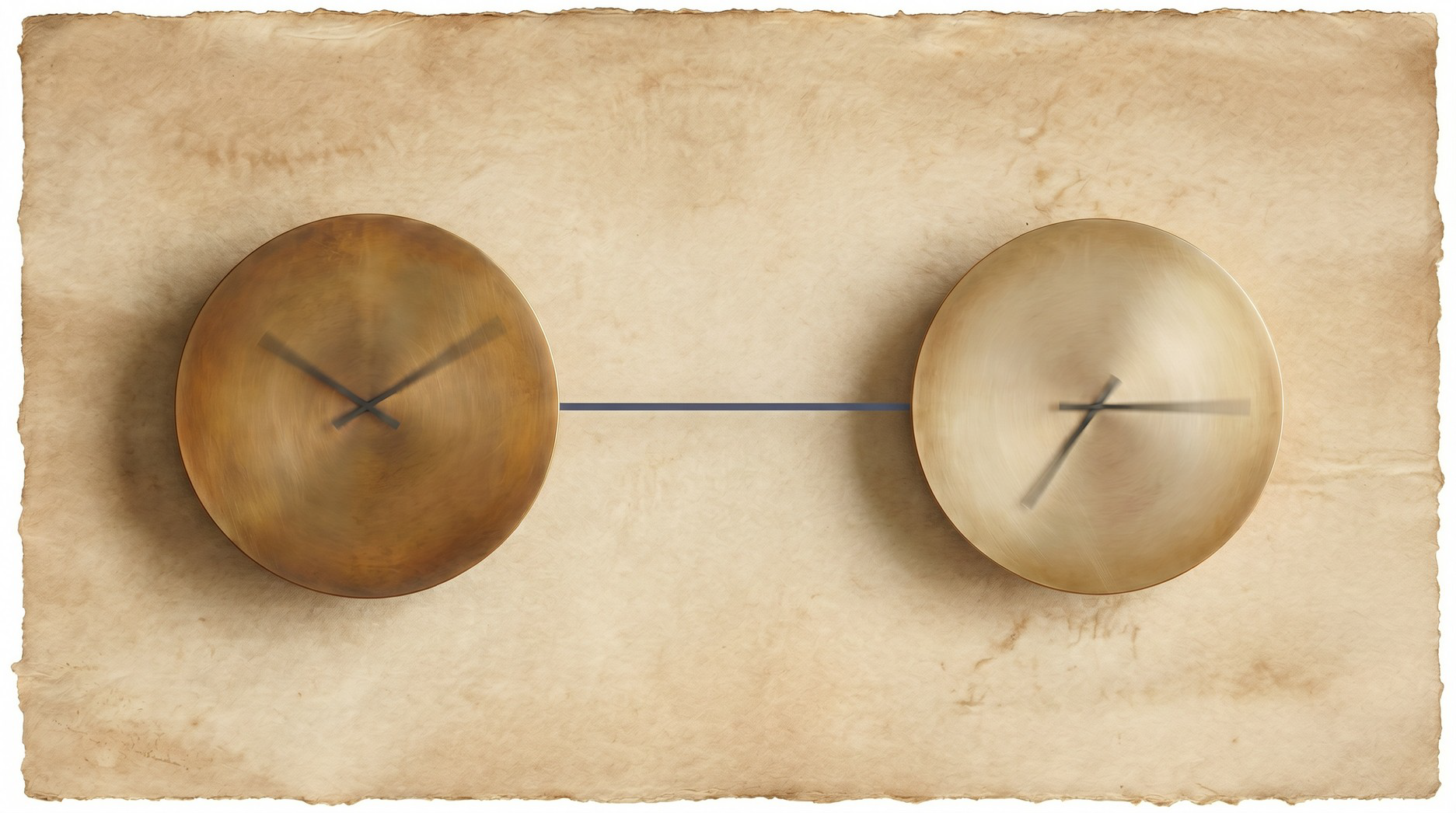
Two clocks are running at once. The clock of compounding crisis runs at the speed of the news cycle. The clock of compounding technological capability runs at the speed of the model release cycle. Each is running faster than the institutions built to absorb it, and the two have begun to keep time with each other. What is returning, when it returns, is a familiar historical pattern raised by an exponent we have not yet named. The title of this essay is one attempt to name it.
I. A Clash of Worldviews
The disruptions are not separate events. They are one event. They recur in history when the inherited interpretive frame of a civilization can no longer hold the world it is asked to interpret. The disagreements visible at the surface of 2026 are policy disputes. The disagreements that produce them are deeper, about what is real, what is valuable, who decides, and how human life should be organized. They are worldview disputes.
Samuel Huntington argued in 1996 that the next era of conflict would unfold along the seams between civilizations rather than between states, and his civilizational map has aged better than the policy world that dismissed it at the time.⁴ Francis Fukuyama, having earlier proposed that liberal democracy was the terminus of political history, spent the two decades after acknowledging in print that the terminus was provisional and was being contested again from inside the societies that thought they had won.⁵ Thomas Barnett mapped the world into a functioning Core and a disconnected Gap and warned that the seams between them were where the next century’s instability would concentrate.⁶ None of them had the whole picture at the time of their writings. We are now living all three pictures at once, and the fact that they read as complementary rather than competing is itself a finding.
The post-Cold-War economic settlement, organized around open markets, expert institutions, and multilateral frameworks, is being contested by an alternative coalition organized around state capacity, supply-chain control, technology sovereignty, and demographic confidence. Both coalitions claim a future. Both have working economies, working military and intelligence apparatus, working state-aligned technology programs, and working theories of legitimacy. The interpretive frame inherited from the late twentieth century cannot hold both, and the news cycle has begun forcing a choice the inherited frame was not designed to adjudicate.
A useful name for the felt texture of all this is what the futurist Jamais Cascio has called BANI, an acronym for Brittle, Anxious, Non-linear, and Incomprehensible.⁷ Brittleness now means that systems which worked yesterday fail tomorrow without warning, anxious populations have lost the ability to tell imminent threats from imagined ones, and non-linear effects cascade in directions no actor intended until the incomprehensible becomes the daily texture of trying to make a reasoned decision. BANI has been with us for several years, but the rate at which it is compounding has changed and the accelerants that have arrived are compounding it further. Both clocks now run fast at once, against an interpretive frame whose own instruments are being recalibrated by the acceleration they are built to read. That is the new condition.
II. The Pattern Returning
The pattern is older than the present moment. It came around once before in a form recognizable enough that the writers who lived through it left a record we can still read. Erich Fromm wrote Escape from Freedom in his apartment in New York in 1941, having fled Frankfurt seven years earlier, watching the German occupation of Europe extend toward the family and colleagues he had left behind.⁸ He argued that modern people, when faced with the burden of freedom in a collapsing institutional order, often flee toward authoritarianism, conformism, or destructiveness rather than bear the responsibility of autonomous choice. Hannah Arendt wrote The Origins of Totalitarianism through the late 1940s in New York, at the New School and in the apartments she rented while finishing it, publishing in 1951. The Human Condition followed in 1958.⁹ She argued that totalitarianism emerged when the public realm, the space in which people appeared to each other as equals doing the work of common life, was hollowed out by mass society and replaced by isolation, surveillance, and ideology that promised certainty in exchange for autonomy. Viktor Frankl wrote Ein Psycholog erlebt das Konzentrationslager, published in English as Man’s Search for Meaning, in Vienna in 1946, in a city still in physical ruins from the war, three years after walking out of Auschwitz and Türkheim and into a profession that did not yet know what to do with what he had to report.¹⁰ He argued that the people who survived the camps with their humanity intact were the ones who refused to surrender the construction of meaning to circumstances they could not control. Each of them was writing inside a moment that looked, from the inside, like the end of a civilization. Each of them was diagnosing a structural condition the policy responses of the day were not built to address. Taken together they describe a sequence we now know too well. People flee uncertainty, public space thins out, and meaning has to be rebuilt from materials closer to hand than the institutions that previously supplied it.
The intellectual revolution running underneath those years has not received the same continuing readership, but it produced the deeper rearrangement. The world picture that organized Western thought from Newton through Laplace, in which the universe was a separable mechanism whose state could in principle be specified in three dimensions and one time and from a vantage outside the system being read, was dismantled in physics over the first three decades of the twentieth century. Max Planck introduced the quantum of action in 1900. Albert Einstein, in 1905, produced the annus mirabilis papers on the photoelectric effect, special relativity, and Brownian motion, and then in 1915 and 1916 the papers on general relativity that made space and time properties of a coupled field rather than absolute stage on which events occurred. Niels Bohr proposed his atomic model in 1913. Werner Heisenberg developed matrix mechanics in 1925 and the uncertainty principle in 1927. Erwin Schrödinger produced his wave-mechanical formulation in 1926. John von Neumann published the Hilbert-space formulation of quantum mechanics in 1932, which is the mathematical framework that still organizes the field.¹¹
In my view, the intellectual revolution from Newton to relativity and quantum mechanics was, at root, a dimensional revolution. The old physics fit in three dimensions and one universal time, in a world whose state could in principle be specified from outside it. The new physics required higher-dimensional state spaces to be coherent at all, with the observer now inside the system being read and determinism dissolved into probability. The reading of nature moved from low-dimensional and separable to high-dimensional and entangled, and the mathematics that had described a machine gave way to mathematics for fields of coupled variables that observe themselves.
The political philosophers writing during the 1930s and 1940s were responding to a world whose interpretive underwriting had already given way, even when they did not name the underwriting directly. Fromm, Arendt, and Frankl wrote as if the older confidence in autonomous, separable, observable-from-outside reasoning could no longer support the institutional architecture that depended on it. Their diagnoses are read today as political philosophy. Read alongside the physics, they are something more than that.
Stephen Toulmin, in Cosmopolis: The Hidden Agenda of Modernity, argued in 1990 that the seventeenth-century settlement separating science, ethics, politics, and aesthetics into method-governed domains, each treated as self-governing in its own register, produced a single interpretive frame that failed in all four domains together when the assumptions underlying it gave way in the early twentieth century.¹² The political collapse and the scientific collapse were analogous collapses, expressed in different material, and the analogy holds in the precise sense Toulmin gave it. The philosophers writing in the 1930s and 1940s were responding to a world whose mathematical foundation had already given way, and the foundation matters because the inherited governance instruments of the late twentieth century were built on that foundation.
The same upheaval was visible in the arts of the same years. Constantin Brâncuși stripped bronze toward an essence representational sculpture could not reach.¹³ Jackson Pollock would later make the American counterweight, working on the floor of his Springs studio in East Hampton, Long Island, while the gesture recorded itself.¹⁴ T. S. Eliot, James Joyce, Arnold Schoenberg, and the Bauhaus school did parallel work in poetry, prose, music, and architecture across the same two decades, each abandoning the single-perspective subject for something high-dimensional, layered, and recursive.¹⁵ The art that emerged from those years is now read by markets in 2026 at prices the broader culture is only beginning to translate.
The artworks in Christie’s May 18, 2026 evening sale priced at record levels are products of exactly this revolution. A Pollock canvas, Number 7A, 1948, sold for one hundred eighty-one million dollars. A Brâncuși bronze, Danaïde, cast around 1913, sold for one hundred seven million.¹⁶ What the market priced in 2026 was the trace of human presence inside material, since the appearance of the work can now be generated by any image system in seconds. The prices do not by themselves prove the interpretation, since auction values also reflect scarcity, provenance, and trophy demand. The market behavior is consistent with the interpretation, particularly when the buyers of the works are the same population funding the systems that can now generate their appearance. The pattern that produced those works in the 1910s and 1940s, and the pattern that pays a quarter of a billion dollars for them in 2026, is a kindred pattern operating now under conditions of higher coupling and faster propagation.
The enterprise decision systems being built today, in this practice and in others, are among the first managerial instruments deliberately designed to model high-dimensional, interdependent decision environments at enterprise scale. The mathematical inheritance they carry is not, despite the temptation of the analogy, the quantum revolution directly. It is the closer, less celebrated inheritance of mid-twentieth-century operations research. George Dantzig developed the simplex method for linear programming in 1947 at the Pentagon and refined it through his work at RAND. Richard Bellman developed dynamic programming at RAND in the early 1950s. John von Neumann, who had earlier given quantum mechanics its Hilbert-spaces formulation, published Theory of Games and Economic Behavior with Oskar Morgenstern at Princeton in 1944, which became one of the founding documents of modern decision theory.¹⁷ Those mathematicians were working in the immediate intellectual shadow of the quantum founders, often inside the same institutions and using overlapping linear-algebra and probability machinery, but their object was different. They built the mathematics that lets a decision system optimize across coupled variables in a high-dimensional space, which is the mathematics that has now matured into enterprise infrastructure. The dimensional inheritance is genuine. Its lineage is operations research, not quantum mechanics, and the lineage applies specifically to the class of capabilities the enterprise systems described above actually deploy, which is high-dimensional decision optimization across coupled variables. It does not extend, by association, to claims about consciousness, general intelligence, or the broader social future of AI. The distinction matters because confusing the two is the standard error in talking about what AI systems are actually doing inside firms, and broadening the dimensional-inheritance claim past the specific capability class it describes is the same error in the other direction.
The inherited governance instruments are failing in plain view. The board structures, regulatory frames, professional credentialing systems, and committee cadences that organize enterprise authority in 2026 rested on the assumption that the world being governed is low-dimensional, separable, and observable from outside. None of those conditions still holds. The instruments we have are calibrated to a universe that no longer exists, and they are now being asked to govern instruments calibrated to the universe that replaced it. The gap is structural.
The pattern returning to the Nth power names this. The exponent is not rhetorical decoration. In a coupled system, the number of possible joint configurations of the variables grows exponentially with their count, and the number of distinct interaction terms grows combinatorially. Either way, a problem in twelve coupled dimensions is not twelve times harder than a problem in one but qualitatively different from it. That is the precise sense in which 2026 is not the 1930s scaled up. The inherited governance instruments were built for low-dimensional problems where the interactions could be enumerated and audited one at a time. The new instruments operate in regimes where the interactions cannot be enumerated at all, only sampled, and the sampling itself depends on the same systems being sampled. The exponent names that regime. It does not claim to be a number. It claims to be a class of problem the previous century did not have to govern, and the interwar generation built the mathematical disciplines this century is about to need to enter it. Practitioners in this complexity science space now build high-dimensional representations in Hilbert spaces, using functional analysis to identify the variables in a data set responsible for the system’s operation. Those variables, decomposed at Nth order, become the control knobs for constraint-based, non-linear optimization of the dynamical system itself. The technical chain and its lineage are carried in endnote 28.²⁸
III. The Mass-Accelerant
The gap has closed. The mathematics that once only described a strange universe now builds one, in real time, at enterprise scale. In 1925 the new science was describing a strange universe and the political and economic consequences took most of a century to propagate. In 2026 the new technology is building the strange universe inside the calendar quarter, and the propagation interval has collapsed from generations to quarters.
AI systems are constructing the present moment by the hour. Cognitive labor that used to be carried by editors, analysts, drafting attorneys, and policy researchers is increasingly carried by generative systems. Judgment loops that used to require a meeting, a memo, and a margin note now resolve in seconds inside a glass-box model context window. The machinery of public life, untouched by the new physics through the entire interwar period, is now being remade by the descendants of that physics inside the calendar quarter.
Inside a Fortune 100 enterprise in 2026, the honest reading of the world is high-dimensional in the formal sense. The crisis dimensions and the capability dimensions no longer sit on separate axes. They are interpenetrating, and the interpenetration is happening through technologies whose mathematics is itself high-dimensional. The model that ranks the policy options is the same model that targets the political advertising about those options, and is downstream of the same model that prices the commodity contracts the policy would affect. A response to one shock is, three steps away in the operational dependencies, exacerbating a different shock through a cascade of Nth-order effects no one has time to trace. The exponent of the title is operational here.
Together, AI, high-dimensional mathematics, and non-linear optimization are mass-accelerants of existing dynamics in the worldview clash. The capability does not produce the conflict. It speeds the conflict to a tempo the inherited governance instruments were never designed to keep.
IV. What This Does to People
The structure described so far is not abstract to the people living inside it. The cost shows up first as a loss of meaning, and then at the ballot box.
The most immediate effect on the average human being is the loss of meaning. The institutional ballast that once produced meaning by default has thinned out. The newspaper, the church, the union, the family, the neighborhood, the workplace, and the professional association used to provide a frame inside which a person could locate themselves and a community against which they could measure their lives. By “frame” I mean the interpretive scaffold a person uses to make sense of events, decide what matters, and locate themselves inside what is happening. Each of those frames has been weakened over the past forty years by economic restructuring, by technological disintermediation, by demographic change, and by the migration of social life onto platforms whose engagement metrics are at right angles to anything that produces durable meaning. A person in 2026 is left to construct the frame on their own materials, and most people do not have the materials.
Fromm named the mechanism eighty years ago. When the institutional ballast goes, people do not become free in any positive sense. They become available to whoever offers them the most convincing flight from freedom. The flight to authoritarian certainty, on the right and on the left, is what Fromm predicted under exactly these conditions, and it is the dominant political signal across multiple democracies in 2026. The traumatic muscle memory of offshoring across the last thirty years, which removed a large sector of the middle-class labor market for generations, sits underneath it. People who were told their work was appreciated and would be sustaining of a middle-class life were instead displaced from the promises of capitalism, and that displacement is now compounding with AI-driven cognitive-labor displacement and with migration-driven population shifts in a way the inherited political instruments were not built to absorb.
A nationalist wave has rolled across the democracies of the North Atlantic since 2024. Rassemblement National topped the French vote in the June 2024 European parliamentary elections with 31.4 percent. The FPÖ took first place in Austria that September. The AfD came in second in the February 2025 Bundestag at 20.8 percent in the final certified result. Reform UK has often run ahead of the Conservatives in British polling during 2025 and 2026. The United States held a presidential election in November 2024 in which immigration was the dominant campaign issue and the candidate who ran on it most directly was returned to office.¹⁸ The pattern is visible across the North Atlantic, and it is the pattern Fromm described.
Two readers open the same news on two platforms and walk away with incompatible accounts of the same event. They develop incompatible models of what is real, and they lose the precondition for acting together on the same evidence. Arendt diagnosed the loss underneath that fifty years before the platforms existed. The information environments through which civic life used to be carried have fragmented into algorithmic feeds whose primary function is engagement rather than common ground. Arendt’s diagnosis of the loss of the public realm reads, in 2026, as if she had written it about social platforms specifically. A high-dimensional information space, structured by recommendation systems no participant can see whole, cannot be governed by low-dimensional civic intuitions formed for a shared front page.
Springfield, Ohio, in September 2024 was a clear visible example. The city had absorbed a substantial Haitian immigrant population over the prior several years through normal channels of asylum and Temporary Protected Status. On the evening of September 10, 2024, the false claim that those immigrants were eating local pets was repeated on a national debate stage and amplified across social platforms within hours. The next morning, Springfield City Manager Bryan Heck and Mayor Rob Rue issued public statements that no credible reports of such incidents existed in the city’s records. The Springfield Police Division confirmed the same. The Clark County Combined Health District confirmed the same. The claim was nevertheless repeated nationally, and bomb threats began arriving at Springfield public schools on September 12, requiring building evacuations across the following two weeks. City hall and the Combined Health District were evacuated on September 13.¹⁹ The mechanism is the one Arendt described. When the public realm fragments, the basic shared factual ground on which civic argument depends fragments with it, and the people on the ground in the place the argument is about are the ones who absorb the cost.
When the public realm cannot hold, totalitarian movements move in to fill the vacancy, and the public realm is therefore not a luxury but the precondition for being able to act meaningfully at all.
Where Arendt’s concern was the public realm, Frankl’s was the person inside it. His answer was that meaning is operational, learnable, and never delivered by waiting. The people who came through the interwar collapse with their humanity intact were the ones who held the discipline against the circumstances they had, rather than the ones with the best circumstances. The work is operational, not consolatory, and it can be learned. Frankl’s discipline is also the closest analogue, at personal scale, to what high-dimensional environments now ask of institutions. The person inside the moment cannot govern it from outside any more than a board can govern an autonomous system without entering the loop the system is running.
The clearest visible example, since 2022, has been the work the Ukrainian writers and cultural workers have continued to do under conditions that would otherwise produce despair. When Russian forces first occupied his village of Kapytolivka in 2022, the Ukrainian children’s book author Volodymyr Vakulenko buried his diary in a glass jar under a cherry tree in his garden and told his father, “give it to our people when they come.” He was abducted by Russian forces a second time on March 24, 2022, and his body was later identified, by DNA, in grave number 319 in a mass burial site at Izium. After the de-occupation, the novelist Victoria Amelina, who had transformed herself from a writer of fiction into a war crimes researcher, found the diary under the cherry tree, photographed every page, and prepared it for publication. She was mortally wounded by a Russian missile strike on the Ria Pizza restaurant in Kramatorsk on June 27, 2023, and died of her injuries on July 1, before her own book was finished. Her unfinished manuscript, Looking at Women Looking at War, was completed by colleagues, published in 2025 with a foreword by Margaret Atwood, and awarded the Orwell Prize for Political Writing on June 25, 2025.²⁰ Amelina wrote in her foreword to the Vakulenko diary, “as long as a writer is read, he’s alive.” Frankl, who survived the camps because he refused to wait for circumstances to supply his meaning, would have understood both of them at once.
If this is the moment we are in, what should we do? How a person keeps meaning, and how that private discipline enters public life, are braided together. A braid is self-reinforcing, load-bearing, stronger, and topologically more complex than either strand alone.
V. The First Strand. The Personal Practice That Produces Light
The first half of the answer is the part a person can begin tonight, without permission from any institution, and without waiting for anyone else to act.
The discipline I want to name plainly is the practice of engaging in experiences that produce an ineffable residue. I mean experiences that leave something behind. A book read closely, then re-read because the first reading missed the place where the argument actually turns. The slow work of a meal made for someone who is going to eat it in your house. A hard conversation that ends in repair rather than agreement, and an afternoon given to a friend who needs it with no billable hours involved. The slow making and slow attending of objects, relationships, and acts that carry the trace of human presence.
I have written elsewhere about a teacher who tried to teach me to see this when I was sixteen.²¹ What I learned in her classroom is what the May 18, 2026 auction at Christie’s just confirmed in cash. What gets priced at one hundred eighty-one million dollars for a Pollock and one hundred seven million for a Brâncuși is not the appearance of the work, since the appearance can now be generated by any teenager with a phone. The market is paying for the trace of a human’s presence inside the material. The hours Brâncuși spent polishing the bronze head in his Paris studio around 1913, releasing what he believed was the essence of the form from the matter that contained it. The afternoons Pollock spent on the floor of his Springs barn in 1948, moving around a canvas with a stiffened brush, letting the gesture record itself. Each work is the trace of a specific person at a specific workbench on specific afternoons, doing something the world had not seen before. The experience the viewer has standing in front of those works is what the market priced, and AI cannot produce it because AI has never been embodied.
The same thing is available to a person in their own life, not at a level any auction house will price, but at a level much smaller and much more important. A well-made meal carries the trace of the person who cooked it. A letter actually written rather than texted carries the trace of the writer. A craft pursued for years without commercial reward carries the trace of the years. These are not luxuries to be carved out of busy lives. They are the practices that produce a residue the BANI condition is otherwise eroding. The residue builds resilience and strength in the person who keeps it.
What the work has taught I have learned over thirty years, at a desk in Princeton, in client rooms across three continents, and in the two career stretches in China and Iraq. The third-clock discipline I built on those years is the same discipline I bring now to the architecting of autonomous decision systems in my own practice. The work is done most often at the desk in my house in the middle of the night, when the quiet is the kind the critical reasoning work requires. I was at that desk one evening trying to find a form for an agent that would carry three capabilities at once, human-like reasoning, knowledge validation, and autonomous system execution, inside a single architecture that could hold them together rather than bolt them in sequence. I had been holding the problem for months. The various forms of artificial intelligence and applied mathematics each did some part of what was needed and none of them did the whole, and the question was how the parts fit. The moment came the way pieces of a jigsaw resolve, not one after another, but together. The architecture I had been holding became visible end to end at once, and what I was building was visible as one thing rather than three problems. I documented the moment at the desk because I have learned over the years that the moments worth keeping are kept by writing them down. What the documenting recorded was the same kind of residue that stays after standing in front of a Brâncuși bronze or a Pollock canvas or a Noguchi table. What a bronze carries that an architecture cannot is the trace in worked material. What an architecture carries that a bronze cannot is the recognition of three problems becoming one. I felt the recognition that evening at the desk, and learned to trust the residue when it comes. The third clock keeps time inside the work, not outside it.
What the work has taught I have also learned in particular rooms with particular people. In a recent steering committee for a Fortune 100 client, three hours into a long afternoon, a senior executive responsible for one of four functions the recommendation on the screen would reorganize looked at it for a long moment and said, quietly, “If this is right, then I do not understand what my job is anymore.” He was not protesting. He was reporting. The recommendation was right by every internal validation the firm could bring to bear on it. His thirty years of expertise was right too, by every measure his organization had ever used to evaluate it. The mathematics had read the firm in dimensions his career had been built on holding separate.
There was no villain in that room. There was the work of one career, the work of an analytical method I have spent thirty years building, and a table with both of them on it, and a question no one in the room had the standing to answer because the standing had just been re-described. That is the gap. It is not a defect to be optimized away. It is what happens when the math can see across the axes (function, geography, P&L line, time horizon) that the firm was built to keep apart, and I was in the room when it opened.
Meaning has to be made from the materials at hand. Language, image, sound, the slow shaping of stone or canvas or paragraph or relationship. As institutions thin out, that hand-made practice matters more. The light, in its personal register, comes from this inner practice. There is no other source available to a person tonight.
VI. The Second Strand. The Public Practice That Carries Light
The second half of the answer is what the practitioner-witness owes the public.
Philosophers, regulators, and public talkers all have a role in the moment we are in, but they cannot carry it alone. Some of the public work has to be done by the people who built the systems being deployed, because public trust attaches differently when the work came first. The mid-century explainers carried that authority quietly, in public. Einstein had worked the physics,²² Keynes had worked the economics,²³ and Oppenheimer had worked the bomb,²⁴ and what they said about consequence carried because the work was already known.
The architects of enterprise AI now carry an analogous responsibility. The systems being built inside companies for logistics, materials, capital allocation, and decision support are also reshaping the public realm. The dual use was not designed in. It emerged. The architects who see this most clearly are the ones living with the recognition that what they built for one purpose is doing something else in the world, and that the obligation to explain comes with a quiet accountability for the second use. The standard is the one the mid-century explainers held themselves to. Speak only to what the work has actually taught, no more and no less. What makes the obligation new is the mathematics. The same mathematics that gives the new instruments their reach is what makes their second-order effects unreadable to the institutions trying to govern them, and the practitioner is the person who can see across both.
Leadership of this kind is needed at every level. It belongs in the boardroom and the classroom, on the newsroom desk, and in the slow work of teaching the next generation what the current generation is still learning. Not as a single voice descending from the top, but as a culture of practitioners distributed across many fields, each doing the personal work and offering it publicly in whatever forum is available to them. The culture is being formed already. It is not yet at the scale the moment requires. It is also not nothing.
History matters at this scale because the standard already exists in the record. Marcus Aurelius held the Roman frontier through plague and war from 161 to 180, carrying public responsibility while also keeping private Greek notebooks in the camp, the writing we have come to know as the Meditations, never intended for publication.²⁵ The Antonine Plague killed somewhere in the range of five to ten million people across the empire during his reign by modern epidemiological reconstruction, and the Marcomannic Wars ran on the northern frontier through most of it. He carried the public work and also kept the private discipline, and the discipline produced the steadiness the public work required.
Lincoln matters here for the same reason. He delivered the Gettysburg Address on November 19, 1863, in two hundred seventy-two words, likely in the prodromal phase of varioloid smallpox, carrying personal grief for his son Willie, who had died at age eleven the year before, and the accumulated weight of two and a half years of the deadliest war his country had ever fought.²⁶ The address worked because he delivered it from inside that exhaustion rather than around it. He explained the moment publicly because he had been working on it privately, in language, for months. Eisenhower, almost a century later, delivered his Farewell Address on January 17, 1961, three days before leaving office, with a warning about the military-industrial complex that carried because the warning was his own private judgment offered publicly by the leader who had built the architecture from the inside.²⁷ In each case the private discipline produced the steadiness the public work required, and the public work gave the private discipline somewhere to land.
What this looks like on Monday is concrete enough to put on a calendar. Two practices, each small, each repeatable, and each designed to defend the third clock inside an institution that is otherwise being run on the first two.
The first is the reading practice. Once a week, a single long-form argument from outside the firm’s own intellectual circle gets read in full by the senior team, in advance of any position the firm takes on the news cycle that touches it. Not summarized. Not extracted. Read. The cost is one hour of the senior team’s calendar per week. The benefit is that no firm position on any contested public question gets formed without one piece of evidence the firm did not select.
The second is the dissent paragraph. Any major model-driven recommendation that reaches a governance body, whether a board committee, an investment committee, or an executive operating committee, travels with a single paragraph of dissent written by a senior practitioner inside the firm who disagrees with it. The dissent is written before the recommendation is presented, not after. It is read aloud by the dissenting practitioner, in the room, before discussion opens. It is not advisory and it does not require resolution. It is structural, and it exists because in a high-dimensional decision environment the absence of an articulated alternative is the single most reliable indicator that the recommendation has not yet been governed. The dissent paragraph is written by a senior practitioner the recommendation will affect, designated by the governance body in advance, and not necessarily the most senior person in the room. The practice is triggered for every model-driven recommendation above a threshold the governance body sets and reviews quarterly. The dissent does not carry decision authority and does not require legal indemnification beyond the protection already extended to good-faith governance speech.
Both practices are inexpensive. Both are difficult to maintain. Both are visible from outside the firm to the practitioners who are doing them, because the decisions they produce should be measurably better than the decisions produced by institutions that did not adopt them, within the working year in which they begin.
Two small practices are a deliberately modest answer to a problem framed at large scale, and the modesty is the point. The work is recursive. A board that adopts the reading practice and the dissent paragraph will, within a quarter or two, find itself in a position to see what it had been failing to see, and what to do next will become more visible from inside that position than it could be made from outside it. The playbook is small on purpose. The right next moves can only be discovered from inside the work by the people doing it.
The civic stakes are direct, and they are visible in this writing window. The German vote in February of last year produced one of them. The French and Austrian votes the autumn before produced others. The American election in November of 2024 was a third. In each of those contests the line between governable disagreement and ungovernable certainty was being argued, in public, by populations who had been losing their grip on a shared factual ground for a decade. The people want a shared factual ground; they need the light to give themselves the permission to believe, to trust, and to identify a common reality they have a stake in.
VII. The Third Clock
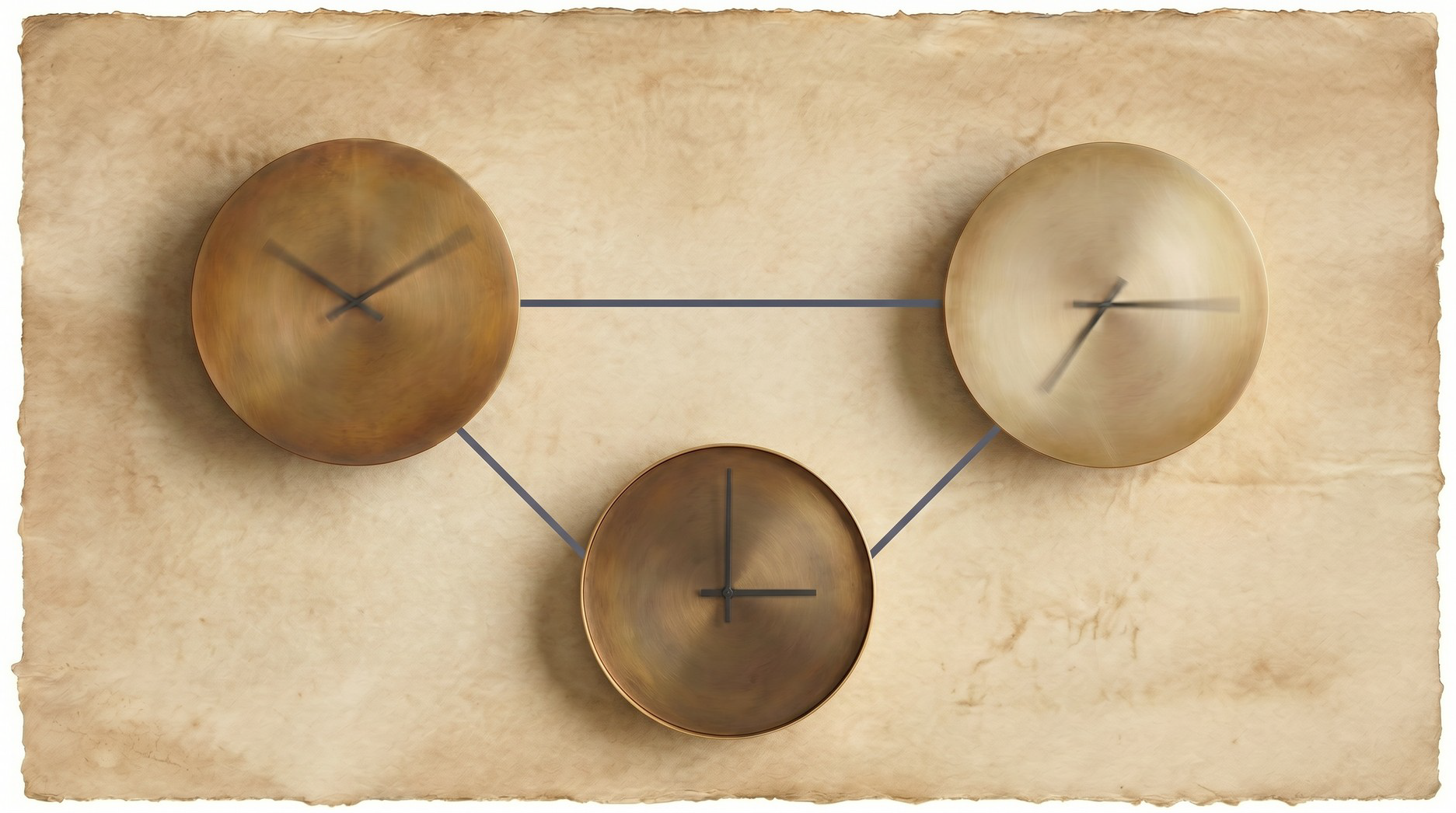
In the prelude I told you that two clocks were running. The clock of compounding crisis at the speed of the news cycle, and the clock of compounding capability at the speed of the model release cycle. That was what I knew how to name at the beginning of the essay. It was true and it was insufficient.
There is a third clock, which has been here the whole time.
It runs slower than the other two and does not produce news.
Marcus Aurelius kept it in a campaign tent on the northern frontier in the late 170s. He had buried a son. The plague had killed somewhere between five and ten million people inside the empire he was responsible for. He was sixty years old, in the field again, and he wrote in Greek on whatever surface he had, for no reader. The notebooks we read as the Meditations are what he kept by writing through. He did not call this a clock. He called it the work of being a man.
Volodymyr Vakulenko kept it under a cherry tree. Victoria Amelina kept it walking into the morgue at Izium to identify what was left of him. Frankl kept it in barracks 14 at Türkheim.
I have travelled and worked extensively in my career for more than thirty years. Two stretches stand out when the third clock was apparent. From 1994 to 1998 I traveled to China as it was awakening, and from 2006 to 2010 I worked in Northern Iraq during the Iraq War. During each of those times I created a discipline where I would reflect upon the day’s events quietly, contemplatively, in order to make sure the consequential events I was witnessing registered with me and I was able to internalize their importance. The clock slowed. I burned the experiences into memory, and was able to use that memory to function effectively the next day on the lessons I had just registered.
The third clock is the one at which any of this is done. It produces no news. The people keeping it are usually not in the room where the news is being made, which is the only reason there is news worth reading at all.
The light the prelude was asking after is coming from this clock, and any reader doing comparable work in 2026 knows it from the inside.
I am writing this on a Saturday morning at three am. Jazz music is playing quietly in the background. The house is still. I can hear the wind outside. There is iced cold brew coffee. In three hours the first email of the day will arrive. By Monday morning the war in Ukraine will have continued, the news in Washington will have moved twice, and the model release cycle will have produced something the firms I work with will spend the week metabolizing. I cannot slow any of this. What I can do is be here, at this table, writing in this hour, because the third clock is the one I am responsible for, and writing is one of the ways I keep it.
A Closing Note for the Practitioner
If any of this is worth carrying into the working week, start smaller than strategy usually allows. Protect one stretch of attention each day, without an audience. Read outside your usual sources of information in full. Treat AI deployment as a governance judgment before it becomes an operating habit. And hold the discipline of refusal alongside the discipline of capability, because the most consequential engineering judgment of this decade is what a system should be designed not to do. Writing that judgment into the architecture before the architecture is built is what separates a trustworthy system from a powerful one.
The standard is older than the technology and survives the technology.
I have spent most of thirty years learning the science and technology, trying to understand how to design and engineer such a foundational capability for autonomous intelligence and decision-making systems. Most of this thinking has happened at times and in places where the pace of the third clock governed.
The iced cold brew is gone. The first email has arrived. I am going to close the laptop in a moment and go for a walk. It is six in the morning now and the sky outside is beginning to lighten. The light, when it comes, comes from the practice. The practice belongs to whoever does the work. There is no other source.
Stephen DeAngelis
Princeton, NJ
May 2026
About the Author
Stephen F. DeAngelis is the founder, president, and CEO of Enterra Solutions and Massive Dynamics, two companies that apply artificial intelligence and advanced mathematics to complex enterprise challenges. His work spans international relations, national security, and commercial technology, with visiting research affiliations at Princeton University, Department of Chemistry, the Computing and Computational Sciences and National Security Directorates of the Oak Ridge National Laboratory, the Software Engineering Institute at Carnegie Mellon University, and the MIT Computer Science and Artificial Intelligence Laboratory. He holds patents in autonomous decision science.
Notes
¹ Russia’s full-scale invasion of Ukraine began on February 24, 2022. By May 2026, the war had entered its fifth calendar year. Encyclopedia Britannica, “Russia-Ukraine War,” entry updated regularly. UN General Assembly Resolution ES-11/1 (March 2, 2022) condemning the invasion. https://www.britannica.com/event/2022-Russian-invasion-of-Ukraine
² The North Atlantic Treaty was signed in Washington on April 4, 1949. Sustained defense-posture reorganization in response to the Ukraine conflict has accelerated through the 2024-2026 period. NATO official history, “A Short History of NATO.” https://www.nato.int/cps/en/natohq/declassified_139339.htm
³ The Strait of Hormuz has experienced sustained disruption since the resumption of direct US-Iran conflict in February 2026. Iranian forces have attacked merchant shipping repeatedly across the Persian Gulf, Gulf of Oman, and Strait of Hormuz. Windward maritime intelligence, “Iran War Vessel Attacks and Maritime Infrastructure Strikes,” April 2026. https://windward.ai/blog/iran-war-vessel-attacks-and-maritime-infrastructure-strikes/
⁴ Huntington, Samuel P. The Clash of Civilizations and the Remaking of World Order. New York, Simon & Schuster, 1996. Huntington’s thesis, first advanced in Foreign Affairs in 1993, was that post-Cold-War conflict would unfold along the seams between civilizational blocs rather than between states or ideologies.
⁵ Fukuyama, Francis. The End of History and the Last Man. New York, Free Press, 1992. Fukuyama later revised the position substantially in Political Order and Political Decay, Farrar, Straus, and Giroux, 2014, and Liberalism and Its Discontents, Farrar, Straus, and Giroux, 2022, acknowledging the contestation of the terminus from within liberal societies themselves.
⁶ Barnett, Thomas P. M. The Pentagon’s New Map, War and Peace in the Twenty-First Century. New York, G. P. Putnam’s Sons, 2004. Barnett’s Core-Gap framework, developed during his work at the U.S. Naval War College, mapped the world by degree of integration into the global economic system and predicted that the seams between functioning Core and disconnected Gap would be where twenty-first-century instability concentrated. The author has corresponded with Barnett over many years and considers him an interlocutor; this affiliation is disclosed here for transparency and does not affect the use of his framework in the text.
⁷ The BANI framework, an acronym for Brittle, Anxious, Non-linear, and Incomprehensible, was coined by futurist Jamais Cascio in 2020 as a successor frame to VUCA. Institute for the Future, Navigating the Age of Chaos, A Sense-Making Guide to a BANI World (2020, updated 2025). Cascio, Jamais. “Facing the Age of Chaos.” Medium, April 2020. https://www.iftf.org/insights/navigating-the-age-of-chaos-a-sense-making-guide-to-a-bani-world-that-doesnt-make-sense/
⁸ Fromm, Erich. Escape from Freedom. New York, Farrar & Rinehart, 1941. Fromm authored the book while in exile in the United States, having fled Nazi Germany in 1934. Holt Paperbacks reissue, 1994.
⁹ Arendt, Hannah. The Origins of Totalitarianism. New York, Harcourt, Brace, 1951. Arendt, Hannah. The Human Condition. Chicago, University of Chicago Press, 1958.
¹⁰ Frankl, Viktor E. Ein Psycholog erlebt das Konzentrationslager. Vienna, Verlag für Jugend und Volk, 1946. English translation as Man’s Search for Meaning, Beacon Press, 1959.
¹¹ The principal papers of the quantum revolution: Planck 1900, Einstein’s 1905 annus mirabilis papers across Annalen der Physik volumes 17 and 18 and the 1915-1916 general relativity papers, Bohr 1913, Heisenberg 1925 and 1927, and Schrödinger 1926. John von Neumann formalized the Hilbert-spaces formulation of quantum mechanics in Mathematische Grundlagen der Quantenmechanik, Berlin, Springer, 1932. American Physical Society, “This Month in Physics History, February 1927, Heisenberg’s Uncertainty Principle.” https://www.aps.org/apsnews/2008/02/1927-heisenberg-uncertainty-principle
¹² Toulmin, Stephen. Cosmopolis, The Hidden Agenda of Modernity. New York, Free Press, 1990. Toulmin argued that the seventeenth-century settlement which separated science, ethics, politics, and aesthetics into autonomous domains, each governed by formal method, produced a single interpretive frame that failed in all four domains together when the assumptions underlying it gave way in the early twentieth century. University of Chicago Press paperback edition, 1992.
¹³ Brâncuși, Constantin (1876-1957), Romanian-born sculptor based in Paris from 1904. The bronze and marble heads, including Sleeping Muse, Mademoiselle Pogany, Danaïde, and the Bird in Space series, were the central work of his career. Geist, Sidney. Brancusi, The Sculpture. New York, Grossman, 1968.
¹⁴ Pollock, Jackson (1912-1956), American Abstract Expressionist. The drip-painting period at his studio in Springs, East Hampton, ran from 1947 to 1951. Number 7A, 1948, was painted at the Springs studio in 1948. Naifeh, Steven, and Gregory White Smith. Jackson Pollock, An American Saga. New York, Clarkson Potter, 1989.
¹⁵ Eliot, T. S. The Waste Land, first published in The Criterion (October 1922) and The Dial (November 1922). Joyce, James. Ulysses, Paris, Sylvia Beach / Shakespeare and Company, February 2, 1922. Schoenberg, Arnold. Suite for Piano, Op. 25, composed 1921-1923, the first work entirely in his twelve-tone method. The Bauhaus school operated in Weimar (1919-1925), Dessau (1925-1932), and Berlin (1932-1933) under Walter Gropius, Hannes Meyer, and Ludwig Mies van der Rohe.
¹⁶ Christie’s. “Christie’s Commences Spring Marquee Week With $1.1 Billion in Sales in A Single Night.” Press release, May 18, 2026. Masterpieces, The Private Collection of S.I. Newhouse totaled $630.8 million across 16 lots. Pollock’s Number 7A, 1948 sold for $181,185,000, a new auction record for the artist. Brâncuși’s Danaïde (bronze with gold leaf, conceived c. 1913) sold for $107,585,000, also a new auction record. https://press.christies.com/wp-content/uploads/2026/05/00e4ec1accf7b9fb0e29599b95b3296b.pdf
¹⁷ Dantzig, George B. Linear Programming and Extensions. Princeton, Princeton University Press, 1963. Dantzig developed the simplex method at the Pentagon in 1947 and continued the work at RAND. Bellman, Richard. Dynamic Programming. Princeton, Princeton University Press, 1957. Bellman developed dynamic programming at RAND in the early 1950s. von Neumann, John, and Oskar Morgenstern. Theory of Games and Economic Behavior. Princeton, Princeton University Press, 1944. The book founded modern game theory and provided the formal framework for utility theory and rational decision under uncertainty. For the institutional history of the optimization tradition, see Mirowski, Philip. Machine Dreams, Economics Becomes a Cyborg Science. Cambridge, Cambridge University Press, 2002.
¹⁸ European Parliament election results, June 6-9, 2024 (Rassemblement National 31.4% in France). Austrian federal election results, September 29, 2024 (FPÖ 28.8%, first place). German Bundestag election results, February 23, 2025 (AfD 20.8% in the final certified second-vote share, second place). Source: Federal Returning Officer, Mitteilung 29/25, final-result press release, https://www.bundeswahlleiterin.de/en/info/presse/mitteilungen/bundestagswahl-2025/29_25_endgueltiges-ergebnis.html. Reform UK polling overtaking the Conservatives from spring 2025 (YouGov, More in Common, and Find Out Now successive surveys). United States presidential election, November 5, 2024. AP VoteCast survey of approximately 120,000 voters identified immigration as among the most-cited determining issues. Pew Research Center, “Voters’ Views on Immigration in the 2024 Election,” October 2024. https://results.elections.europa.eu/en/ ; https://apnews.com/hub/ap-votecast ; https://www.pewresearch.org/politics/
¹⁹ Springfield, Ohio city officials publicly stated in early September 2024 that no credible reports existed of immigrants harming pets. City Manager Bryan Heck and Mayor Rob Rue issued statements; the Springfield Police Division confirmed no such reports in its records. The claim was nevertheless repeated nationally on September 10, 2024, and produced bomb threats requiring evacuation of Springfield schools, city hall, and the Clark County Combined Health District over the following two weeks. The New York Times, “How a False Claim About Haitian Immigrants Eating Pets Spread,” September 11, 2024. The Atlantic, “The Town That Trump Cast as a Crisis,” September 19, 2024. https://www.nytimes.com/2024/09/13/us/politics/biden-trump-haitian-immigrants-cats-dogs.html
²⁰ Vakulenko, Volodymyr. I Am Transforming… A Diary of Occupation, foreword by Victoria Amelina. Vivat Publishing, Ukraine, 2023. Amelina, Victoria. Looking at Women Looking at War, A War and Justice Diary, foreword by Margaret Atwood. William Collins / HarperCollins, February 2025. The book was awarded the George Orwell Prize for Political Writing on June 25, 2025, at a ceremony in London hosted by Lord Ken Macdonald KC. PEN Ukraine, “The Orwell Prize to Victoria Amelina’s book Looking at Women Looking at War,” June 26, 2025. The Guardian, Sarah Shaffi, “Orwell prize for political writing awarded to novelist killed in Ukraine war,” June 25, 2025. https://pen.org.ua/en/knyzhka-viktoriyi-amelinoyi-otrymala-premiyu-orvella ; https://www.theguardian.com/books/2025/jun/25/orwell-prize-for-political-writing-victoria-amelina-ukraine
²¹ DeAngelis, Stephen F. What She Taught Me to See, on the May 18 auction at Christie’s, and a debt I owe to the professor who showed me how to look. DeAngelisReview, Memorial Day Weekend 2026. https://www.deangelisreview.com/blog/what-she-taught-me-to-see
²² Einstein, Albert (1879-1955). The 1905 annus mirabilis papers on the photoelectric effect, special relativity, and Brownian motion, and the 1915-1916 papers on general relativity. Isaacson, Walter. Einstein, His Life and Universe. New York, Simon & Schuster, 2007.
²³ Keynes, John Maynard (1883-1946). The General Theory of Employment, Interest and Money. London, Macmillan, 1936. Skidelsky, Robert. John Maynard Keynes, A Biography, three volumes. London, Macmillan, 1983-2000.
²⁴ Oppenheimer, J. Robert (1904-1967). Scientific director of the Manhattan Project at Los Alamos, 1943-1945. Bird, Kai, and Martin J. Sherwin. American Prometheus, The Triumph and Tragedy of J. Robert Oppenheimer. New York, Alfred A. Knopf, 2005. The book was awarded the Pulitzer Prize for Biography in 2006.
²⁵ Marcus Aurelius reigned from 161 to 180 CE. The Antonine Plague began in 165 CE and recurred through the end of his reign, killing an estimated five to ten million people across the Roman Empire by modern epidemiological reconstruction. The Marcomannic Wars ran on the northern frontier through most of his reign. The Meditations, written in Greek, in the camp, as private notes never intended for publication, date from the campaigns of the 170s. Harper, Kyle. The Fate of Rome, Climate, Disease, and the End of an Empire. Princeton, Princeton University Press, 2017. Marcus Aurelius. Meditations, translated by Gregory Hays. New York, Modern Library, 2002.
²⁶ Abraham Lincoln delivered the Gettysburg Address on November 19, 1863, at the dedication of the Soldiers’ National Cemetery in Gettysburg, Pennsylvania. The address is 272 words in the standard text (the Bliss copy, the only version Lincoln signed and dated). Lincoln was diagnosed shortly after returning to Washington with a mild case of varioloid smallpox and was likely in the prodromal period when he delivered the address. His son Willie had died of typhoid fever on February 20, 1862, at age eleven. Wills, Garry. Lincoln at Gettysburg, The Words That Remade America. New York, Simon & Schuster, 1992. Goldman, Armond S., and Frank C. Schmalstieg Jr. “Abraham Lincoln’s Gettysburg Illness.” Journal of Medical Biography 15 (2007), 104-110.
²⁷ Dwight D. Eisenhower delivered his Farewell Address on January 17, 1961, three days before leaving office. The address warned against the “acquisition of unwarranted influence, whether sought or unsought, by the military-industrial complex.” Eisenhower had served as Supreme Commander of Allied Expeditionary Forces in Europe during the Second World War before two terms as President from 1953 to 1961. Eisenhower Presidential Library, “Farewell Address” archival materials. https://www.eisenhowerlibrary.gov/research/online-documents/farewell-address
²⁸ On the operational chain referenced in the body: the mathematical apparatus practitioners in this complexity science space deploy includes operator-theoretic methods for high-dimensional dynamical systems (Koopman and Perron-Frobenius operators, which lift non-linear dynamics into linear operators on infinite-dimensional Hilbert spaces of observables), reproducing kernel Hilbert spaces methods for state estimation and control, dynamic mode decomposition and its variants for identifying the variables governing observed behavior, and constraint-based non-linear optimization frameworks for steering the system once the governing variables are identified. The lineage is the operations research / control engineering / functional analysis family; the apparatus matured through the latter half of the twentieth century and has now reached enterprise deployment scale. Koopman, B. O. “Hamiltonian Systems and Transformation in Hilbert Spaces.” Proceedings of the National Academy of Sciences 17 (1931), 315-318. Mauroy, Alexandre, Igor Mezić, and Yoshihiko Susuki, editors. The Koopman Operator in Systems and Control. Cham, Springer, 2020. Schölkopf, Bernhard, and Alexander J. Smola. Learning with Kernels. Cambridge, MIT Press, 2002. Schmid, Peter J. “Dynamic Mode Decomposition of Numerical and Experimental Data.” Journal of Fluid Mechanics 656 (2010), 5-28.
Share this post