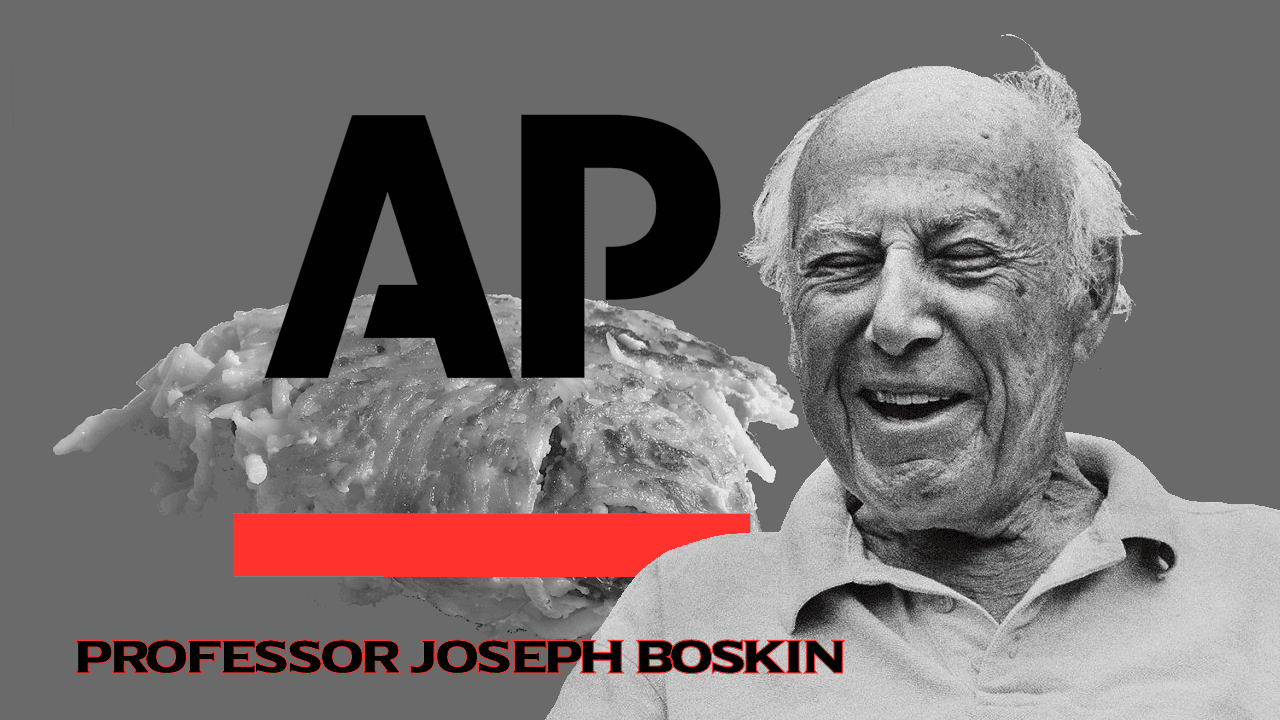
O.
On Monday evening, May 18, 2026, two paintings sold at Christie's in Rockefeller Center for nearly three hundred million dollars between them. A Jackson Pollock canvas, dripped on a Long Island barn floor in 1948, went for one hundred eighty-one million. A Brâncuși bronze head, polished in a Paris studio around 1913, went for one hundred seven million. Both set new auction records for their artists. The newspapers the next morning called it a story about money.
It is not a story about money. It is the conclusion of an argument a high school teacher in Westchester County was already making about Brâncuși and Pollock, to sixteen and seventeen-year-olds in a philosophy classroom, in the fall of 1978.
That teacher was Dr. Florence Hetzler. I was sixteen. This is what I have come to understand she was telling us, and what the auction last week confirmed.
I.
In the fall of 1978, I first walked into a classroom of Dr. Florence Hetzler at Scarsdale Senior High School, in Scarsdale, NY, as a junior. She taught Latin and French and philosophy. She did not speak the way other teachers spoke. She explained complex philosophy to teenagers, and to the right kind of student she was motivational and inspiring.
Sometime that year, or possibly the following, she organized a couple of class trips to Manhattan and across the river to Long Island City. We went to Isamu Noguchi's working studio. It was not a museum, and it was not open to the public. Noguchi was alive and working there. A few years later he would begin converting a former photogravure plant across the street, at 32-37 Vernon Boulevard, into what would open in 1985 as the Isamu Noguchi Garden Museum.
She took us to Lincoln Center and Carnegie Hall to meet opera singers and ballet dancers. The goal was to expose us to the arts and to open our minds to aesthetics, one of her passions. I did not fully understand what I was seeing. I understood only that the woman who had taken me there understood it completely, and that the understanding mattered to her in a way that was very deep and passionate.
Between my junior and senior years, in the summer of 1979, Dr. Hetzler arranged for me to enroll in summer classes at Fordham University, where she also held a faculty position. She did this for me. I understood that I was being taken somewhere to expand my mind, to find more challenging coursework, and that the person doing the taking thought it was important enough to spend her own time and her own institutional standing on a teenager, her student, who lived about a mile away from her.
I graduated from Scarsdale High School in June 1980. It would take me decades to understand what she had given me.
II.
What I knew of her then was only what she let me see in a classroom. The rest I learned much later, most of it after she had died.
Florence M. Hetzler was born in Rochester in 1926. She joined Scarsdale Senior High School in 1951 and stayed for thirty-four years. She completed her Fordham doctorate in 1959, writing it on Aquinas reading Aristotle's Physics, which is the deep end of medieval scholasticism and the deep end of philosophy generally, while instructing teenagers in Scarsdale. She was a Fulbright Scholar at the Sorbonne in 1960 and a professor of philosophy at Canisius College in Buffalo the following academic year, on leave from Scarsdale both times. She joined Fordham's faculty in 1968 and held both appointments at once, teaching teenagers on weekdays and graduate philosophers on evenings and weekends, for nearly two decades.
She founded the International Brâncuși Society and edited the volume Art and Philosophy: Brâncuși, The Courage to Love, which Peter Lang published in 1991, the year she died. Mircea Eliade attended a panel of hers at Notre Dame in April 1978, and her 1982 French translation of Brâncuși's writing on the Endless Column is preserved among his papers at the University of Chicago.
There is a part of this I did not know when I was sixteen and would not learn until I was much older. In the years she was teaching me, 1978 and 1979 and 1980, she was working on what would become her most cited piece of writing. In 1982, two years after I graduated, she published an essay in the Journal of Aesthetic Education called "The Aesthetics of Ruins: A New Category of Being." The essay argued that a ruin is a third kind of beauty, neither natural nor artistic but a fusion of the two, and that in front of a ruin we come closer to what she called the sublime, the ineffable, and the indescribable than we ever come in front of nature alone or art alone. Scholarly literature on ruins aesthetics still credits her framework as foundational to the field. The phrase she gave the literature is still the phrase the literature uses.
She did not present any of this to us as her own argument. She presented it as the question. What is it about a ruin, or a polished bronze head, or a canvas dripped on a floor, that we cannot explain by appearance alone. She was likely composing the argument while teaching it. She was making it legible to sixteen-year-olds at the same time she was making it sayable to the Journal of Aesthetic Education.
In 1983, a few summers after I had graduated, Dr. Hetzler was in Montreal at the World Congress of Philosophy, where she directed a staged interpretation of Brâncuși's Endless Column and personally performed the role of Diotima, the philosopher of love from Plato's Symposium. A Scarsdale high school teacher, in Montreal, on the world philosophical stage, becoming Plato's teacher of Eros to interpret Brâncuși's stairway to heaven.
I did not know any of this when I was her student. I do not believe most of her students did. She did not advertise herself. She arrived, taught, gave us what she had, and went home to write what she wrote.
III.
What she taught us, when we were old enough to receive it, was a single idea.
Art is not decoration.
Art is philosophy in material form.
The sculptor and the painter are doing the same work as the philosopher, by other means. They are trying to give material shape to something that has no representational shape to begin with. Brâncuși, on one level, was not an abstract sculptor. By his art, transcending the material world, he embodied Platonist ideals, polishing forms for years to release the essence of a subject from the matter that contained it. He flared up, the literature records, whenever he heard anyone say abstract. He insisted on the opposite. He was a realist of essence. The surface was beside the point. He said it plainly. The real is not the external form. The real is the essence of the thing.
The trip to Noguchi's studio was the lived form of the same argument. Noguchi had been Brâncuși's assistant in Paris in 1927. He carried the Romanian sculptor's discipline of essence into American sculpture and into the postwar New York art world. When Dr. Hetzler described his work, she was walking us through one of the most direct lines of artistic transmission in modern art, and she was doing it with a group of high school students from a Westchester high school. She knew exactly what she was doing. We did not.
Pollock came into my vocabulary through her too. I understood Pollock later as the American counterweight to the European modernists she had personally worked on. Brâncuși removed the depicter from the depiction by polishing toward essence. Pollock removed the depicter by stepping inside the painting. He worked on the floor. He moved around the canvas. He let the gesture record itself. "When I am in my painting, I'm not aware of what I'm doing," he wrote in his statement for the journal Possibilities, Winter 1947 to 1948, and the sentence is the most exact description of the discipline ever offered. He had no representational subject. His subject was his own presence inside the act of making.
Brâncuși and Pollock were doing the same philosophical work from opposite directions. One reduced by subtraction. The other reduced by immersion. One released essence from matter. The other released gesture into matter. Neither was painting or sculpting a picture of anything. Both were trying to leave, in matter, the trace of something that had no representational form. They were making, as Dr. Hetzler would have said, the kind of object that contains a residue we can describe only as ineffable.
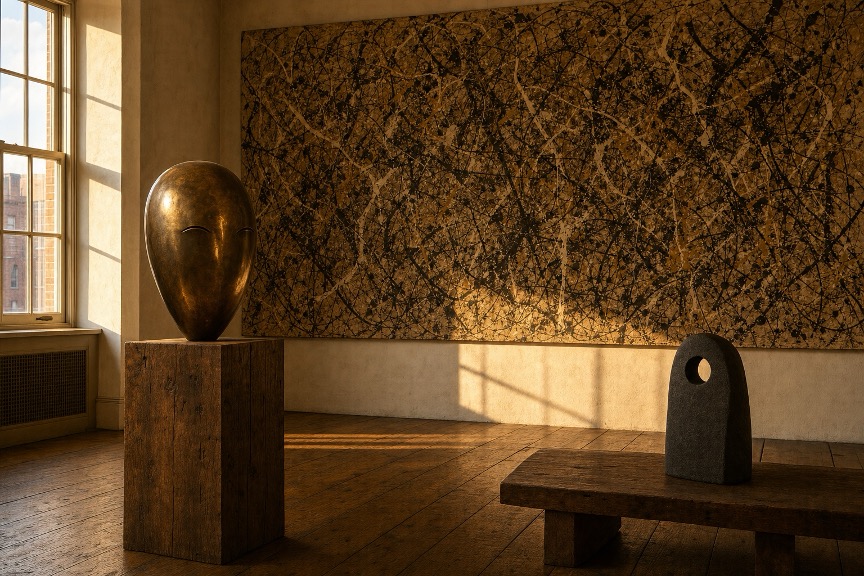
Three vocabularies in one warm room. A polished bronze ovoid, a field of dripped enamel, a reduced stone form. The argument she had been making to teenagers in Scarsdale, made spatial.
IV.
On the evening of Monday, May 18, 2026, at Christie's in Rockefeller Center, sixteen works from the estate of the publisher S.I. Newhouse came to auction in a single-owner sale. The sale carried the title Masterpieces: The Private Collection of S.I. Newhouse. Two of the sixteen works set records for their artists on the same evening. Jackson Pollock's Number 7A, 1948, a horizontal field of oil and enamel just under eleven feet wide that he had laid on the floor of his Springs barn in 1948, sold for one hundred eighty-one million dollars. Constantin Brâncuși's Danaïde, a bronze head with gold leaf that he had polished in his Paris studio around 1913, sold for one hundred seven million dollars. The Newhouse sale totaled six hundred thirty million dollars. Christie's evening sales that single night passed one billion dollars, only the second time in history that a single auction evening exceeded that mark.
The news the next morning was about the money. It is the news the next morning always is.
But the money is not the question. The question is what kind of object two collectors with that much capital, on the same evening, in a full salesroom and the entire global press, just decided was worth more than any work of its kind has ever been worth before. Markets at this level are not noise. They are a signal about scarcity. When the bidding for a single Pollock canvas runs for seven minutes and lands at three times the artist's previous auction record, the market is telling us something quite precise about what it believes is rare in the world right now.
What it is telling us is this.
We are living through the most powerful explosion of image-making technology in human history. The systems available to any teenager with a phone can produce, in seconds, an image in the style of any artist who has ever been digitized. They generate Pollock-adjacent surfaces, mimic Brâncuși-adjacent forms, and churn out a thousand variations before lunch. They have read the visible record of human image-making, and they can rearrange it on demand. They are the most extraordinary instrument of appearance ever devised.
What they have not produced, and what they are not architected to produce, is the thing two buyers at Christie's just paid two hundred eighty-nine million dollars for. No model has ever stood in a Paris studio polishing a bronze head for weeks to see whether the light off the surface makes the egg shape come alive. None has laid a primed canvas on the floor of a barn in East Hampton and walked around it dripping enamel from a stiffened brush to see what the gesture leaves behind. None has ever abandoned a hundred earlier versions in the rubbish because the proportion was almost right but not yet right. None has, by architecture, ever been present in any material at all. This is not a limit of the current models. It is a limit of the architecture.
The two objects that just set records were each, in their entirety, the trace of a human being's presence inside a material. That is the essence Brâncuși meant when he said the essence is not the external form. It is the presence Pollock meant when he said he was inside the painting. It is the residue Dr. Hetzler meant when she taught us, decades before any of this was urgent, that the most important thing an artwork carries is what it leaves with the viewer after they observe the piece.
That residue is what the market just priced.
It is the only thing the market has ever priced at this level, and the reason it is being priced at this level now, in this particular year, is that the contrast with what surrounds us has never been sharper. The digital substrate is the medium of appearance. It is exceptionally good at appearance. What it does not have, and cannot have because it has never been embodied, is the trace of a maker's hand inside the material. A Pollock canvas and a Brâncuși bronze are unforgeable in a way no digital file can ever be unforgeable, because what makes them what they are is not their appearance. It is the record of a particular human's presence at a particular workbench on a particular afternoon, and the residue left with the viewer.
That is rare. The market knows it is rare. Every year it grows rarer.
V.
There is one more ineffable residue. Hers in me.
I learned all of this from a woman who did not live to see any of it confirmed by an auction house. Florence Hetzler died on November 1, 1991, at Calvary Hospital in New York, after a long illness. She was sixty-five. She is buried in the family plot at Holy Sepulcher Cemetery in Rochester. She published her Brâncuși volume earlier the same year, and I would like to believe she held a copy in her hands.
She gave me the vocabulary to see. She did not tell me what to think about Brâncuși, or Noguchi, or Pollock. She showed me, in a practical sense, where they were and what they were doing and why everyone should care. She arranged the bus. She made the call to Fordham. She stood in front of a classroom of fourteen to seventeen-year-olds in Westchester County for thirty-four years and gave us, week after week, what she had spent her own life acquiring.
I did not write to her after I left Scarsdale. I did not visit her at Fordham. I was twenty-eight when she died, and what she had given me had not yet ripened into anything I could thank her for. Forty-six years after I left her classroom and thirty-five years after she died, this is the form the thanking takes.
I have spent my career building autonomous decision systems. The central question of my industry, right now, is whether a machine can produce essence, or only appearance. I argue about it in conference rooms with people who have never read a page of philosophical aesthetics. The question I have spent my career on is the question I first heard her ask about Brâncuși, in different words, almost half a century ago. She was working on art. I work on machines. The question is the same. The answer I am qualified to give is much smaller than the answer she gave. Much of my working language around aesthetics has its roots in what she taught me.
The auction on May 18 was, for me, a quiet confirmation. The works she had walked me toward as a teenager just told the market what she had been telling teenagers in Scarsdale all along. The thing the market priced is the thing she taught us was the only thing worth seeing. The contrast that made the prices possible is the contrast she had identified before any of us knew the contrast was coming.
She did not need the confirmation. The argument was already correct.
I needed it.
The residue she left in me is the only reason the auction looked, to me, like anything more than a story about money.
Stephen F. DeAngelis
Princeton, NJ
About the Author
Stephen F. DeAngelis is the founder and CEO of Enterra Solutions. He was Dr. Florence Hetzler's student at Scarsdale Senior High School from 1978 to 1980.
Notes:
1. The Isamu Noguchi Foundation and Garden Museum, timeline and "Noguchi's Vision for The Isamu Noguchi Garden Museum." Noguchi purchased the former Astoria Photo Engravers Supply Company building at 32-37 Vernon Boulevard in 1974 and used it as a studio warehouse adjacent to his working studio across the street, where he had lived and worked since 1961. Conversion of the photogravure-plant building into a public museum space began in early 1982; visits by appointment opened in late spring 1983; the Isamu Noguchi Garden Museum opened formally on May 11, 1985. https://www.noguchi.org/timeline/ and https://www.noguchi.org/isamu-noguchi/digital-features/noguchis-vision-for-the-isamu-noguchi-garden-museum/
2. Obituary, "Dr. Florence M. Hetzler, native of Rochester, well-known professor," Catholic Courier, November 1991. Records her death on Friday, November 1, 1991, at Calvary Hospital in New York City following a long illness, age 65, residence in Scarsdale, NY, and Dablon Pointe, Cape Vincent, NY; interment in the family plot at Holy Sepulcher Cemetery in Rochester; her Marymount College B.A. magna cum laude in 1946; her M.A. from L'Université Laval, Quebec, magna cum laude in 1947; her Fordham doctorate of philosophy in 1959; her Fulbright Scholar appointment at the Sorbonne in 1960; her professorship at Canisius College in Buffalo while on leave from Scarsdale in 1961–62; her appointment at Fordham University, School of General Studies, from 1968; and her tenure as professor of French, Latin, and philosophy at Scarsdale Senior High School from 1951 to 1985. http://lib.catholiccourier.com/1991-catholic-courier/catholic-courier-1991%20-%200911.pdf
3. Hetzler, Florence M., biographical note in Introduction to the Philosophy of Nature (Peter Lang, 1990). Records her founding of the International Brâncuși Society "for bringing together artists and philosophers," along with her Fulbright Scholar tenure at the Sorbonne, her receipt of the Teacher of the Year Award at Fordham University, and her Fellowship of the World Academy of Art and Science. Google Books reference: https://books.google.com/books?id=ks56AAAAIAAJ. Hetzler's role as founder is corroborated in the subsequent scholarly literature, including Alicja Kuczyńska, "Berleant's Phenomenology of Sculptural Space: Brâncuși," Contemporary Aesthetics, Vol. 19 (2021), which treats her as the convener of philosophical scholarship on Brâncuși.
4. Hetzler, Florence M., ed., Art and Philosophy: Brâncuși, The Courage to Love (New York, Bern, Frankfurt am Main, Paris: Peter Lang, 1991). The founding scholarly volume of the International Brâncuși Society, published the year of her death.
5. Hetzler, Florence M., "The Aesthetics of Ruins: A New Category of Being," Journal of Aesthetic Education, Vol. 16, No. 2 (Summer 1982), pp. 105–108. The essay argues that a ruin constitutes a third kind of beauty, neither natural nor artistic, in which "we come closer to the sublime, the ineffable, and the indescribable than we do in natural beauty or in artistic beauty only." University of Illinois Press. JSTOR: https://www.jstor.org/journal/jaesteduc
6. "Ancient Ruins and the Sublime," British Journal of Aesthetics, advance article published 2025, DOI 10.1093/aesthj/ayaf043. The paper identifies Hetzler's ruins aesthetics as foundational to the field and extends her argument. https://academic.oup.com/bjaesthetics/advance-article/doi/10.1093/aesthj/ayaf043/8350909
7. Kuczyńska, Alicja, "Berleant's Phenomenology of Sculptural Space: Brâncuși," Contemporary Aesthetics, Vol. 19 (2021). Documents Hetzler's directed staged interpretation of Brâncuși's Endless Column at the 1983 World Congress of Philosophy in Montreal, in which Hetzler personally performed the role of Diotima. https://contempaesthetics.org/2021/01/05/berleants-phenomenology-of-sculptural-space-brancusi-alicja-kuczynska/
8. University of Notre Dame Observer, April 12, 1978, which records that Hetzler would "make introductory comments on 'Eliade and Brancusi: The Endless Column,' and comments after the production will be made by Eliade." https://archives.nd.edu/Observer/v12/1978-04-12_v12_115.pdf. Hetzler's 1982 French translation of Brâncuși's "La colonne sans fin" is preserved in the Mircea Eliade Papers at the University of Chicago Library Special Collections, Box 2, Folder 4. https://www.lib.uchicago.edu/e/scrc/findingaids/view.php?eadid=ICU.SPCL.ELIADEM
9. The Noguchi Museum, "Chronology of Isamu Noguchi." Documents Noguchi's 1927 travel to Paris on a John Simon Guggenheim Fellowship and his apprenticeship in Brâncuși's studio, ending when the studio floor collapsed after a rainstorm in summer 1927. https://www.noguchi.org/isamu-noguchi/biography/chronology/
10. Pollock, Jackson, "My Painting," statement published in Possibilities, No. 1 (Winter 1947–48), pp. 78–83, edited by Robert Motherwell and Harold Rosenberg. The full passage reads: "When I am in my painting, I'm not aware of what I'm doing. It is only after a sort of 'get acquainted' period that I see what I have been about. I have no fears about making changes, destroying the image, etc., because the painting has a life of its own. I try to let it come through. It is only when I lose contact with the painting that the result is a mess. Otherwise, there is pure harmony, an easy give and take, and the painting comes out well." Pollock-Krasner Foundation; MoMA archive: https://www.moma.org/interactives/exhibitions/1998/pollock/website100/txt_possibilities_drip.html
11. Christie's, "Christie's Commences Spring Marquee Week With $1.1 Billion in Sales in A Single Night," press release, May 19, 2026. Records that Masterpieces: The Private Collection of S.I. Newhouse, the single-owner evening sale on May 18, 2026, totaled $630.8 million across 16 lots; that Christie's total evening sales for May 18 reached $1.1 billion, only the second time in history that a single auction evening exceeded $1 billion (after the Paul Allen collection sale); and that Number 7A, 1948 sold for $181,185,000, "three times the previous auction record" for Pollock, after seven minutes of bidding. https://press.christies.com/wp-content/uploads/2026/05/00e4ec1accf7b9fb0e29599b95b3296b.pdf
12. Christie's, "Jackson Pollock's postwar masterpiece 'Number 7A, 1948,'" essay by John Elderfield, Chief Curator Emeritus of Painting and Sculpture at The Museum of Modern Art, New York. Documents of the work as painted in 1948 in Pollock's barn studio outside his house at Springs, near East Hampton, Long Island; that Pollock had been using the barn as his studio for two years; and the artist's own statement that "On the floor I am more at ease. I feel nearer, more a part of the painting, since this way I can walk around it, work from the four sides and literally be in the painting." https://www.christies.com/en/stories/jackson-pollock-number7a-1948-john-elderfield-44b8c76206ad4793a8dccc3c899ea86f
13. Christie's, "Constantin Brancusi's 'Danaïde' changed sculpture forever," essay by Friedrich Teja Bach. Documents the work as bronze with gold leaf and black patina, height excluding base of 10⅞ in (27.1 cm), conceived and cast circa 1913, sold for $107,585,000 on May 18, 2026, setting a new auction record for the artist. https://www.christies.com/en/stories/newhouse-constantin-brancusi-danaide-friedrich-teja-bach-2891b5ddc13c4d238a4b60da49839418
9. The Noguchi Museum, "Chronology of Isamu Noguchi." Documents Noguchi's 1927 travel to Paris on a John Simon Guggenheim Fellowship and his apprenticeship in Brâncuși's studio, ending when the studio floor collapsed after a rainstorm in summer 1927. https://www.noguchi.org/isamu-noguchi/biography/chronology/
10. Pollock, Jackson, "My Painting," statement published in Possibilities, No. 1 (Winter 1947–48), pp. 78–83, edited by Robert Motherwell and Harold Rosenberg. The full passage reads: "When I am in my painting, I'm not aware of what I'm doing. It is only after a sort of 'get acquainted' period that I see what I have been about. I have no fears about making changes, destroying the image, etc., because the painting has a life of its own. I try to let it come through. It is only when I lose contact with the painting that the result is a mess. Otherwise, there is pure harmony, an easy give and take, and the painting comes out well." Pollock-Krasner Foundation; MoMA archive: https://www.moma.org/interactives/exhibitions/1998/pollock/website100/txt_possibilities_drip.html
11. Christie's, "Christie's Commences Spring Marquee Week With $1.1 Billion in Sales in A Single Night," press release, May 19, 2026. Records that Masterpieces: The Private Collection of S.I. Newhouse, the single-owner evening sale on May 18, 2026, totaled $630.8 million across 16 lots; that Christie's total evening sales for May 18 reached $1.1 billion, only the second time in history that a single auction evening exceeded $1 billion (after the Paul Allen collection sale); and that Number 7A, 1948 sold for $181,185,000, "three times the previous auction record" for Pollock, after seven minutes of bidding. https://press.christies.com/wp-content/uploads/2026/05/00e4ec1accf7b9fb0e29599b95b3296b.pdf
12. Christie's, "Jackson Pollock's postwar masterpiece 'Number 7A, 1948,'" essay by John Elderfield, Chief Curator Emeritus of Painting and Sculpture at The Museum of Modern Art, New York. Documents of the work as painted in 1948 in Pollock's barn studio outside his house at Springs, near East Hampton, Long Island; that Pollock had been using the barn as his studio for two years; and the artist's own statement that "On the floor I am more at ease. I feel nearer, more a part of the painting, since this way I can walk around it, work from the four sides and literally be in the painting." https://www.christies.com/en/stories/jackson-pollock-number7a-1948-john-elderfield-44b8c76206ad4793a8dccc3c899ea86f
13. Christie's, "Constantin Brancusi's 'Danaïde' changed sculpture forever," essay by Friedrich Teja Bach. Documents the work as bronze with gold leaf and black patina, height excluding base of 10⅞ in (27.1 cm), conceived and cast circa 1913, sold for $107,585,000 on May 18, 2026, setting a new auction record for the artist. https://www.christies.com/en/stories/newhouse-constantin-brancusi-danaide-friedrich-teja-bach-2891b5ddc13c4d238a4b60da49839418
Share this post