
By Stephen DeAngelis
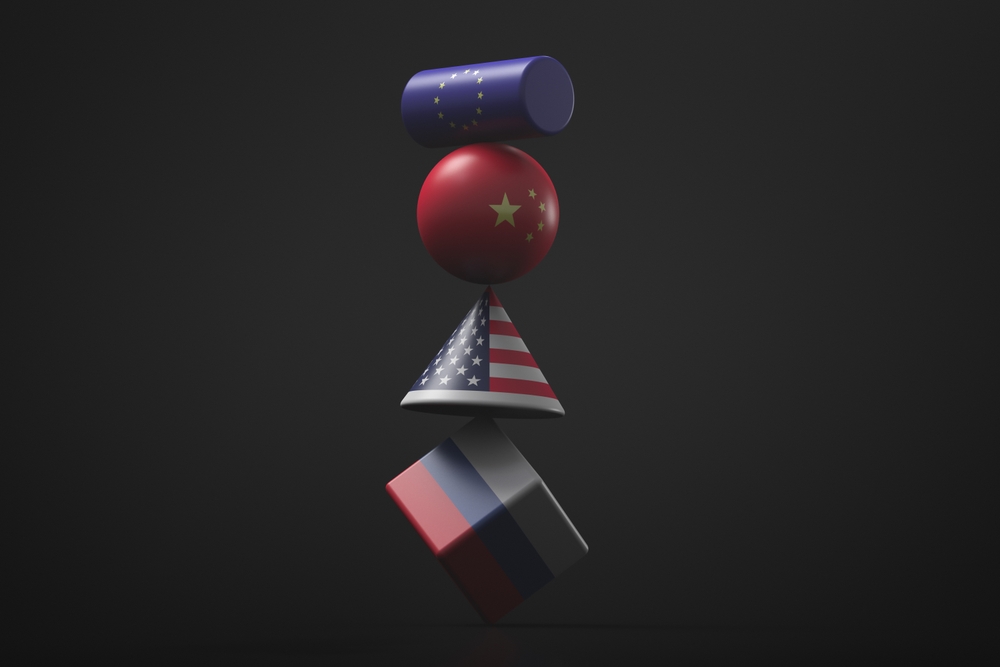
For business leaders, no question is more pressing than: “Where is the world order headed?” How the world is ordered plays a huge role in how global trade is conducted. A number of pundits have made predictions; however, political whims are changing so rapidly that it seems a fool’s errand to venture a guess. The best one can do is look for trends and keep abreast of current news. Analysts from the Boston Consulting Group (BCG) call the current situation “a patchwork world order.”[1] Despite the patchwork nature of the current global landscape, business leaders must continue to make decisions about how to run their businesses. The BCG analysts explain, “After a year of big trade policy shifts, global business leaders are left with a dilemma. Despite the prospect of continued uncertainty over tariffs and other policies, at some point they must move beyond tactical maneuvers, like stocking more inventory, and take important structural decisions. But when and where?”
Like Alice in Wonderland
In Lewis Carroll’s Alice’s Adventures in Wonderland, Alice came upon a Cheshire Cat in a tree and asked, “Would you tell me, please, which way I ought to go from here?” The Cat replied, “That depends a good deal on where you want to get to.” To which Alice replied, “I don't much care where.” The wise Cat responded, “Then it doesn't much matter which way you go.” Dismayed, Alice said, “So long as I get somewhere.” To which the Cat replied, “Oh, you're sure to do that, if only you walk long enough.” Like Alice, many global business and political leaders are now asking, “Which way should I go from here?” With no clear answer to that question, the world will nevertheless end up somewhere. At the start of last year, BCG analysts outlined four broad “tectonic shifts in global trade corridors.”[2] Some of their observations remain valid, while recent developments have brought other predictions into question. Below are their forecasts.
• North America. A year ago, BCG analysts observed, “North America is solidifying into a resilient trade bloc that will continue to reduce its dependence on Asia, especially China. For now, this substitution of supply sources seems to be working.” Fast forward. A year to the day that BCG analysts published their findings, President Trump insisted the United States-Mexico-Canada trade agreement (USMCA) is no longer relevant for the U.S.[3] Although the USMCA may not be renewed, the fact remains that the U.S. does massive combined trade with Canada and Mexico (i.e., around 30% of its total goods trade). With the end of USMCA a real possibility, the Canadian Prime Minister struck a new trade deal with China.[4]
• China. According to BCG analysts, “China will emerge as the stronger trade partner for the rest [of the world] as its commerce with the West slows. Increasingly, indigenous technologies and deeper economic relationships with fast-growing emerging markets will drive growth.” One of the ways China is embedding its economy in the rest of the world is by embracing the post-carbon economy. As America doubles down on the waning carbon economy, China leads in supplying the world with green technologies and is making itself irreplaceable in that arena. And that’s the arena in which the emerging global south is forging its future. Vikram Singh, a Senior Director at RMI, explains, “From Brazil to Morocco and Namibia, from Bangladesh to Egypt and Vietnam, [the Global South] has already overtaken the Global North in terms of the share of solar and wind in electricity generation, or the share of electricity in final energy.”[5]
• The Global South. Speaking of the Global South, BCG analysts noted, “The Global South will rise as a force in world trade, powered by dynamos such as India and Southeast Asia, as developing nations contribute more to global supply chains and develop new capabilities. South-South trade will also surge and is moving beyond exporting natural resource-based commodities to more sophisticated manufactured goods.” Demographics alone can help explain the importance of the Global South. Most of the world’s population (about 85% of it) lives in the Global South. While the Global North is growing old, the Global South remains young. Jason Hsu, founder and CIO at Rayliant Global Advisors, explains, “Famed French sociologist and philosopher Auguste Comte said that demography is destiny. Indeed, aging demographics is one of the most predictable macro challenges for humanity — the ultimate slow-motion train wreck. The world is getting older. … Over the next 20 years, aging developed markets will lean on emerging markets for their younger and more plentiful workforce, giving emerging markets newfound bargaining power.”[6]
• The European Union. A year ago, the BCG analysts noted, “The European Union’s trade growth with China will largely stagnate. The region is becoming more reliant both on long-standing trade partners such as the US and Japan and emerging markets such as India, Turkey, and Africa.” Much has changed over the past year, including new tariffs and the feud over Greenland. These developments have motivated the EU to look for growth opportunities beyond trade with the United States. Recently, for example, progress was made towards ratifying a huge trade deal with South America.[7] The Economist reports, “The pact creates a free-trade bloc of more than 700m people. By 2040, removing tariffs on around 90% of goods on both sides and simplifying trade in services will boost the EU’s exports by €49bn ($56bn) and Mercosur’s by €9bn, the Europeans estimate.”[8] The EU also completed “the mother of all trade deals” with India. If the deal is ratified and implemented by the EU and India, it will create a free trade zone that includes some 2 billion people and one-quarter of global GDP.[9]
As the world order continues to reorganize, companies must act. But, as the BCG analysts ask, “When and where?” Journalists from The Economist observe, “Growing geopolitical risks will force firms to incorporate more redundancy and flexibility into their operations. That will probably entail more diffuse production in multiple locations around the world, although many of these facilities will be final-assembly plants, not necessarily whole factories. Companies will have to think more carefully about which industries they enter where.”[10] Futurist Mark Van Rijmenam believes the next world order won’t be organized around ideological differences but resources. He explains, “Nations now jockey for energy and mineral access the same way they once fought over oil fields.”[11] What he doesn’t attempt is a description of what this new world order may look like.
Concluding Thoughts
Few observers doubt that the world order is experiencing fundamental changes. The question for business leaders is: How do I move forward in a chaotic world? BCG analysts insist, “The best way to plan in an unpredictable context is to think in terms of scenarios.” This advice is not new. Journalist Anjli Raval reports, “For decades, scenario planning has helped organizations map out a range of futures based on variables including economic shifts, technological leaps and regulatory changes. Pioneered at Shell — which anticipated the 1973 oil shock — scenario planning has been a corporate staple since.”[12] She adds, “Scenario planning was never about predicting the future — it’s about training for it.” The staff at John Galt highlights five ways that scenario planning can enhance business decisions.[13] They are: understanding tradeoffs and risks; evaluating impact probabilities; being adaptable and responsive; thinking strategically end-to-end; and unlocking hidden opportunities.
Scenario planning is an integral part of the Enterra System of Intelligence™. Built upon Enterra’s Autonomous Decision Science® (ADS®) & Generative AI technology platform, the System is a cross-enterprise analysis and control system that spans the data and process layers of SAP’s value-chain expansive transactional Systems of Record. Enterra’s System will autonomously perform end-to-end optimization, planning, and decision-making at scale and at the speed of the market with human-like intelligence and reasoning. A defining feature of the Enterra System of Intelligence is its architecture which is comprised of a set of interconnected business applications that leverage a common analysis, optimization, and decision-making/learning platform. These business applications include:
• Enterra Consumer Insights Intelligence System™
• Enterra Revenue Growth Intelligence System™
• Enterra Demand and Supply Intelligence System™
• Enterra Global Insights and Decision Superiority System™ (which is part of Enterra Business WarGaming™)
Enterra’s System of Intelligence can help business leaders rapidly explore a multitude of options and scenarios. Regardless of where the world order is headed, companies benefit from exploring numerous possible outcomes, especially the most likely outcomes. Doing so they can best mitigate dangers and take advantage of emerging opportunities.
Footnotes
[1] Aparna Bharadwaj, Dominic DeSapio, Marc Gilbert, Nikolaus Lang, Kasey Maggard, Michael McAdoo, Morten Seja, and Peter Ullrich, “Trade in Transition: How to Prepare for a Patchwork World Order,” Boston Consulting Group, 8 January 2026.
[2] Priscille Arbour, Aparna Bharadwaj, Tim Figures, Marc Gilbert, Nikolaus Lang, Georgia Mavropoulos, Michael McAdoo, and Cristián Rodríguez-Chiffelle, “Great Powers, Geopolitics, and the Future of Trade,” Boston Consulting Group, 13 January 2025.
[3] Bo Erickson and David Shepardson, “Trump says USMCA is irrelevant for US,” Reuters, 13 January 2026.
[4] Maria Cheng, “Canada, China slash EV, canola tariffs in reset of ties,” Reuters, 16 January 2026.
[5] Vikram Singh, “Powering Up the Global South,” Rocky Mountain Institute.
[6] Jason Hsu, “Demographic Shifts: How Aging Economies Impact Emerging Market Assets,” Rayliant Insights.
[7] Patricia Cohen, “E.U. and South America to Form Free-Trade Zone With 700 Million People,” The New York Times, 9 January 2026.
[8] Staff, “Europe and South America seal a trade pact for the Trump era,” The Economist, 11 January 2026.
[9] Staff, “‘The Mother of All Trade Deals’,” World Politics Review, 27 January 2026.
[10] Staff, “Geopolitics is warping multinationals’ commercial decisions,” The Economist, 15 January 2026.
[11] Mark Van Rijmenam, “What Will Decide the Next World Order After Oil?” The Digital Speaker, 13 January 2026.
[12] Anjli Raval, “Scenario planning is getting a stress test,” Financial Times, 12 May 2025.
[13] Staff, “5 Ways Scenario Planning Transforms Your Supply Chain Strategy,” John Galt Blog, 25 June 2025.