What the Marble Carried
The sculptor wrote a book on the proportions of the body, and the book is gone. The young man he made is still about to take a step.
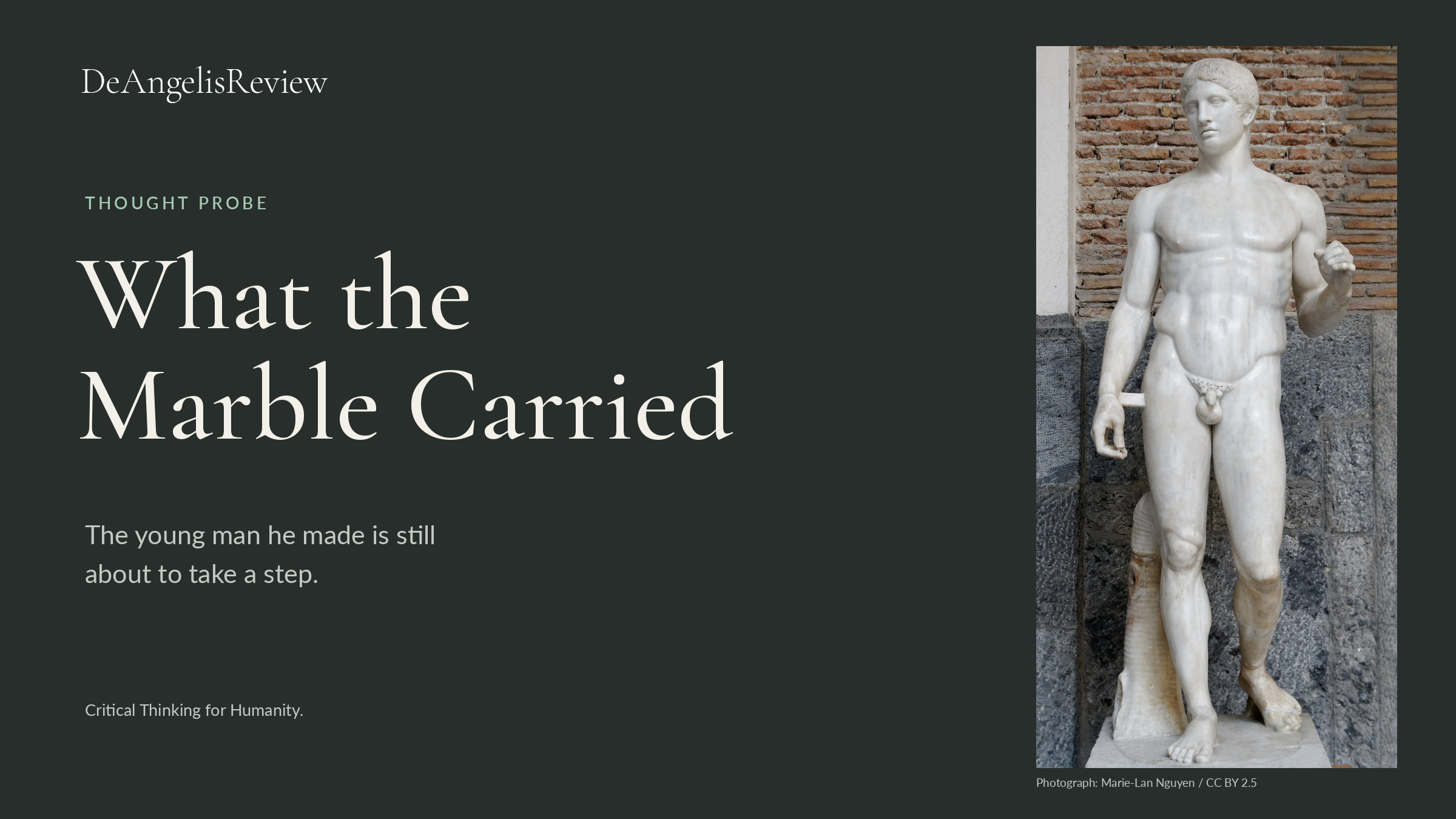
All of his weight is on the right leg. The hip rides up on that side and tips the pelvis. The right foot takes everything. The left leg has nothing to do. It trails, knee soft, heel lifted so that only the toes touch. The right shoulder drops toward the working hip, the left lifts away from the idle one, and a long slow curve runs from the neck to the planted heel. The head turns toward the leg that holds him. He is about two meters of marble, and he has been on the edge of this step for some two thousand years.
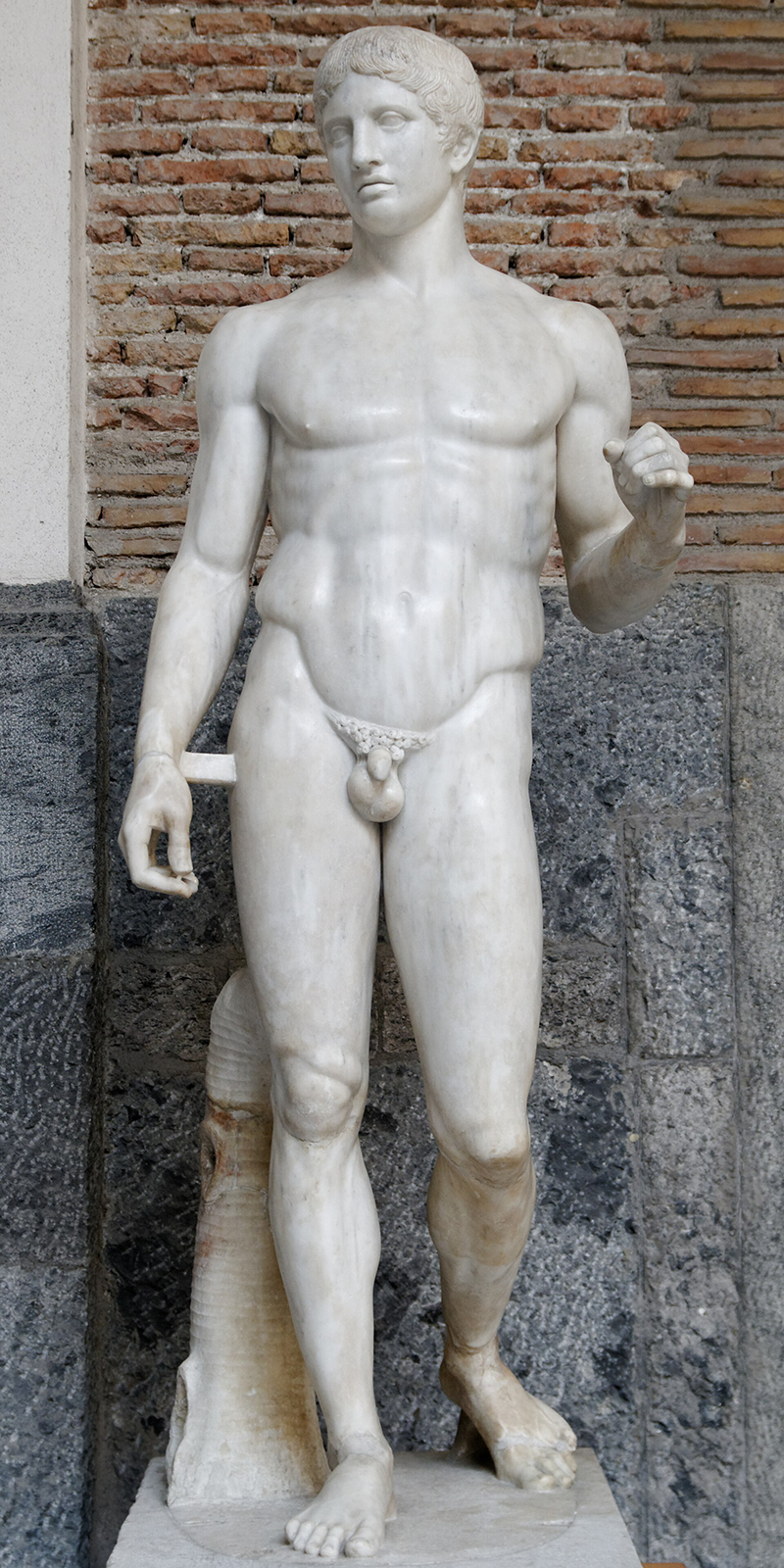
The left arm is bent at the elbow, the hand closed on air. There was a spear in it once, by the usual account, and it would have leaned back against that raised shoulder. The name he goes by, Doryphoros, the spear bearer, is the one Pliny wrote down, and it takes the spear for granted, which not everyone does. Whatever the empty hand held is gone. The shoulder is still up. He is carrying the weight of something that is not there. He is a portrait of no one, an idea of a body, and someone worked the idea out.1
Marble tells on itself. Behind his right calf a tree stump rises to the knee, and a stone bar runs from the right wrist to the hip. Polykleitos, the sculptor, made neither. His figure was bronze, and bronze holds an arm out over nothing. Marble is heavy and cracks, so the Roman copyist propped the leg and tied down the wrist or the copy would have broken. The pose came through, and the engineering under it had to be done again in a less forgiving material.2
I know him from photographs of copies in museums in America and Europe, and not from standing in front of him. What stayed with me was the balance, and the lost book, and the question of how much of the book is still in the balance.
Polykleitos cast the bronze around 440 BC. It is gone, nobody knows how. He also wrote a book on the proportions of the body, the Canon, a word that means a rule, and the book is lost too. Of the man himself, beyond the copies and the reports of the book, there remain a credit and two sayings that later writers give him. Pliny, five centuries on, credits him with the stance in the photograph, statues that throw their weight onto one leg. He is quoted as saying the work is hardest when the clay comes to the fingernail. And that perfection comes about little by little, through many numbers.
Neither saying survives in his own hand. The first is in Plutarch, who took it to mean the finish, when the rough mass is done and the small things get decided. The second was kept by an engineer. Philo, writing nearly two centuries after the bronze, quotes it for a reason that has nothing to do with statues. Catapult builders, he says, had built engines to the same rules, the same wood, the same weight of iron, and some threw far and some fell short, and nobody could say why. So he hands them the sculptor’s warning. A tiny deviation each time, across many parts, and the error at the end is large. Nobody can check the book against the saying. If the man who wrote the book also said this, the concern is the same. Not the size of any one part. How the parts hold together when there are many, and how little it takes to lose it.3
A century before Pliny, the scholar Varro saw the rule from the outside. The figures were square-built, he said, and almost all made on one model, and Pliny records it as a mark against him. If the figures were built by the book, that is how the book would look from outside, the same young man nearly every time. What the rule was, we have from Galen, a physician six centuries after the bronze. The Canon placed beauty in the fit of the parts, finger to finger, hand to forearm, everything to everything, and Polykleitos made a statue by the book and gave it the same name. Whether that statue was the Doryphoros has been argued for more than a century. The scheme cannot be rebuilt from what Philo and Galen report, and the modern attempts do not agree.
What we have is copies, dozens of them, Roman marble, and no two agree on all of him. Kyoko Sengoku-Haga and her colleagues set scans of the Naples copy beside scans of the one in Minneapolis and found that as whole figures the two do not match at all. Part by part they match better, and heads, hands, and feet agree to within a few millimeters, most of the time. Her team’s explanation is mechanical. The copyists may have taken molds from the bronze one piece at a time, and a mold carries a hand exactly while carrying nothing about where the hand goes. My reading sits on top of theirs. It is Philo’s catapults again, the parts agreeing and the whole not. What drifted was the relation of the pieces to each other, and if Galen has the book right, that relation, everything to everything, is what the book was about. The copies agree on the fingers. Where they wander may be exactly where the rule lived.4
Around 25 BC Vitruvius put the proportions of a man into a treatise on architecture. A census in 1967 counted seventy-eight manuscripts of it, the oldest copied out in the ninth century, and Leonardo quoted him beside a man inside a circle and a square. Nothing shows that a number in Vitruvius came from Polykleitos. Of the Canon there is no manuscript at all, only what Galen reports of it, and why the one book kept being copied and the other stopped, nobody can say.5
If anything of the rule survives, it is in bodies like this one, and a body does not tell you which numbers its maker began with. Nothing about the balance says it was worked out at all. It looks like a young man who got tired of standing, and people do that at bus stops without deciding to. Where the comparison was closest, at the heads, the hands, the feet, the copies agree with each other to within a few millimeters, down to the finish, the stage Polykleitos called hardest. Where they part is in how those pieces sit together. Varro saw one model. We have more than fifty copies that do not quite agree, and what the marble carried is the result without the reasons. What did come through is a Roman copy standing in Naples, and the longer you look for the arithmetic in him, the more he looks like a young man about to walk away.
Stephen DeAngelis
Princeton, NJ
September 2026
About the Author
Stephen F. DeAngelis is the founder, president, and CEO of Enterra Solutions and Massive Dynamics, two companies that apply artificial intelligence and advanced mathematics to complex enterprise challenges. His work spans international relations, national security, and commercial technology, with visiting research affiliations at Princeton University, Department of Chemistry, the Computing and Computational Sciences and National Security Directorates of the Oak Ridge National Laboratory, the Software Engineering Institute at Carnegie Mellon University, and the MIT Computer Science and Artificial Intelligence Laboratory. He holds patents in autonomous decision science.
Photograph source and license
Doryphoros, Roman marble copy after Polykleitos, Museo Archeologico Nazionale di Napoli, inv. 6011. Photograph by Marie-Lan Nguyen, licensed CC BY 2.5. Source file, Wikimedia Commons, https://commons.wikimedia.org/wiki/File:Doryphoros_MAN_Napoli_Inv6011_n02.jpg. License terms, https://creativecommons.org/licenses/by/2.5/.
ENDNOTES
1 The stance and the missing spear. The Naples copy came out of the ground without attributes. Angelo Solari’s restoration placed a shaft in the left hand, which stands empty in the reference photograph, and the conventional reconstruction has the bent left arm holding a spear that rested against the left shoulder. Vincenzo Franciosi sets out that reconstruction, with the stance the body describes, and then argues against it, proposing a shield on the left arm and a sword in the right hand. His is the dissent behind the body’s “not everyone.” Either way the left hand once held something that is gone. The name Doryphoros, spear bearer, is the one Pliny records at Natural History 34.55, cited in note 3, and the body’s point is that the name presupposes the reconstruction rather than confirming it. Alessandra Avagliano calls the statue the only ideal figure among the large marble sculptures found at Pompeii, as against the portrait statues: Franciosi, pp. 11 and 15 to 19, and Avagliano, p. 70, in Pompei/Messene. Il “Doriforo” e il suo contesto, edited by Vincenzo Franciosi and Petros G. Themelis, Università degli Studi Suor Orsola Benincasa, Naples, 2013, https://universitypress.unisob.na.it/materiali/L000083.pdf.
2 The stump and the strut. Both are visible in the photograph. For the reason, marble’s weight and its tendency to crack where bronze would hold, the plainest statement is the Smarthistory commentary on the Naples statue, an educational source rather than a primary one: https://smarthistory.org/polykleitos-doryphoros-spear-bearer/. The object is Museo Archeologico Nazionale di Napoli inv. 6011, recognized as a copy of the Doryphoros by Karl Friederichs in 1863 (Franciosi, p. 11), recovered in 1797 in the building at Pompeii VIII 7, 29 known as the Palestra Sannitica, carved in marble of Luni and dated to the Augustan or Tiberian period, about two meters (Avagliano, pp. 67 to 70), and 2.12 meters with its plinth (Themelis, p. 167), all in the volume cited in note 1.
3 The sculptor, the bronze, the book, and the two sayings. Everything said about Polykleitos comes from writers later than he was. No text of his survives. The ancient testimonia are collected in translation in Andrew Stewart, One Hundred Greek Sculptors: Their Careers and Extant Works, Polykleitos of Argos, Perseus Digital Library, https://www.perseus.tufts.edu/hopper/text?doc=Perseus:text:1999.04.0008:part=2:chapter=2:section=3, and the quotations below follow Stewart’s renderings unless another translator is named. Pliny, Natural History 34.55 to 56, in H. Rackham’s translation, lists a Doryphoros and separately what artists call a Canon, says that “a discovery that was entirely his own is the art of making statues throwing their weight on one leg, although Varro says these figures are of a square build and almost all made on one model”: https://www.attalus.org/pliny/hn34a.html. The body’s “a mark against him” rests on Pliny’s “although,” which sets Varro’s remark against the credit. Varro (116 to 27 BC) is the intermediary Pliny names. The saying about the fingernail is reported twice by Plutarch, Moralia 86A (On Progress in Virtue 17) and 636C (Table Talk 2.3), in Stewart’s rendering “the task is hardest for those whose clay has come to the fingernail” and “the work is hardest, when the clay is at the fingernail.” At 636B to C Plutarch explains it: the formless parts are fashioned first and the details articulated afterwards, which is the reading the body follows. The Loeb text of Table Talk 2.3, 636B to C, in Plutarch’s Moralia, volume VIII, translated by Paul A. Clement and Herbert B. Hoffleit (Harvard University Press and Heinemann, 1969), “the work is hardest when the clay is at the nail,” is scanned at https://archive.org/stream/moraliainfifteen08plutuoft/moraliainfifteen08plutuoft_djvu.txt. The saying about many numbers is in Philo of Byzantium, Mechanics 4.1 (49.20), about 250 BC. In Stewart’s translation the context is that many builders “have begun the construction of weapons of the same size, and have made use of the same system of rules, the same types of wood, and the same amounts of iron, and have kept to the same weight, yet of these some have made machines that throw their missiles far and with great force, while those made by others have lagged behind their specifications,” so Philo warns the engineer with “the saying of Polykleitos the sculptor: perfection, he said, comes about little by little through many numbers,” because “in many of the items that go to make up the machine a tiny deviation is made each time, resulting in a large cumulative error.” The body’s suggestion that the book shared the saying’s concern is the author’s inference, marked as such in the prose; Philo does not cite the Canon. Galen, De Placitis Hippocratis et Platonis 5, second century AD, places beauty in the commensurability of the parts, finger to finger, all of these to the palm and wrist, these to the forearm, the forearm to the upper arm, and everything to everything else, as written in the Canon of Polykleitos, and says Polykleitos made a statue according to the treatise and called both the Canon. He does not say which statue. The Greek text is at the Scaife Viewer, https://scaife.perseus.org/library/urn:cts:greekLit:tlg0057.tlg032/. The bronze is dated about 450 to 440 BC (Franciosi, p. 14, in the volume cited in note 1; the Getty chapter cited in note 4 records Stewart at about 440 and Borbein at 450 to 440). No surviving ancient account records what became of it. Whether the Canon statue is the Doryphoros has been argued for more than a century without a definitive conclusion, per the same Getty chapter, which also argues, from the copies, that Polykleitos built the model of the Doryphoros to be reused in other works, a modern reading of the same fact Varro complained of. Modern reconstructions of the proportions differ in method and result. Compare Richard Tobin, The Canon of Polykleitos, American Journal of Archaeology 79 (1975), 307 to 321, which rebuilds the scheme from a module taken from the little finger, https://www.journals.uchicago.edu/doi/10.2307/503064, with Andrew Stewart, The Canon of Polykleitos: A Question of Evidence, Journal of Hellenic Studies 98 (1978), 122 to 131, https://doi.org/10.2307/630196.
4 The copies and the scans. The Parco Archeologico di Pompei, in its E-Journal degli Scavi di Pompei, counts more than fifty replicas and variants of the Doryphoros, citing Kreikenbom 1990: Il Canone di Policleto, dalla scoperta del “Doriforo” di Pompei a una nuova ricostruzione dell’originale greco di V sec. a.C., https://pompeiisites.org/e-journal-degli-scavi-di-pompei/il-canone-di-policleto-dalla-scoperta-del-doriforo-di-pompei-a-una-nuova-ricostruzione-delloriginale-greco-di-v-sec-a-c/. The Minneapolis copy is Minneapolis Institute of Art, accession 86.6, 1.96 meters, dated to the reign of Augustus though earlier dates have been proposed (Themelis, in the volume cited in note 1). The museum’s collection record is at https://collections.artsmia.org/art/3520/the-doryphoros-unknown-roman. The scan comparison is Kyoko Sengoku-Haga et al., Polykleitos and His Followers at Work, in Artistry in Bronze: The Greeks and Their Legacy, J. Paul Getty Museum, 2017, https://www.getty.edu/publications/artistryinbronze/the-artist/10-haga-et-al/. The authors’ words: the Naples and Minneapolis copies “don’t match at all when they are compared as a whole. But compared separately in body parts, they match better. Maybe it is because the copy-makers, when they took plaster casts of the original bronze statues, took molds part by part,” and for heads, hands, and feet “their deviations are in most cases within a few millimeters.” The body reports the mold explanation with the same “may have” the authors’ “maybe” carries. The further inference, that the copies wander in the relations between parts, that Galen locates the Canon in those relations, and that this is the same accumulation of small deviations Philo warned about, is the author’s reading of the sources set together, not a claim the Getty team makes.
5 Vitruvius and Leonardo. Vitruvius, De architectura, dedicated to Augustus and dated about 35 to 23 BC in a Cambridge University Press study of the treatise, https://www.cambridge.org/core/books/abs/artes-and-the-emergence-of-a-scientific- culture-in-the-early-roman-empire/architectonic-ars-of-architecture-explanation-and-method-in-vitruvius-de-architectura/81228C1B8D479F963A09DD8CF86EE71. Book III, chapter 1, gives the proportions of a well-made man, the face a tenth of the height, the navel the center of a circle that touches the fingers and toes of a man lying flat. The preface to the same book names Polyclitus among sculptors whose fame outlived them, but nothing in the text attributes its numbers to him: Joseph Gwilt’s translation at Bill Thayer’s Lacus Curtius, https://penelope.uchicago.edu/Thayer/E/Roman/Texts/Vitruvius/3*.html. The oldest surviving copy is British Library Harley MS 2767, dated by the Library to the first quarter of the ninth century: https://searcharchives.bl.uk/catalog/040-002048598. Carol Herselle Krinsky catalogued the seventy-eight the body counts in Seventy-eight Vitruvius Manuscripts, Journal of the Warburg and Courtauld Institutes 30 (1967), 36 to 70, and the medieval tradition runs from the ninth to the fourteenth century: Pierre Gros, Vitruve, l’architecture et sa théorie, à la lumière des études récentes (1982), reprinted at OpenEdition Books, https://books.openedition.org/efr/2503?lang=en. The body draws no conclusion about why the Canon was not transmitted, because no source states one; its loss is attested only by the absence of any manuscript, and the only report of the book’s contents is Galen’s, in note 3; the two sayings there are sayings of the man, not quotations from the book. Leonardo’s drawing, Studio di proporzioni del corpo noto come Uomo vitruviano, metalpoint, pen and ink, and touches of watercolor on white paper, Gallerie dell’Accademia, Venice, cat. 228, is dated by the Gallerie to his Milanese years. The Gallerie’s own note is that the text beside the figure cites Vitruvius, that the measures drawn follow Alberti’s De statua rather than the Vitruvian text, and that Leonardo probably did not know the Latin treatise closely: https://www.gallerieaccademia.it/en/opera/studio-di-proporzioni-del-corpo-noto-come-uomo-vitruviano/.
Share this post