
By Stephen DeAngelis
Executive Summary
The April 8, 2026, ceasefire between the United States and Iran has been widely interpreted as a de-escalation. It is not. It is a false resolution, a phase in a non-linear compounding system in which structural risk continues to rise while organizational attention drops. This brief examines why the pause is the most dangerous condition in the current crisis environment and what leaders should do about it. More specifically, it argues that the current window demands a new enterprise intelligence and AI orchestration layer, one that can perceive and act across the non-linear timescales that the crisis has exposed.
The Polycrisis³ framework describes three interacting dimensions. The first is the base polycrisis of geopolitical, economic, and energetic disruptions. The second is the technological exponent of artificial intelligence and quantum computing, which operates on its own timeline and did not observe the ceasefire. The third is the organizational response function, the dimension most directly within leadership’s control and most degraded by the false resolution dynamic.
This brief introduces three actionable concepts.
First, the false resolution pattern. In non-linear systems, periods of apparent calm are not interruptions of the crisis. They are phases of it. The false resolution widens the gap between actual risk and perceived risk to its maximum, precisely when organizations are most likely to stand down their sensing architectures.
Second, the self-liquidating proof point. The false resolution window is the optimal entry for enterprise resilience transformation. One high-value process, one instrumented intelligence layer, one fiscal year to demonstrate measurable return. The return funds the next process, making the transformation self-financing. The current window has a known expiration date tied to the Section 122 bridge tariff expiration in July 2026.
Third, the shift from linear planning to non-linear architecture. The dominant enterprise planning model runs a sequential monthly cascade that is structurally incapable of representing non-linear dynamics. Only two in five companies consider their S&OP process effective. The alternative, non-linear optimization orchestrated by an intelligent agent-based architecture, absorbs the planning complexity that the sequential cascade cannot represent and replaces it with concurrent, continuous planning that operates across all timescales simultaneously. An organization with a monthly planning cycle and a two-week disruption window has exactly one planning cycle to respond. An organization with a continuous sensing architecture has every hour of every day of that window.
The organizations that will define the next decade are not the ones that responded most heroically to the acute crisis. They are the ones that used the false resolution most effectively. The architecture exists. The technology is available. The window is open. What remains is the decision to act before it closes.
The April 2026 ceasefire between the United States and Iran did not resolve the compounding crises threatening global supply chains and competitive positions. It paused them. That pause is the most dangerous phase in a non-linear system, a false resolution in which organizational attention drops while structural risk continues to rise. The technological exponent of the crisis, the relentless advance of artificial intelligence and quantum computing, did not observe the ceasefire and never will. My concern is that the leaders who stand down their sensing architectures and resilience postures during this pause will enter the next acute phase with maximum surprise and minimum preparation. The window for building the architecture that prevents that outcome is open now, and it has a known expiration date.
The Moment That Felt Like Relief
On the evening of April 8, 2026, less than two hours before a United States military deadline, Pakistan brokered a tentative ceasefire between Washington and Tehran. The Strait of Hormuz, functionally impaired since late February, would reopen. Brent crude fell approximately fourteen percent in a single session, dropping below one hundred dollars per barrel after having surged to one hundred seventeen. Global markets exhaled. Boards stood down their emergency postures. Risk teams that had been running scenario models around the clock shifted back to quarterly cadences. The crisis, it appeared, had passed.1
It had not passed. It had paused.
Iran’s Supreme National Security Council accepted the ceasefire terms while announcing that its “hands remain on the trigger.” The agreement covered the Strait but explicitly excluded Lebanon, where Israeli operations continued. Russia and China had vetoed a United Nations Security Council resolution on Hormuz safety just twenty-four hours earlier.2 The United States simultaneously threatened fifty-percent tariffs on nations supplying Iran with weapons, extending the economic dimension of the conflict into new sovereign relationships.3 The International Monetary Fund had already warned that the war had produced the worst-ever disruption in global energy supplies and that poor nations with no reserves would absorb the hardest impact regardless of how quickly the fighting stopped.4
The ceasefire did not resolve the crisis. It paused it, and the pause is the most dangerous phase. I want to be direct about what that means. For leaders who have built enterprise resilience architectures, this pause is the best window they will get to extend and harden what they built. For the majority who have not, it is a trap that will close before they recognize it.
The Non-Linear Structure of Compounding Crises
In the first brief in this series, I introduced the concept of Polycrisis² to describe the condition in which traditional geopolitical, economic, and energetic crises function as a base, while exponential technological disruptions function as an exponent that changes the nature of the problem rather than merely its magnitude. Artificial intelligence is restructuring labor markets and competitive dynamics. Quantum computing is advancing toward the capacity to break current cryptographic standards. Together they do not simply compound the polycrisis. They change what the problem is.5
The mathematical notation is deliberately heuristic. It is not a formula. It is a description of a structural relationship that linear thinking consistently fails to perceive. When a base condition and an exponent compound simultaneously, the output accelerates in ways that no extrapolation from prior data points can predict. Remove one crisis and the system does not return to its pre-crisis state. The interactions have changed it.
This week produced a third dimension of that structure that deserves its own examination.
In a non-linear system, periods of apparent calm are not interruptions of the crisis. They are phases of it.
This is the insight that linear mental models most reliably miss. When conditions deteriorate sharply, organizations activate. Sensing layers go live. Boards engage. The acute crisis produces a temporary improvement in organizational intelligence, not because the environment is better, but because attention is elevated. When conditions apparently improve, the opposite occurs. Attention migrates back toward efficiency. Sensing layers return to baseline. The structural fragilities that were present before the crisis became less visible than they were before the acute phase began, even as the crisis deepened them.
This is a structural feature of how complex adaptive systems respond to perturbation, and I want to name it plainly because most crisis-management frameworks do not. The recovery period concentrates organizational attention on the disruption that just occurred, making that specific disruption the least likely to recur in the same form. The next acute phase will arrive through a different vector, at a moment when the organization has retooled for the environment that existed during the false resolution. In twenty-five years of working with organizations in volatile environments, I have watched this cycle repeat in supply chains, in financial institutions, and in government agencies. The pattern is not a failure of intelligence. It is a failure of architecture.
The false resolution does not merely fail to resolve the crisis. It actively prepares the conditions for a worse one.
What Non-Linearity Actually Means in Practice
A linear model of crisis tells one story. The Strait of Hormuz was impaired, oil prices rose, a ceasefire was reached, oil prices fell, conditions normalized. The slope of the disruption was reversed. We are on the way back to where we were.
A non-linear model tells a structurally different story, and the distinction matters operationally.
In a non-linear compounding system, the state of the system after a perturbation is never identical to the state before it. The perturbation changes the relationships between components, not merely the values of variables. After the 2008 financial crisis, the apparent recovery of 2010 and 2011 occurred within a structurally altered system. The fragilities that manifested in the European sovereign debt crisis were not the same fragilities that had produced the 2008 event. They were new fragilities, created in part by the organizational responses to the old ones.
I saw the same non-linear dynamic in the supply chain disruptions that followed the COVID-19 pandemic. The apparent recovery of 2022 occurred within a supply chain architecture that had been structurally altered by the disruption. The concentration of more than ninety percent of the world’s advanced logic chip fabrication in a single geographic cluster around TSMC in Taiwan meant that every company dependent on leading-edge semiconductors had traded one supply chain risk for a different and arguably more severe one. Pharmaceutical manufacturers that consolidated active pharmaceutical ingredient sourcing with single suppliers in India replaced a diversified risk profile with a sole-source dependency that was invisible until those suppliers experienced their own disruptions. Organizations that built large safety stocks to buffer against future shortages tied up working capital at precisely the moment that rising interest rates made that capital expensive, creating a new financial single point of failure. The disruptions of 2023 and 2024 arrived through the new vulnerabilities that the recovery had inadvertently created.
The current situation has a similar structure, but with a critical amplification. The Section 122 bridge tariffs, which created an up-to-fifteen-percent global levy after the Supreme Court invalidated the prior tariff regime, are set to expire in July 2026. The Yale Budget Lab estimates the current tariff regime will raise approximately $1.3 trillion over the 2026 to 2035 period, with long-run global GDP slightly lower across all scenarios. These are structural alterations to the trade architecture on which global supply chains depend.
These are not temporary perturbations.6,7 Meanwhile, refining capacity damage in the Middle East will constrain refined product supply for months even with the Strait fully reopened. J.P. Morgan Research had already placed the probability of a US and global recession in 2026 at thirty-five percent before the Iran conflict escalated.8
The False Resolution Pattern in Complex Systems
I want to be precise about what makes the false resolution phase structurally distinct from both the acute crisis phase and genuine stabilization, because the distinction carries real operational consequences.
In an acute crisis phase, the sensing function of an organization is forcibly activated. Information flows that were blocked by organizational silos become unblocked because the cost of silos suddenly exceeds their benefit. The crisis performs a crude form of the sensing function that a mature Sense, Think, Act & Learn architecture would perform continuously, at enormous cost and with high error rates, but it does activate. In a genuine stabilization phase, the conditions that produced the crisis have been structurally addressed and the sensing layer remains active because it has been institutionalized rather than activated by emergency. The false resolution is structurally different from both. The external signals suggest improvement, which triggers the deactivation of crisis-mode attention, while the underlying conditions remain unaddressed. This is the most dangerous phase in a non-linear compounding system, not because the external environment is at its worst, but because the gap between the actual risk level and the organization’s perceived risk level is at its maximum.
Diane Vaughan coined the term “normalization of deviance” in her analysis of the Challenger disaster, describing how incremental acceptance of technical anomalies becomes institutionalized as normal when prolonged periods without catastrophic failure produce complacency.9 Karl Weick, separately, documented the collapse of sensemaking in organizations under extreme conditions, the process by which the mental models that allow people to act coherently disintegrate under stress.10
One of my personal heroes and a great explainer of complex issues, Richard Feynman, understood something that Vaughan and Weick documented from the outside. At a televised hearing on the Challenger disaster in February 1986, he dropped a piece of the O-ring rubber into a glass of ice water. When he pulled it out, the rubber stayed stiff. In a room producing thousands of pages of testimony, Feynman made the failure visible and comprehensible in a single gesture. Making complex structural failure legible to the people who must act on it, without jargon and without equivocation, is a form of leadership. Feynman’s example represents the standard this brief series aspires to meet.
The pattern holds across complex adaptive systems under non-linear risk. The false resolution is the period during which normalization of deviance accelerates because the acute crisis has temporarily made deviance visible and the recovery has made it invisible again. The Columbia disaster demonstrated that NASA had not learned from Challenger the lesson about false resolution. The organization had instead normalized a new set of deviations during the recovery period.
The Exponent Does Not Observe Ceasefires
The feature of Polycrisis² that makes the false resolution particularly dangerous right now is the independence of the exponent from the base condition.
In a linear model, when the base condition de-escalates, the overall risk level falls proportionally. In the squared model, the exponent operates on its own timeline, determined by technological development cycles rather than geopolitical negotiation cycles. A two-week ceasefire in the Middle East has no effect on the pace at which AI is restructuring competitive dynamics or on the quantum computing timelines that determine when current cryptographic standards become vulnerable.
The National Institute of Standards and Technology published its post-quantum cryptography standards in 2024.11 The Cybersecurity and Infrastructure Security Agency issued federal procurement guidance requiring quantum-resistant products in early 2026. Google has deployed hybrid post-quantum key exchange in its services and has committed to completing its full migration by 2029. These events establish a technical timeline that is not negotiable and not paused by ceasefires. Peer-reviewed research estimates that large enterprises will require twelve to fifteen years for complete cryptographic migration. If quantum capability arrives by 2030, organizations that use the false resolution as an opportunity to defer their migration programs are accepting a structural vulnerability that will not be visible until it is catastrophic. This is not only a CISO concern. It is a CSO concern, because the encrypted data most valuable to harvest-now-decrypt-later adversaries include supplier contracts, logistics routing, and multi-tier sourcing architectures, the very data that defines supply chain competitive advantage.
The same temporal independence applies to artificial intelligence. BCG research found that the top five percent of AI-mature companies are achieving 1.7 times the revenue growth and 3.6 times the total shareholder return of lagging firms.12 That gap reflects a competitive divergence that compounds every quarter regardless of what is happening in the Strait of Hormuz.
The exponent has not paused. The artificial intelligence restructuring of labor markets continued through every day of the conflict. The harvest-now-decrypt-later campaigns that quantum-aware adversaries are running against encrypted enterprise data did not observe the ceasefire. The epistemic contamination of AI-generated intelligence, deepfakes, synthetic market signals, and AI-generated misinformation that compromises the reliability of the data on which organizations make decisions, did not stop because oil prices fell.
The World Economic Forum has warned of a quantum divide, a structural gap between organizations that have begun their post-quantum migration and those that have not.13 I am convinced the same divide is already visible in AI maturity, and I will state this plainly. The false resolution is the period when this divide accelerates fastest, not because leading organizations speed up during the pause, but because lagging organizations slow down. BCG’s 2025 research confirms that sixty percent of companies are reaping hardly any material value from their AI investments, with most remaining in the experimenting and piloting stages that McKinsey’s 2025 State of AI survey documents, running proofs of concept and isolated experiments rather than embedding AI into their operating architecture.14,15 During periods of apparent stability, organizations that have not yet made the architectural commitment to AI tend to redirect investment toward efficiency gains and cost reduction rather than the structural transformation that builds resilience and competitive sensing. That incremental approach feels rational in the moment. It is the mechanism through which the competitive gap compounds, because the five percent of firms that have made the architectural shift are reinvesting their AI-driven returns into stronger capabilities, planning to spend up to sixty-four percent more of their IT budgets on AI and pulling further ahead every quarter.14
The base is still rising. The exponent is still accelerating. The product of the two is not lower because of the ceasefire. It is higher, because the two-week pause creates the organizational conditions for a third disruption that will be less anticipated than either of the first two.
What the Non-Linear Geometry Looks Like
Consider a curved surface that rises steeply, then flattens briefly, then continues rising. A traveler on that surface, looking only at the immediate terrain, sees the flattening as evidence that the ascent has ended. The flattening is real. But the overall trajectory of the surface has not changed. The traveler who stops climbing during the flat section, and who uses the respite to remove equipment needed for the next ascent, will be less prepared for the steeper section ahead than if the acute phase had continued without interruption.
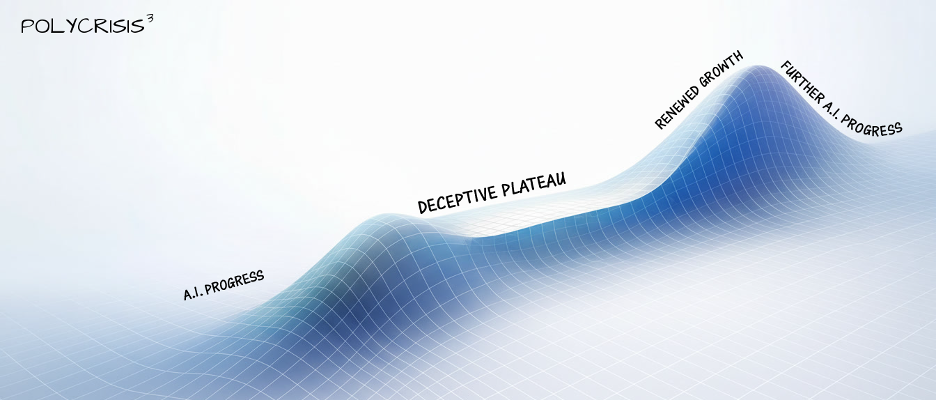
What I am observing has at least three interactive dimensions. The first is the base polycrisis. The second is the technological exponent. The third is the organizational response function, the combination of system perturbation timescales and organizational response capacity, which determines how much of the compounding disruption an enterprise actually absorbs. The third dimension is the one most directly within leadership’s control, and it is the one most affected by the false resolution dynamic.
The organizations that treat the ceasefire as an opportunity to extend and stress-test their sensing architectures will exit this false resolution phase better positioned than they entered it. The organizations that treat the ceasefire as permission to stand down will exit this phase more exposed. This is not a symmetric choice. The cost of maintaining elevated sensing during a false resolution is operational and recoverable. The cost of being under-prepared at the onset of the next acute phase is strategic and compounding.
The Geometry of the Self-Liquidating Response
In the Polycrisis² brief, I introduced the concept of a self-liquidating proof point as the practical entry to enterprise resilience transformation. The model is straightforward. One high-value process, one instrumented intelligence layer, one fiscal year to demonstrate measurable return. Use that return to fund the next process. Compound the transformation from demonstrated value rather than institutional faith.
The false resolution phase is the optimal window for this entry. During an acute crisis, organizations are in emergency mode. Budget allocation is defensive. Leadership attention is consumed by the immediate disruption. The conditions for disciplined proof-point selection, instrumentation, and measurement are simply not present. During a false resolution, the emergency conditions have eased sufficiently to create space for deliberate architectural design. The organizational memory of the crisis is recent enough that the argument for investment in sensing and resilience architecture does not require extensive persuasion.
This is the window. The proof-point model works precisely because it converts the strategic argument into a financial proposition that is demonstrable within a budget cycle.
The entry point is specific. Identify one high-value business process where an enterprise intelligence layer can demonstrate a measurable financial return within a single fiscal year. In consumer products, demand sensing is a natural starting point. An intelligence layer that continuously reconciles sell-through data, promotional calendars, and external signals produces forecasting accuracy improvements that are measurable within a quarter and financially material within a year. In industrial supply chains, supplier risk monitoring offers a similar profile. Continuous ingestion of geopolitical, financial health, and logistics signals against a multi-tier supplier map produces early warnings that avert disruptions whose cost can be precisely calculated after the fact. Either process, executed with the right architecture, generates a return that is visible on a P&L before the next budget cycle opens.
Let that return fund the next process, and the next. The transformation becomes self-financing. The window created by this specific false resolution has a known expiration date. The Section 122 bridge tariffs expire in July 2026. The two-week ceasefire expires by late April. That is exactly the interval the self-liquidating proof-point model is designed for.
Building Resilience and Optimizing Value Chains Across Timescales
Polycrisis³ operates across at least three distinct timescales simultaneously, and the failure to perceive all three at once is the structural weakness that the false resolution exploits.
The near-term timescale spans days to weeks. This is the ceasefire, the price of crude, the board’s emergency posture. Every organization can operate here. When the Strait of Hormuz closes, the near-term response activates. When it reopens, it deactivates. This is the only timescale most organizations are equipped to perceive.
The medium-term timescale spans quarters to years. This is the tariff regime expiration in July 2026, the AI maturity gap that compounds quarterly, the false resolution window during which architectural decisions will determine structural position for the next three to five years. The medium-term requires organizational attention sustained by design rather than triggered by crisis.
The long-term timescale spans years to decades. This is the quantum cryptography migration that will require twelve to fifteen years for large enterprises, and the AI competitive divide that will separate organizations into those that built continuous intelligence architectures and those that did not. The long-term timescale does not produce acute signals. It does not appear on quarterly board agendas. It is the timescale on which the most consequential changes occur, and the one the false resolution makes hardest to perceive.
The idea that organizations must simultaneously exploit existing capabilities and explore new ones across different time horizons has deep roots in organizational theory, what David Teece and others have called dynamic capabilities.16
I call the capacity to operate across all three timescales at once Timescale Coherence. The Sense, Think, Act & Learn architecture is designed for exactly this. It maintains continuous perception across all three timescales, which means it perceives the false resolution not as a period of calm but as a medium-term architectural window within a long-term transformation program.
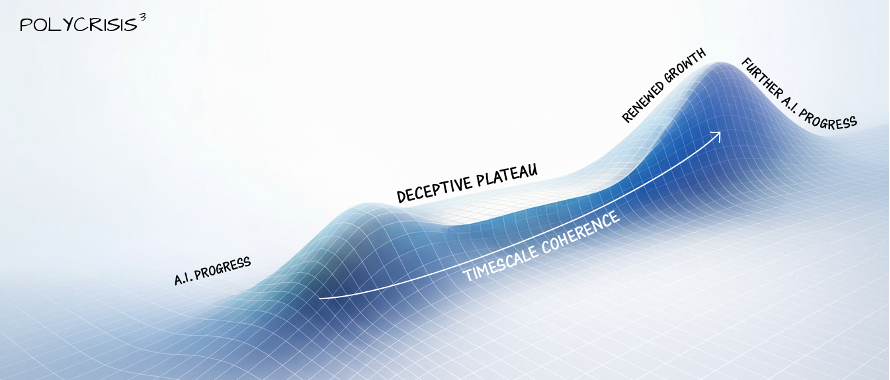
Timescale Coherence is the application of that insight to the specific conditions of Polycrisis³, and I think it is more urgent now than the academic literature has recognized, because the timescale gap is widening faster than organizational design is adapting to it.
An operational requirement of Timescale Coherence is the systemic ability to optimize and simulate across multiple non-linear timescales concurrently. This means the enterprise can evaluate decisions against the near-term financial objective, the medium-term architectural position, and the long-term competitive trajectory at the same time, rather than treating each timescale as a separate planning exercise. The technology to do this exists. It requires an intelligence layer that continuously ingests signals across all three horizons and an optimization engine that can represent the non-linear interactions between them.
The self-liquidating proof point is itself an exercise in Timescale Coherence. It operates on a near-term financial cycle, one fiscal year, while building toward a medium-term architecture that positions the organization for the long-term competitive divide. The proof point works as a mechanism for translating long-term structural awareness into near-term financial action, not as an emergency response.
From Linear Planning to Non-Linear Architecture
More enterprise planning processes have failed in the last three years than in the previous twenty, and the failures share a common structure. The planning process itself is linear. It was designed for a linear world. It is now operating inside a non-linear environment, and it cannot perceive the dynamics that are killing it. McKinsey’s 2024 Global Supply Chain Leader Survey found that ninety percent of supply chain leaders encountered significant disruptions that year, and it still takes companies an average of two weeks to plan and execute a response to a disruption, far longer than the weekly cadence of sales and operations execution. Their 2025 follow-up found that the share of companies planning major investments in digital supply chain systems fell from forty-seven percent to twenty-five percent in a single year, and only nineteen percent have deployed AI tools at scale.17
Consider how the dominant enterprise planning model works. A demand forecast is produced. That forecast feeds a supply plan. The supply plan feeds financial reconciliation. Financial reconciliation feeds an executive approval cycle. Each step depends on the completed output of the prior step. The entire cascade runs on a monthly cadence, occasionally accelerated to biweekly during acute disruptions. Research from Supply Chain Insights confirms what practitioners already know. Only two in five companies consider their S&OP process effective, and only eleven percent successfully link planning to execution.18
This is a sequential batch process designed for a world where disruptions were periodic, predictable, and separated by intervals of relative stability. In that world, a monthly cycle was adequate because the system state did not change materially between planning runs. In a Polycrisis³ environment where the base, the exponent, and the organizational response function are all moving simultaneously across multiple timescales, a monthly batch process is structurally blind to the dynamics it needs to perceive. The architecture of the process itself cannot represent the environment it is supposed to perceive.
The structural mismatch runs deeper than speed. Linear planning assumes the system returns to equilibrium after a perturbation. Non-linear systems do not. The perturbation changes the relationships between variables, not just their values. When the Strait of Hormuz closed and reopened, the planning process recalibrated from the prior period’s actuals. But those actuals described a system state that no longer existed. Shipping routes had been renegotiated. Refining capacity had been damaged. Tariff exposures had shifted. Working capital structures had been altered by emergency drawdowns. The planning process treated these as updated inputs to the same model. They were not updated inputs. They were evidence that the model itself had changed.
This is why the false resolution is so dangerous from a planning perspective. The sequential cascade interprets the apparent return to prior conditions as evidence that the system has stabilized. The demand forecast reverts toward historical baselines. The supply plan relaxes its constraint assumptions. The financial reconciliation projects recovery. Every one of those adjustments is wrong, not because the data is inaccurate, but because the planning architecture is structurally incapable of representing the non-linear transformation that the disruption produced.
The AI and Non-Linear Alternative
The alternative is a structurally different process designed for a structurally different environment. Non-linear optimization, orchestrated by an intelligent agent-based architecture, replaces the sequential cascade with concurrent, continuous planning.19 Instead of a monthly cycle where each function waits for the prior function’s output, an agent-based architecture orchestrates sensing, advanced analysis, and response simultaneously. Demand signals, supply constraints, geopolitical risk indicators, and financial parameters are processed concurrently rather than sequentially through non-linear optimization rather than the linear models the cascade assumes. The architecture does not wait for the demand forecast to finish before assessing supply constraints. It assesses both at once, continuously.
When the Strait of Hormuz closes, the impact on refined product supply, on shipping routes, on tariff exposure, on working capital requirements, and on competitive positioning relative to AI-mature competitors is assessed simultaneously, not in a four-week cascade. This is what non-linear architecture means in operational terms.
I want to connect this directly to the Polycrisis³ framework, because the planning architecture is not a side issue. It is the mechanism through which the organizational response function operates. The third dimension of Polycrisis³ is only as fast as the planning architecture that drives it. An organization with a monthly planning cycle and a two-week disruption window has exactly one planning cycle to respond. One pass through the sequential cascade. An organization with a continuous, agent-based sensing and response architecture has every hour of every day of that window.
The difference is structural, not incremental. It is the difference between perceiving the false resolution as a pause and perceiving it as a window. Organizations that can make this transition will not experience the false resolution the way their competitors do. They will experience it as the highest-value interval in the crisis cycle, the period when the competitive gap widens fastest because most organizations have stood down the very sensing functions that the window demands.
That is the architectural argument for non-linear planning. The planning process is not a back-office function that supports strategy. It is the organizational nervous system. In a Polycrisis³ environment, the quality of that nervous system determines whether an organization perceives the pause as an ending or as a window.
The Imperative
The Polycrisis² condition does not resolve. It evolves. Each acute phase is followed by a false resolution that reorganizes the underlying structure of the compounding crises. Each false resolution creates conditions that make the next acute phase worse than the one that preceded it, for the organizations that mistake the pause for the end.
The organizations that will define the next decade are not the ones that responded most effectively to the acute crisis of February through April 2026. They are the ones that used the false resolution most effectively. I have watched this distinction play out again. The organizations that are genuinely resilient are never the ones that responded most heroically to the worst moments. They are the ones that maintained their sensing architectures through the quiet periods, when doing so was the hardest to justify to a board and the easiest to defer to the next budget cycle. That discipline must be built into the architecture itself because human attention and institutional rhythm are both wired for the near-term. A continuous intelligence capability performs at its best precisely when the external environment appears least urgent, because that is when the gap between organizational perception and structural reality is at its widest. That is when the architecture earns its cost.
Polycrisis³ is the product of compounding crises, exponential disruption, and an organizational response function that is weakest at exactly the moment it is most needed.
The architecture for resilience exists. The technology is available. The window is open. What remains is the decision to act before it closes.
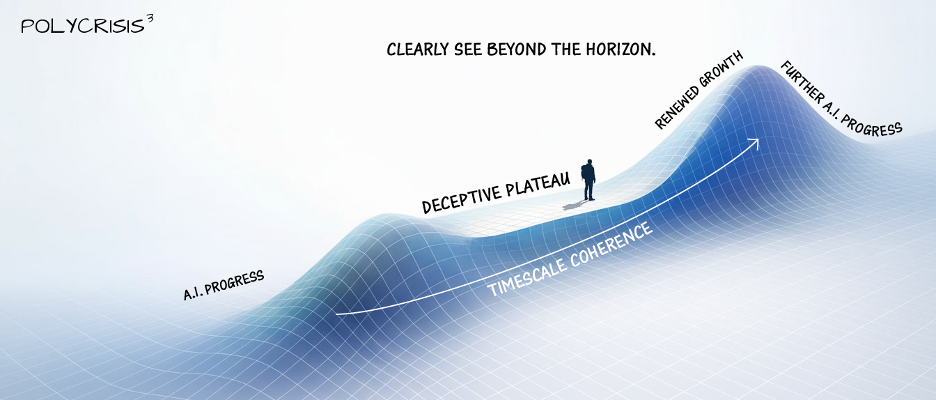
The ceasefire did not end the crisis. It created the most dangerous phase of it, the pause in which most organizations will stand down while the structural risk continues to compound. The organizations that read this pause as the end will be the least prepared for what comes next. The architecture to perceive it exists. The window to build it is open. The only question left is whether your organization will still be climbing when the terrain steepens again.
Stephen F DeAngelis
Princeton, NJ
April 2026
Polycrisis²™, Polycrisis³™, and Timescale Coherence™ are trademarks of Stephen F. DeAngelis. Sense, Think, Act & Learn™ is a trademark of Enterra Solutions.
Stephen F. DeAngelis is the founder, president, and CEO of Enterra Solutions and Massive Dynamics, two companies that apply artificial intelligence and advanced mathematics to complex enterprise challenges. His career spans international relations, national security, and commercial technology. He has served in visiting research affiliations with Princeton University, the Oak Ridge National Laboratory, the Software Engineering Institute at Carnegie Mellon University, and the MIT Computer Science and Artificial Intelligence Laboratory. He is a founding member of the Forbes Technology Council. DeAngelis holds patents in autonomous decision science and has been recognized by Forbes as a Top Influencer in Big Data and by Esquire magazine as the 'Innovator' in its Best and Brightest issue.
About the Stephen DeAngelis Explainer Brief Series
The Stephen DeAngelis Explainer Brief series applies critical reasoning to the complex issues facing society today. In an era of compounding uncertainty and deepening division, the series aims to build understanding and community by making consequential topics accessible through rigorous analysis, current evidence, and honest assessment. Each installment is written in the belief that clarity of thought is itself a form of leadership.
Readers who wish to explore the proof-point entry model for their organization are welcome to reach out at www.deangelisreview.com.
Notes
1. Reuters, “US and Iran agree to two-week ceasefire brokered by Pakistan,” April 8, 2026. https://www.reuters.com/world/asia-pacific/trump-agrees-two-week-ceasefire-iran-says-safe-passage-through-hormuz-possible-2026-04-08/
2. United Nations Security Council, veto of Hormuz safety resolution by Russia and China, April 7, 2026. https://news.un.org/en/story/2026/04/1167257
3. CNBC, “Trump threatens tariffs of 50% on nations supplying weapons to Iran,” April 8, 2026. https://www.cnbc.com/2026/04/08/trump-threatens-tariffs-countries-supplying-weapons-iran-ceasefire.html
4. International Monetary Fund, Managing Director Kristalina Georgieva, “Cushioning the Middle East War Shock,” April 9, 2026. https://www.imf.org/en/news/articles/2026/04/09/sp040926-spring-meetings-2026-curtain-raiser
5. DeAngelis, Stephen F., “Polycrisis²: When Compounding Crises Meet Exponential Technology,” DeAngelis Review, March 2026. www.deangelisreview.com
6. The Yale Budget Lab, “State of US Tariffs: April 2, 2026.” https://budgetlab.yale.edu/research/state-us-tariffs-april-2-2026
7. The Chronicle-Journal, “Global Trade Chaos and New Tariffs Fuel Market Volatility in 2026,” March 18, 2026.
8. J.P. Morgan Global Research, “2026 Market Outlook,” December 2025. https://www.jpmorgan.com/insights/global-research/outlook/market-outlook
9. Vaughan, Diane, The Challenger Launch Decision: Risky Technology, Culture, and Deviance at NASA, University of Chicago Press, 1996.
10. Weick, Karl E., “The Collapse of Sensemaking in Organizations: The Mann Gulch Disaster,” Administrative Science Quarterly, Vol. 38, No. 4, 1993.
11. National Institute of Standards and Technology, Post-Quantum Cryptography Standards, 2024. https://www.nist.gov/pqc
12. BCG, “Are You Generating Value from AI? The Widening Gap,” September 2025. https://www.bcg.com/publications/2025/are-you-generating-value-from-ai-the-widening-gap
13. World Economic Forum, “Why quantum security is a question leaders cannot ignore,” February 2026. https://www.weforum.org/stories/2026/02/quantum-security-question-leaders-cannot-ignore
14. BCG, “The Widening AI Value Gap” (see endnote 12). Research based on BCG Build for the Future 2025 Global Study (n = 1,250). Only five percent of companies are achieving AI value at scale. Sixty percent report minimal revenue and cost gains despite substantial investment. Future-built companies plan to dedicate up to sixty-four percent more of their IT budgets on AI than lagging firms. See also BCG press release, September 30, 2025, https://www.bcg.com/press/30september2025-ai-leaders-outpace-laggards-revenue-growth-cost-savings.
15. McKinsey & Company, “The State of AI: Global Survey,” 2025. https://www.mckinsey.com/capabilities/quantumblack/our-insights/the-state-of-ai. Eighty-eight percent of organizations use AI in at least one business function, but two-thirds remain in pilot mode. Only twenty-three percent have scaled AI agent deployments.
16. Teece, David J., Gary Pisano, and Amy Shuen, “Dynamic Capabilities and Strategic Management,” Strategic Management Journal, Vol. 18, No. 7, 1997.
17. McKinsey & Company, “Supply Chain Risk Pulse 2025: Tariffs Reshuffle Global Trade Priorities,” 2025. https://www.mckinsey.com/capabilities/operations/our-insights/supply-chain-risk-survey. See also McKinsey & Company, “Supply Chains: Still Vulnerable,” Global Supply Chain Leader Survey, October 2024. https://www.mckinsey.com/capabilities/operations/our-insights/supply-chain-risk-survey-2024. Ninety percent of supply chain leaders reported significant disruptions in 2024. Average response time to disruptions was two weeks. Investment in digital supply chain systems fell from forty-seven percent to twenty-five percent. Only nineteen percent have deployed AI tools at scale.
18. Cecere, Lora, “Why Is Sales and Operations Planning So Hard?“, Forbes, January 21, 2015. See also Cecere, Lora, Supply Chain Metrics That Matter, Supply Chain Insights / Wiley, 2015. Statistics confirmed in subsequent Supply Chain Insights research through 2024.
19. IBM, “AI Agents in Supply Chain,” IBM Think, January 30, 2026. https://www.ibm.com/think/topics/ai-agents-supply-chain. See also IBM Institute for Business Value, “Scaling Supply Chain Resilience: Agentic AI for Autonomous Operations,” April 2025. See also Porsche Consulting, “Mastering Supply Chain Complexity with AI,” February 2026.